Teo dia 3 mixtos
Keywords
Summary
170 words
Critical Evaluation
Value of the Information & Strength of the Argument
The video provides a solid, pedagogically effective explanation of experimental design concepts. The instructor uses a clear, step-by-step approach, building from simple to more complex designs. The argumentation is logical and well-structured, with each design introduced to address a specific limitation of the previous one. The use of a concrete example (light and herbivory) makes the abstract concepts tangible. The interactive format, with questions and student contributions, enhances understanding. The instructor correctly emphasizes the importance of the experimental unit, replication, and independence, and clearly explains the rationale behind blocking. The discussion of how to code the models in R adds practical value. The content is scientifically accurate and aligns with standard statistical principles.
Scientific Rigor, Source Quality, Title Accuracy
The scientific rigor is high: the instructor is from a recognized university and demonstrates expertise. The content is methodologically sound, with correct use of statistical terminology. However, no external sources are cited, which is typical for a lecture but limits the ability to verify specific claims. The title ‘Teo dia 3 mixtos’ is not descriptive and does not match the content, which is a lecture on experimental design. This mismatch is minor and does not affect the scientific value. The video is a tutorial/lecture, not a research presentation, so the lack of citations is acceptable.
223 words
Title / Content Match
The title 'Teo dia 3 mixtos' is vague and does not reflect the content, which is a lecture on experimental design in ecology. This mismatch is minor and does not affect the scientific value.
Quality & Reliability
8/10
The video is a university lecture from a recognized academic institution (UBA). The content is methodologically sound, explaining experimental design concepts with clear examples and interactive discussion. The instructor demonstrates deep knowledge and corrects misunderstandings. No external sources are cited, but the pedagogical approach is rigorous.
Key Moments
Markers derived by PSI from the transcript: the creator did not define chapters.
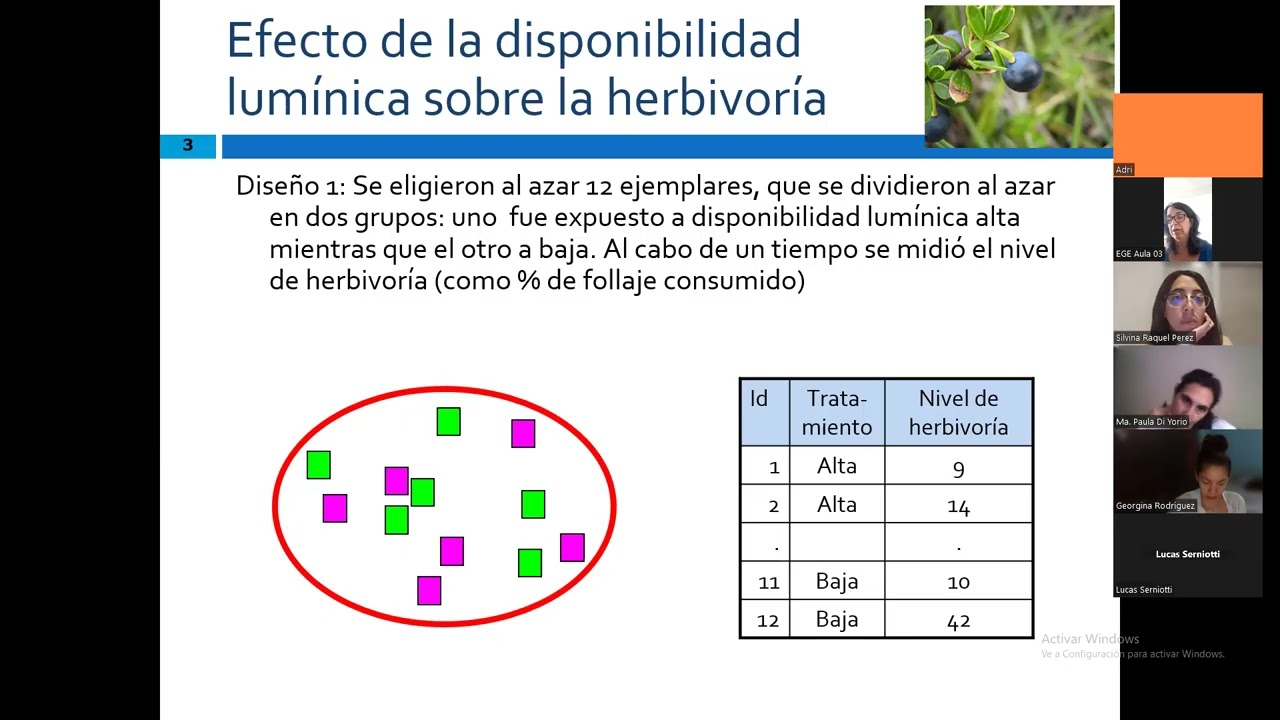
- Introduction and motivating example: hypothesis about light availability and herbivory.
- Discussion of variables and how to measure them; design 1: completely randomized design.
- Design 2: factorial design with two factors (light and herbivore exclusion).
- Design 3: randomized block design to control for spatial heterogeneity.
- Discussion of blocking in practice, including examples from students (cages, glands).
- Explanation of how to model block designs in R, introducing mixed-effects models.
Contribution & Novelties
The video provides a clear and interactive explanation of experimental design, particularly the concept of blocking, which is often misunderstood. It bridges theory and practice by showing how to structure data and models in R. The use of a single example throughout helps solidify understanding.
Pour aller plus loin :
- Randomized block design — Wikipedia article explaining the concept and its applications.
- Factorial experiment — Wikipedia article on factorial designs.
- Mixed model — Wikipedia article on mixed-effects models, which are used to analyze block designs.
85 words
Radar Profile
The radar profile shows high scores in information quantity, quality, and reliability, with a slightly lower technical level. This indicates a well-structured and informative lecture that is accessible to a university audience, with a strong emphasis on conceptual understanding and practical application.