Teo clase 5 parte 2
Keywords
Summary
170 words
Critical Evaluation
Value of the Information & Strength of the Argument
The video provides a solid, practical introduction to GLMM for repeated measures, using a realistic medical dataset. The instructor clearly explains the statistical concepts, including the link function, random effects, and correlation structures, and demonstrates how to implement the model in R. The argumentation is coherent and builds on previous lectures, making it valuable for students learning advanced statistical modeling. The use of a real example enhances the practical relevance, and the discussion of potential pitfalls (e.g., unbalanced data, informative missingness) adds depth.
Scientific Rigor, Source Quality, Title Accuracy
The scientific rigor is high for a teaching context: the instructor correctly specifies the model, discusses assumptions, and highlights limitations. However, no formal sources are cited in the video or description, which is typical for a lecture but limits verifiability. The title is generic and does not convey the specific topic, but it is part of a series, so it is acceptable. The content is well-structured and technically accurate, though it does not reference external literature.
174 words
Title / Content Match
The title 'Teo clase 5 parte 2' is generic and does not reflect the specific content (GLMM with repeated measures), but it is consistent with a series of lectures.
Quality & Reliability
8/10
The video is a university lecture from a recognized institution (UBA), presenting a rigorous statistical methodology (GLMM) applied to a real medical dataset. The instructor explains concepts clearly, addresses potential pitfalls (e.g., missing data, correlation structures), and demonstrates practical implementation in R. The content is scientifically sound, though it lacks formal citations and peer-reviewed references.
Key Moments
Markers derived by PSI from the transcript: the creator did not define chapters.
- Introduction to the lecture: GLMM with repeated measures for non-normal data.
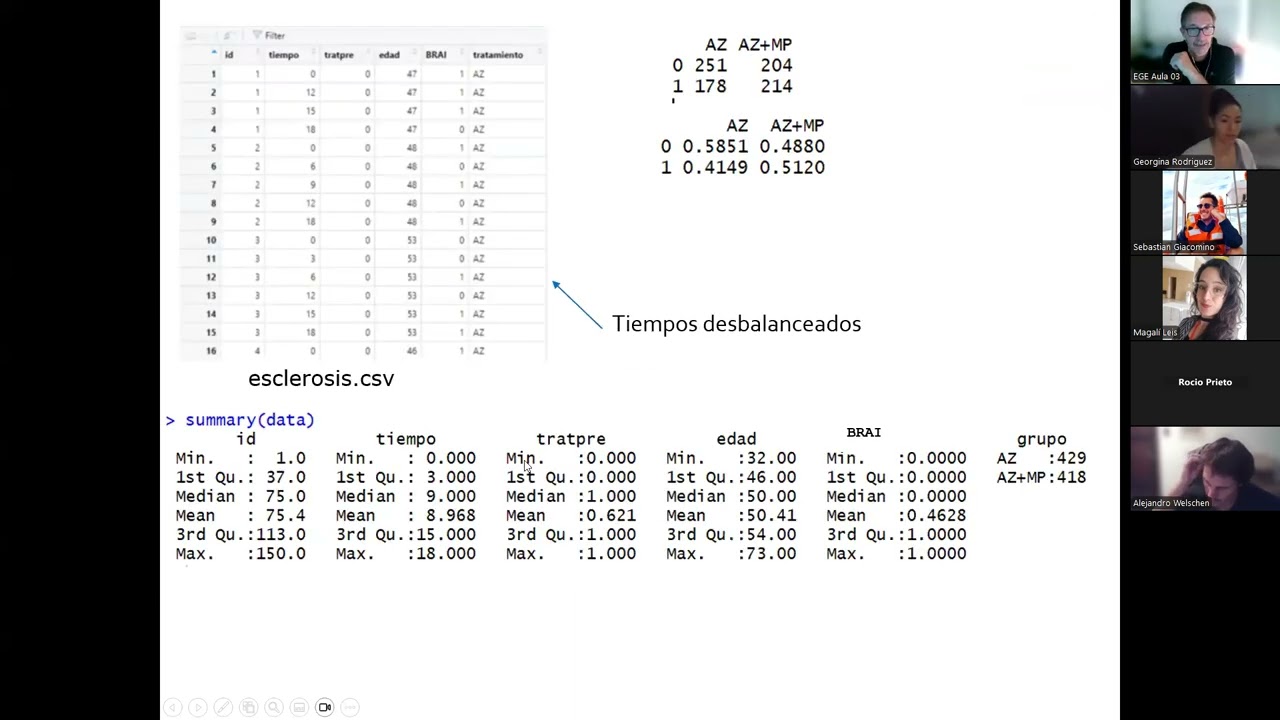
- Presentation of the multiple sclerosis dataset: 150 patients, two treatments, response measured at 6 time points.
- Definition of the binary response variable and explanation of the Bernoulli distribution.
- Identification of fixed and random effects: treatment and time are fixed, patients are random.
- Introduction of the logit link function and the model equation.
- Descriptive statistics and discussion of unbalanced data and missingness.
- Explanation of compound symmetry correlation structure induced by random intercept.
- Model specification in R using glmer and glmmTMB.
- Interpretation of results on logit, odds, and probability scales.
- Discussion of limitations and alternative approaches (marginal models).
Contribution & Novelties
The lecture provides a clear pedagogical explanation of GLMM for repeated measures with binary outcomes, using a real medical example. It bridges the gap between theoretical concepts and practical implementation in R, and addresses common pitfalls such as unbalanced data and informative missingness.
Pour aller plus loin :
- Generalized linear mixed model — Overview of GLMMs.
- Repeated measures design — Explanation of repeated measures designs.
- Logistic regression — Basics of logistic regression.
- Compound symmetry — Definition of compound symmetry.
- Multiple sclerosis — Disease background.
84 words
Radar Profile
The radar profile shows high scores across all dimensions, indicating a well-balanced and comprehensive lecture. The strong technical level and information quality are complemented by a solid reliability, making it a valuable educational resource.