TP Día2 parte 2
Keywords
Summary
146 words
Critical Evaluation
Value of the Information & Strength of the Argument
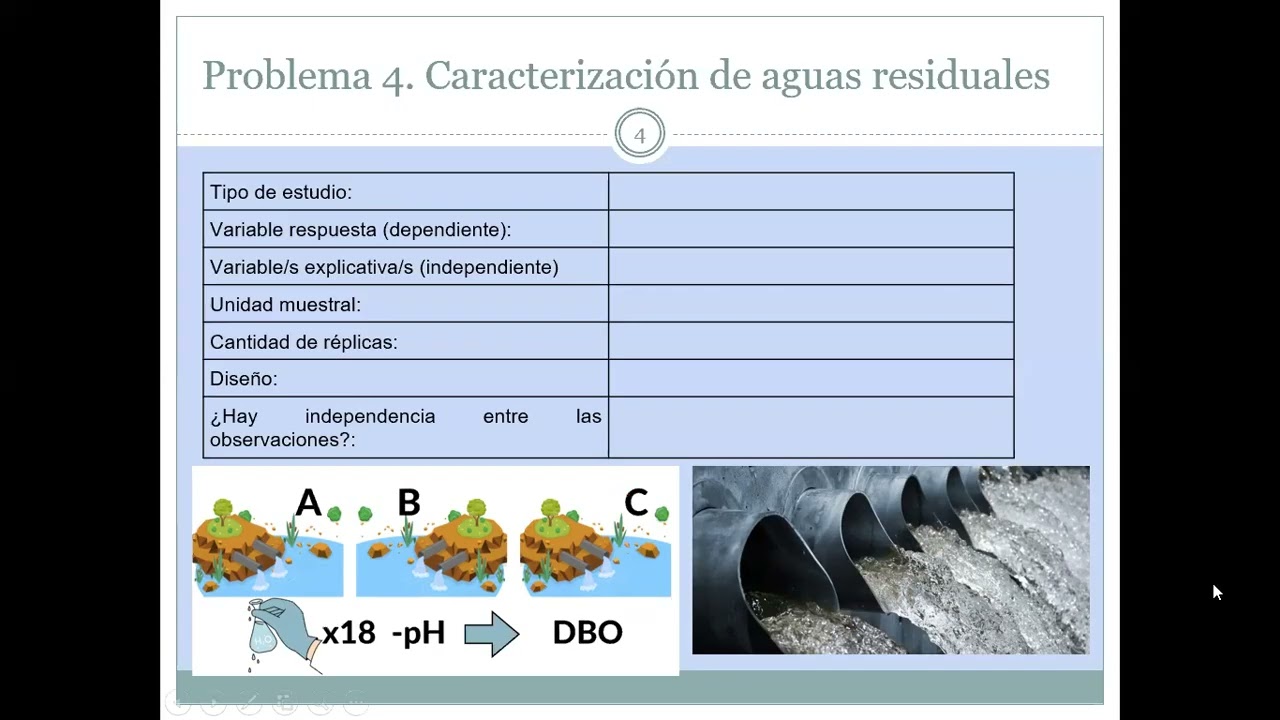
The video provides valuable pedagogical content on statistical modeling, particularly in the context of environmental science. The instructor effectively explains the process of model specification, including variable identification, dummy coding, and interpretation of coefficients. The argumentation is clear and logical, building from basic concepts to more complex interactions. The use of a real-world example (DBO and pH) enhances relevance. However, the video lacks formal citations and does not delve into model diagnostics or validation, which limits its completeness.
Scientific Rigor, Source Quality, Title Accuracy
The scientific rigor is high for a tutorial: the instructor follows standard statistical methodology and emphasizes correct model formulation. No external sources are cited, but the content aligns with established statistical theory. The title is not descriptive, but it is part of a series, so it is acceptable. The video is from a university channel, lending credibility. No comments were provided for analysis.
156 words
Title / Content Match
The title 'TP Día2 parte 2' is generic and does not describe the content, but it is likely part of a series for a specific course.
Quality & Reliability
8/10
The video is a university tutorial on statistical modeling, led by an instructor who demonstrates rigorous methodology: identifying variables, specifying model equations, and interpreting parameters. The content is consistent with standard statistical practice, though it is not peer-reviewed and lacks formal citations.
Key Moments
Markers derived by PSI from the transcript: the creator did not define chapters.
- Introduction and reading of the problem statement.
- Identification of response and explanatory variables.
- Discussion of study design and independence of observations.
- Writing the model equation with dummy variables and interaction terms.
- Interpretation of coefficients and concept of interaction.
- Instructions for loading data in R and descriptive analysis.
Contribution & Novelties
The video offers a clear, step-by-step approach to building an ANCOVA model, which is valuable for students. It emphasizes the interpretation of coefficients in the presence of interaction, a common source of confusion. The pedagogical method of having students attempt the model before revealing it is effective.
Pour aller plus loin :
- Analysis of covariance — Provides background on ANCOVA models.
- Dummy variable (statistics) — Explains dummy coding.
- Interaction (statistics) — Discusses interaction effects in regression.
76 words
Radar Profile
The radar profile shows high scores in information quantity, quality, and reliability, with a slightly lower technical level, indicating a solid educational resource that is accessible to students.