2021 - 6 Plasticidad Fenotipica B
Keywords
Summary
175 words
Critical Evaluation
Value of the Information & Strength of the Argument
The lecture provides a clear and thorough explanation of phenotypic plasticity and genotype-environment interaction, using simple examples to illustrate complex concepts. The argumentation is logical and builds progressively, starting from the definition of reaction norm and moving to the statistical detection of GxE via ANOVA. The instructor effectively distinguishes between different types of GxE (change in scale vs. change in rank) and explains their evolutionary consequences. The use of concrete examples (e.g., running times in different cities) makes the concepts accessible. The lecture also highlights the importance of analyzing reaction norms at the population level, not just for individual genotypes. Overall, the information is valuable for students of evolutionary biology, providing a solid foundation for understanding how genetic and environmental factors interact to shape phenotypes.
Scientific Rigor, Source Quality, Title Accuracy
The lecture is scientifically rigorous, adhering to established definitions and concepts in evolutionary biology. The instructor does not cite specific sources, but the content aligns with standard textbooks on quantitative genetics and phenotypic plasticity. The title accurately reflects the content, which is a continuation of a previous lecture on phenotypic plasticity. The presentation is well-structured, with clear explanations and visual aids. However, the lack of explicit references to primary literature may limit its use for advanced research. The lecture is part of a university course, suggesting it is based on a curriculum that likely includes recommended readings. Overall, the scientific quality is high, and the title is appropriate.
248 words
Title / Content Match
The title accurately reflects the content, which is a continuation of a lecture on phenotypic plasticity, focusing on genotype-environment interaction.
Quality & Reliability
8/10
The lecture is part of a university course, providing a structured and rigorous explanation of phenotypic plasticity and genotype-environment interaction. The content is based on established concepts in evolutionary biology and quantitative genetics. The speaker uses clear examples and logical reasoning, and the presentation is consistent with academic standards. However, no external sources are cited, and the video is a recording of a lecture, so it lacks peer-reviewed references.
Key Moments
Markers derived by PSI from the transcript: the creator did not define chapters.
- Introduction and review of reaction norm and phenotypic plasticity from previous lecture.
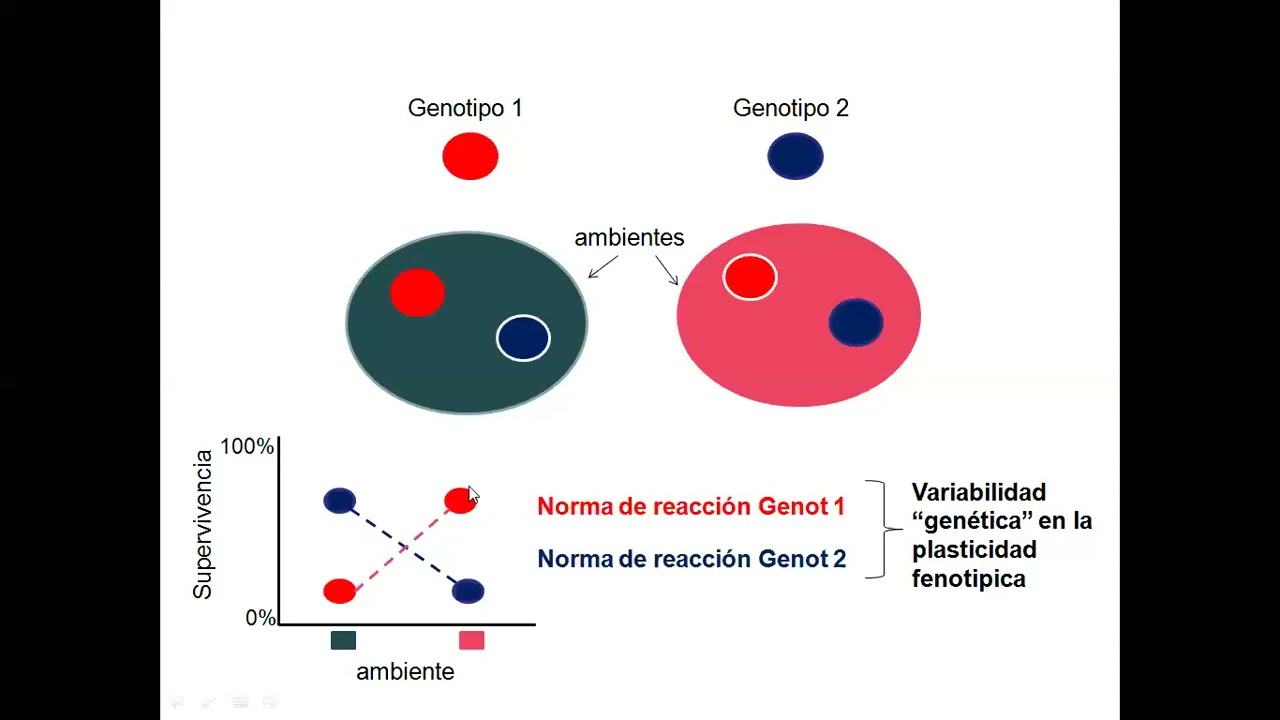
- Introduction of genotype-environment interaction (GxE) and the concept of non-parallel reaction norms.
- Example with two genotypes and two environments (blue and red) illustrating survival and GxE.
- Introduction of the running example: two genotypes running 100m in Buenos Aires and La Paz.
- Case 1: Parallel reaction norms, no GxE, genetic variability but no plasticity.
- Case 2: Parallel reaction norms, no GxE, plasticity but no genetic variability.
- Case 3a: Non-parallel reaction norms, GxE with change in scale.
- Case 3b: Non-parallel reaction norms, GxE with change in rank.
- Discussion of evolutionary consequences: change in scale vs. change in rank and maintenance of genetic variability.
- Real-world example with multiple genotypes showing combined scale and rank changes.
Contribution & Novelties
This lecture provides a clear pedagogical explanation of genotype-environment interaction, distinguishing between change in scale and change in rank, and linking these to evolutionary outcomes. It emphasizes the importance of analyzing reaction norms at the population level. The examples are simple yet effective for teaching.
Pour aller plus loin :
- Phenotypic plasticity — Overview of the concept.
- Reaction norm — Definition and examples.
- Genotype-environment interaction — Explanation of GxE and its implications.
- ANOVA — Statistical method used to detect GxE.
- Quantitative genetics — Field that studies the genetics of complex traits.
91 words
Radar Profile
The radar profile shows high scores in quantity and quality of information, reflecting the lecture's comprehensive coverage and clarity. The technical level is moderate, suitable for university students. The overall reliability is high, as the content is based on established scientific concepts.