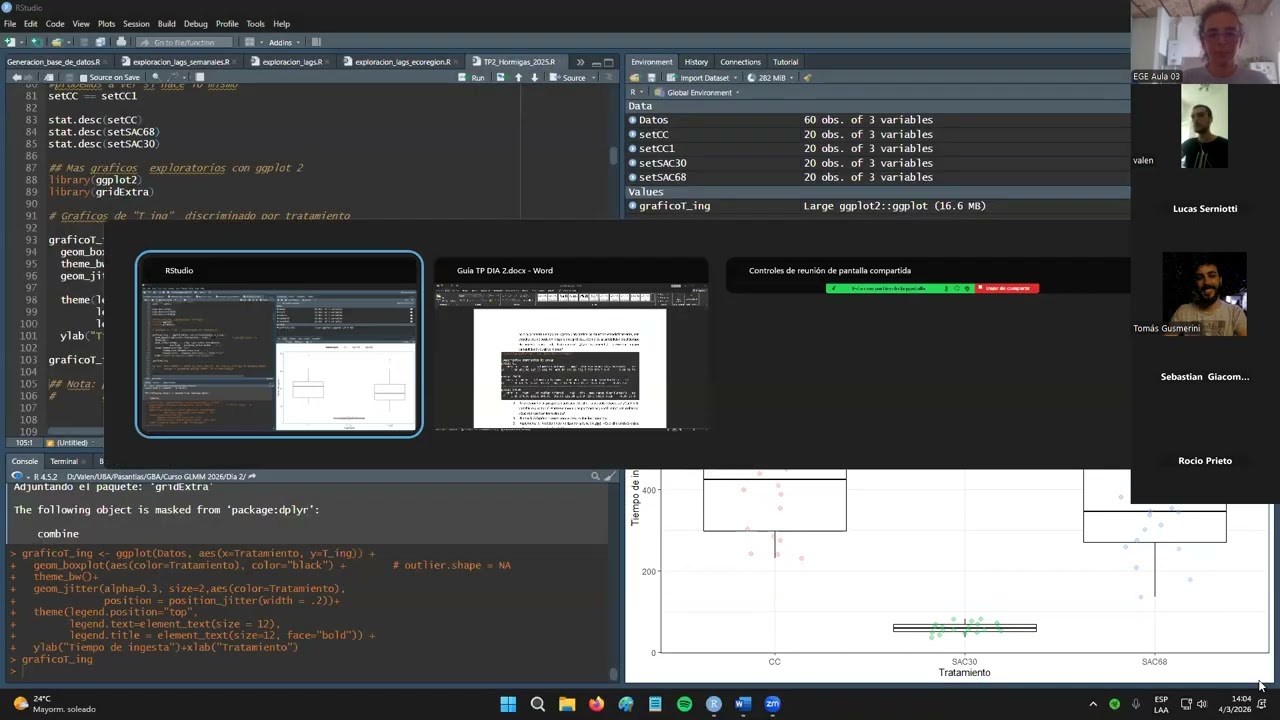
TP Día2 parte 1
Keywords
Summary
219 words
Critical Evaluation
Value of the Information & Strength of the Argument
The video provides valuable hands-on instruction in statistical modeling, particularly in the context of biological experiments. The instructor clearly explains each step, from defining the study design to implementing and comparing models in R. The argumentation is solid, as the instructor justifies each decision based on statistical theory and assumption checks. The use of real data and practical examples enhances the learning value. The video effectively demonstrates the process of model selection and the importance of addressing assumption violations.
Scientific Rigor, Source Quality, Title Accuracy
The scientific rigor is high, as the instructor follows standard statistical procedures and explains the rationale behind each step. The sources are not explicitly cited in the video, but the methods and functions used (e.g., GLS, varIdent) are standard in statistical literature. The title is somewhat generic but accurately reflects the content of a practical session. The video does not include any external references or citations, but the statistical techniques are well-established.
166 words
Title / Content Match
The title 'TP Día2 parte 1' is vague but accurately indicates it is the first part of a practical session (TP) for day 2, which matches the content.
Quality & Reliability
8/10
The video is a university-level tutorial on statistical modeling of biological data, specifically focusing on ANOVA and variance modeling using R. The instructor demonstrates a rigorous approach to checking assumptions and applying appropriate models. The content is scientifically sound and aligns with standard statistical practices.
Key Moments
Markers derived by PSI from the transcript: the creator did not define chapters.
- Introduction to the problem on alternative baits for ant control.
- Discussion of study type, experimental unit, and replicates.
- Exploratory data analysis in R using describeBy and boxplots.
- Formulation of the statistical model and hypotheses.
- Assumption checking and introduction to GLS for variance modeling.
- Implementation of varIdent and varPower variance structures.
- Evaluation of assumptions with standardized residuals and model comparison.
Contribution & Novelties
This video provides a practical, step-by-step tutorial on applying generalized least squares (GLS) models to handle heteroscedasticity in ANOVA, which is a common issue in biological data. It offers a clear demonstration of using R functions like varIdent and varPower, and emphasizes the importance of checking assumptions and using standardized residuals. The session is particularly useful for students learning to apply statistical models to real experimental data.
Pour aller plus loin :
- Generalized least squares — Provides an overview of GLS and its applications.
- ANOVA — Fundamental concept for comparing means across groups.
- R nlme package — Documentation for the nlme package used in the video.
106 words
Radar Profile
The radar profile shows high scores across all dimensions, indicating a well-rounded educational video with strong information content, technical depth, and reliability. The video excels in providing practical statistical training, making it a valuable resource for students.
💬 No comments were provided for analysis.