2021 - 7 Arquitectura Genética B
Keywords
Summary
222 words
Critical Evaluation
Value of the Information & Strength of the Argument
The lecture provides a comprehensive overview of genetic architecture, integrating theoretical concepts with practical examples. The instructor effectively explains the complexity of the genotype-phenotype map, emphasizing the role of epistasis and context-dependent effects. The argumentation is solid, grounded in established genetic principles and supported by examples from the instructor’s own research. The use of the analogy of bricks and cement to explain genetic architecture is particularly effective. However, the lecture could benefit from more explicit citations to the literature, as only a few studies are mentioned by name.
Scientific Rigor, Source Quality, Title Accuracy
The scientific rigor is high, as the content aligns with current understanding in genetics. The instructor references key works, such as Houle et al. (2010) and Hansen, but does not provide full citations. The sources are not explicitly listed, but the lecture is from a university channel, suggesting academic credibility. The title accurately reflects the content, which is a continuation of a previous lecture on genetic architecture. The lecture is well-structured and logically presented.
177 words
Title / Content Match
The title 'Arquitectura Genética B' accurately reflects the content, which focuses on the genetic architecture of traits, including the genotype-phenotype map and methods to study it.
Quality & Reliability
8/10
The lecture is based on established genetic concepts and includes references to specific studies (e.g., Houle et al. 2010, Hansen). The content is presented by an academic institution, suggesting a high level of expertise. However, the video lacks formal citations and the transcription is informal, which slightly reduces the score.
Key Moments
Markers derived by PSI from the transcript: the creator did not define chapters.
- Introduction to genetic architecture and the genotype-phenotype map.
- Explanation of the genetic and phenotypic spaces, citing Houle et al. (2010).
- Discussion of the multiple 'omic' layers within the genetic space.
- Introduction of the 'bricks and cement' analogy for genetic architecture.
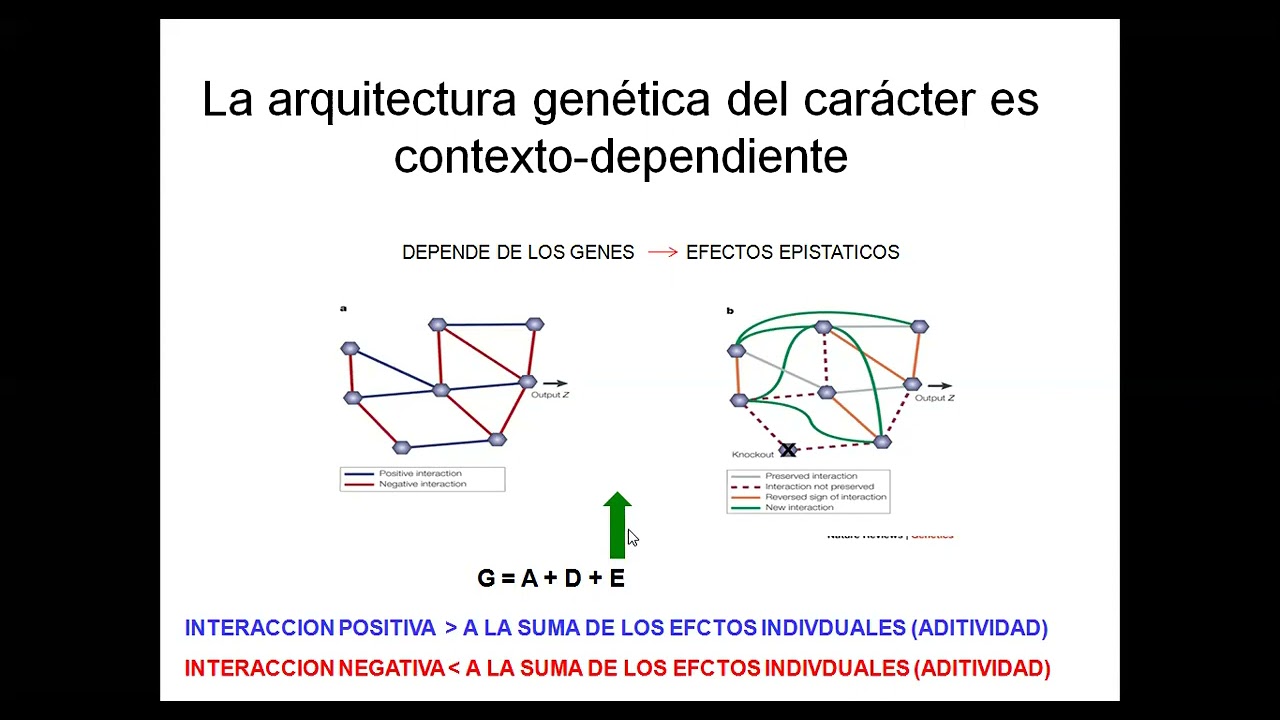
- Explanation of context-dependent effects: epistasis, environment, sex, and age.
- Examples from Drosophila research showing how epistatic interactions change with environment and sex.
- Discussion of canalization and traits with low variability.
- Description of the protocol for creating inbred lines to study genetic architecture in natural populations.
- Explanation of the 20-generation sib-mating process and the resulting homozygous lines.
Cited Sources
- Houle et al. (2010) - Genotype-phenotype map — Mentioned as the basis for the genetic and phenotypic spaces concept.
- Hansen - Genetic architecture — Mentioned as the origin of the term 'genetic architecture'.
Concurring Sources
- Houle et al. (2010) — The concept of genotype-phenotype map is consistent with the lecture.
Contribution & Novelties
The lecture provides a clear and accessible explanation of genetic architecture, emphasizing the importance of context-dependent effects. It offers a practical protocol for studying genetic architecture in natural populations, which is valuable for students and researchers. The use of concrete examples from Drosophila research enhances understanding.
Pour aller plus loin :
- Genotype-phenotype map — Provides background on the concept.
- Epistasis — Explains the genetic interaction concept.
- Canalisation (genetics) — Discusses the buffering of phenotypes.
74 words
Radar Profile
The radar profile shows high scores in quantity and quality of information, with a moderate technical level. The reliability is also high, indicating a well-founded lecture. The balance suggests a comprehensive and trustworthy educational resource.