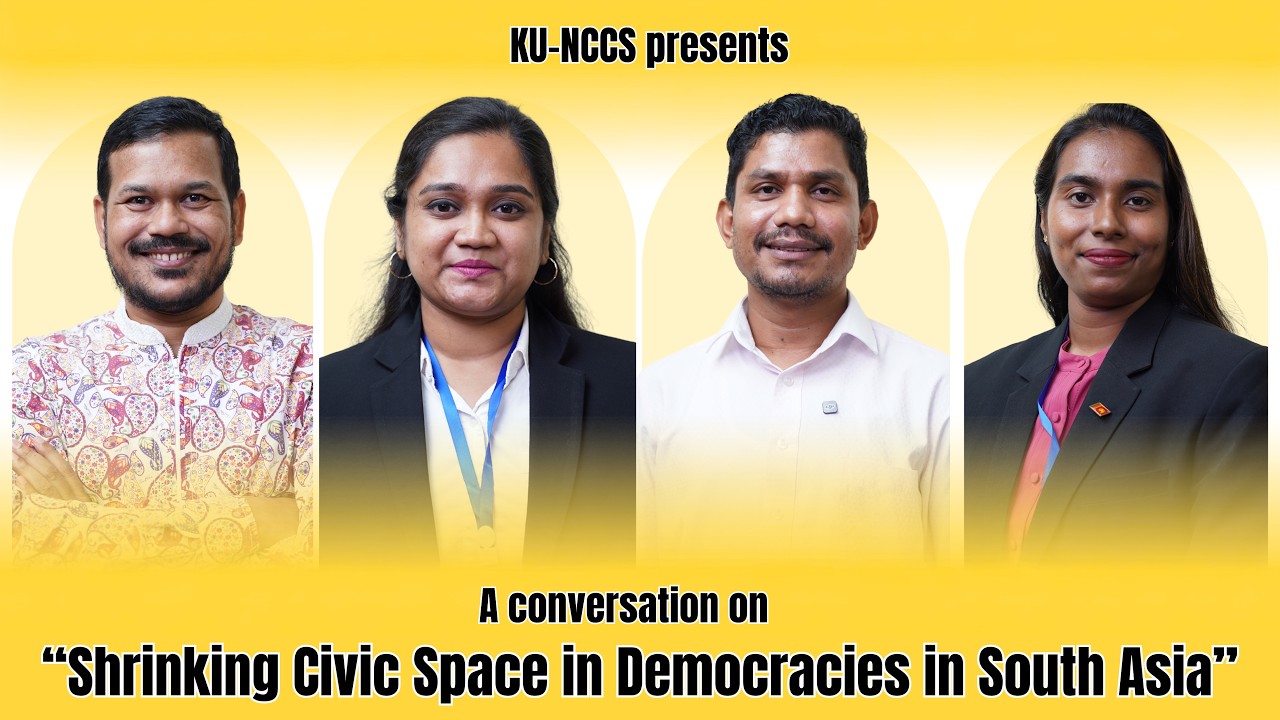
Civic Space in Democracies in South Asia | Nepal, Bangladesh, and Sri Lanka | Kathmandu University
Keywords
Summary
136 words
Critical Evaluation
Value of the Information & Strength of the Argument
The discussion offers valuable firsthand perspectives on recent political transitions in South Asia, with speakers providing contextual insights into the protests and their aftermath. The argumentation is largely based on personal experiences and observations, which adds authenticity but also limits generalizability. The speakers present coherent narratives, but often rely on anecdotal evidence rather than systematic analysis. The value lies in the diversity of viewpoints and the emphasis on civic space as a critical indicator of democratic health.
Scientific Rigor, Source Quality, Title Accuracy
The discussion lacks rigorous scientific rigor, as speakers do not cite specific sources or data to support their claims. The quality of sources is moderate, with references to reports like the CIVICUS Monitor, but these are not systematically integrated. The title accurately reflects the content, focusing on civic space in the three countries. The discussion is more of an opinion exchange than a structured academic analysis, which limits its scientific value.
163 words
Title / Content Match
The title accurately reflects the content, which focuses on civic space in Nepal, Bangladesh, and Sri Lanka, though the discussion is more general than the title suggests.
Quality & Reliability
6/10
The discussion features expert opinions from academics and practitioners, but lacks verifiable data and citations. Claims are anecdotal and context-specific, with no rigorous source verification.
Key Moments
Markers derived by PSI from the transcript: the creator did not define chapters.
- Introduction of panelists and topic.
- Discussion on Bangladesh's post-election context and challenges.
- Ananya Sharma explains the root causes of the youth protests in Bangladesh.
- Lughadarini Yogaraja describes the Aragalaya movement in Sri Lanka.
- Discussion on civic space rankings and regional challenges.
- Reform processes and minority rights in Bangladesh.
- Sri Lanka's economic recovery and youth engagement.
- Concluding remarks on the future of civic space in South Asia.
Cited Sources
- CIVICUS Monitor — Referenced for civic space rankings in South Asia.
Concurring Sources
- CIVICUS Monitor — Supports the discussion on civic space rankings.
Contribution & Novelties
The discussion provides a comparative perspective on civic space in three South Asian countries, highlighting commonalities and differences in their democratic transitions. It offers firsthand accounts of the protests and subsequent reforms, which are valuable for understanding the region’s political dynamics.
Pour aller plus loin :
- CIVICUS Monitor — Tracks civic space globally, relevant for understanding the rankings mentioned.
- Aragalaya movement — Background on the Sri Lankan protests.
- Quota reform movement in Bangladesh — Details on the protests that led to regime change.
83 words
Radar Profile
The radar profile shows moderate scores across all dimensions, indicating a balanced but not outstanding discussion. The strengths lie in the quantity of information and the relevance of the topic, while weaknesses are in technical depth and source reliability.