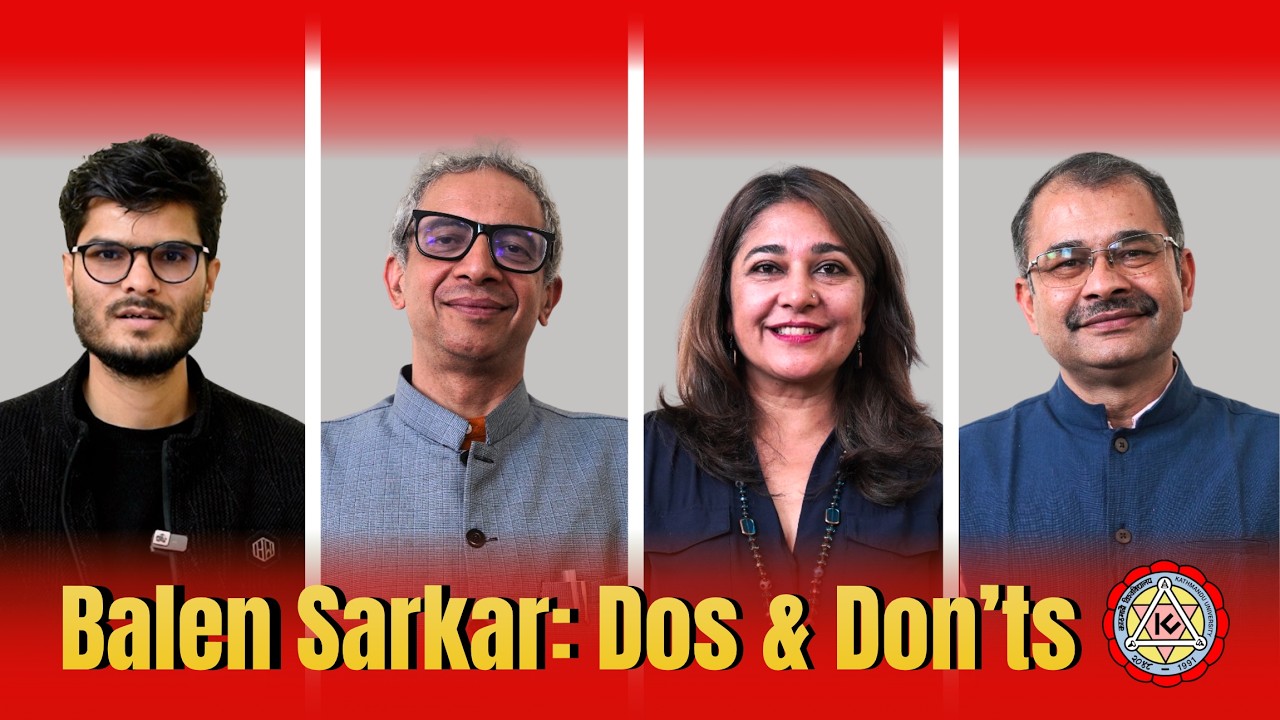
Balen सरकार: आशा र शंका । रूपान्तरणको अवसर | KU Falcha with Dr. Balchandra, Dr. Uddhab Reshu Aryal
Keywords
Summary
217 words
Critical Evaluation
Value of the Information & Strength of the Argument
The value of the information lies in the diverse perspectives of the panelists, who bring expertise in education and political science. They provide a nuanced analysis of the political shift, discussing both the hopes and the challenges. The argumentation is generally coherent, with panelists building on each other’s points. However, some arguments rely on personal opinions and anecdotal evidence rather than robust data. For instance, the discussion on the ‘Zelensky syndrome’ is based on a contested interpretation of Zelensky’s actions, which may not be universally accepted. The panelists also make claims about the youth’s disillusionment with traditional parties without providing concrete evidence. Despite these weaknesses, the discussion is thought-provoking and offers valuable insights into the political dynamics in Nepal.
Scientific Rigor, Source Quality, Title Accuracy
The scientific rigor is moderate. The panelists are credible academics and practitioners, but they do not cite specific studies or data to support their claims. The discussion is more opinion-based than evidence-based. The sources cited are not explicitly mentioned, and the description provides no links to external references. The title accurately reflects the content, focusing on the hopes and doubts about the new government. The adequacy between title and content is good, as the discussion indeed revolves around these themes. However, the lack of verifiable sources and the reliance on personal interpretations reduce the overall rigor.
230 words
Title / Content Match
The title accurately reflects the content, focusing on hopes and doubts about the new government and the opportunity for transformation.
Quality & Reliability
7/10
The discussion features credible academics and practitioners, but lacks verifiable data and relies on subjective opinions. The panel provides diverse perspectives, but the absence of concrete evidence and the presence of unverified claims (e.g., about Zelensky) reduce the overall reliability.
Key Moments
Markers derived by PSI from the transcript: the creator did not define chapters.
- Introduction and welcome of panelists
- Discussion on election results and public sentiment
- Analysis of the 'Balen phenomenon' and creative disruption
- Discussion on generational shift and youth leadership
- Debate on the 'Zelensky syndrome' and skepticism towards new leaders
- Focus on education reform and the new government's agenda
- Challenges of implementation and bureaucratic resistance
- Discussion on secularism and religious performances
- Concluding remarks and hopes for transformative change
Contribution & Novelties
The video provides a unique platform for academic and activist voices to discuss the political transition in Nepal, offering a balanced perspective on the hopes and doubts surrounding the new government. It highlights the potential for education reform and the challenges ahead. The discussion on the ‘Zelensky syndrome’ as a metaphor for skepticism towards new leaders is a novel angle, though it is based on a contested interpretation.
Pour aller plus loin :
- Nepal’s 2015 Constitution — Provides the legal framework for the political system discussed.
- Rastriya Swatantra Party — Background on the party leading the new government.
- Education in Nepal — Overview of the education system and reform challenges.
110 words
Radar Profile
The radar profile shows moderate scores across all dimensions, indicating a balanced but not highly specialized discussion. The highest score is in quantity of information, reflecting the breadth of topics covered, while the lowest is in technical level, as the discussion remains accessible to a general audience.