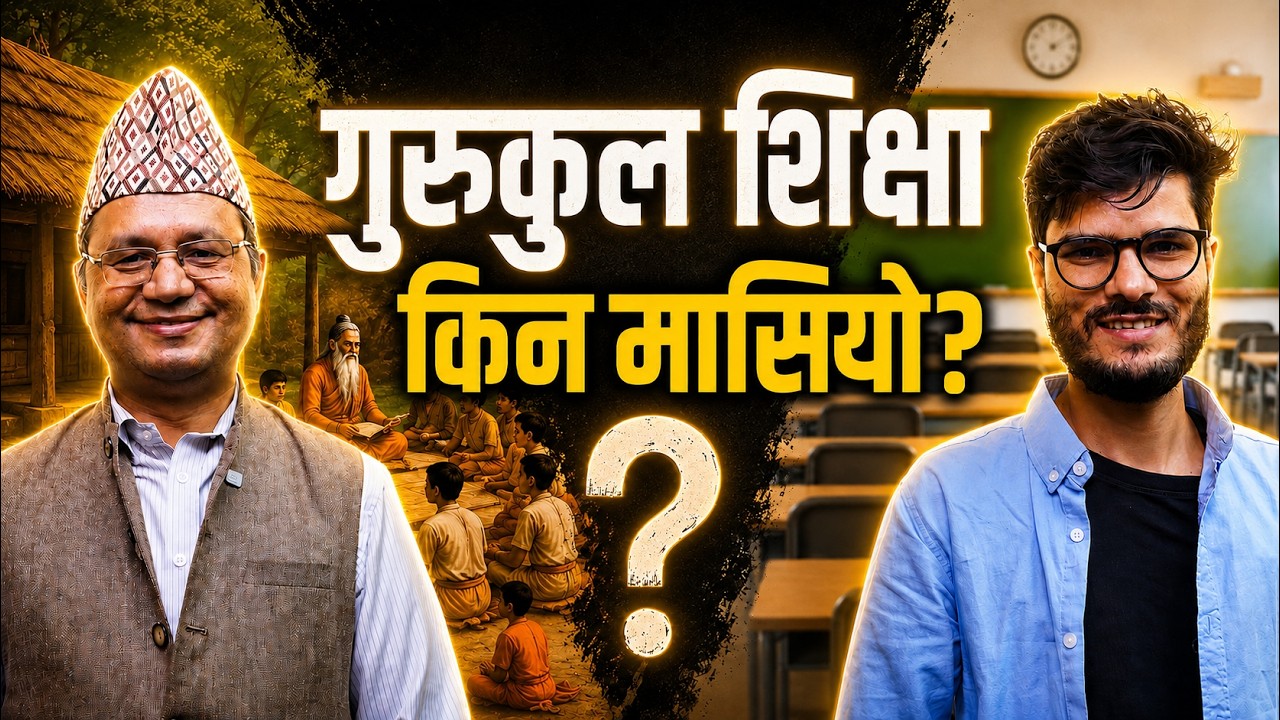
गुरुकुल शिक्षा किन मासियो? | Common Ground with Dr. Nirman Mani Adhikari । Ep 15
Keywords
Summary
230 words
Critical Evaluation
Value of the Information & Strength of the Argument
The value of the information lies in its comprehensive overview of the historical and socio-political factors affecting traditional education in Nepal. The argumentation is coherent, with Adhikari providing a logical narrative from the origins of Gurukuls to their decline and potential revival. He supports his points with historical examples and references to broader regional trends, such as the cultural shifts in India and China. However, the discussion lacks empirical data and specific citations, relying more on interpretive analysis. The argument is persuasive but not rigorously evidence-based.
Scientific Rigor, Source Quality, Title Accuracy
The scientific rigor is moderate; the guest is an academic, but the conversation is more of an opinion piece than a structured academic lecture. No specific sources are cited within the video, and the description does not provide links to references. The title accurately reflects the main topic, though the content also covers related themes. The discussion would benefit from more concrete data and citations to support the claims made.
171 words
Title / Content Match
The title accurately reflects the main topic of the decline of Gurukul education, though the conversation also covers broader themes of traditional knowledge and state-religion relations.
Quality & Reliability
7/10
The discussion is based on the guest's expertise and research, but lacks direct citations to specific studies or data. The arguments are coherent and well-structured, but the evidence is largely anecdotal and interpretive.
Key Moments
Markers derived by PSI from the transcript: the creator did not define chapters.
- Introduction of the guest, Dr. Nirmal Mani Adhikari, and the topic of Gurukul education.
- Discussion on the impact of technology and AI on traditional knowledge.
- Explanation of the origins of Gurukul and its role in ancient society.
- Analysis of how state control and foreign invasions led to the decline of Gurukuls.
- Discussion on the Rana regime's suppression of education in Nepal.
- Recent revival of Gurukuls and factors contributing to it.
- Comparison of state-religion relations in Nepal, India, and China.
- Adhikari's critique of secularism and advocacy for a state that reflects its cultural character.
- Discussion on education policies and the need for curriculum reform.
Contribution & Novelties
The video provides a unique perspective on the decline and revival of Gurukul education in Nepal, linking it to broader historical and political dynamics. It offers a nuanced argument for the state to embrace its cultural heritage while ensuring inclusivity. The discussion is valuable for understanding the intersection of education, religion, and politics in South Asia.
Pour aller plus loin :
- Gurukula - Wikipedia — Overview of the traditional Indian education system.
- Secularism in India - Wikipedia — Context on the debate over secularism in India.
- Nepal’s Education System - UNESCO — Information on current education policies in Nepal.
99 words
Radar Profile
The radar profile shows moderate scores across all dimensions, indicating a balanced but not exceptional performance. The highest score is in quantity of information, reflecting the comprehensive coverage of the topic, while the lowest is in technical level, as the discussion is accessible and not highly technical.
💬 No comments were provided for analysis.