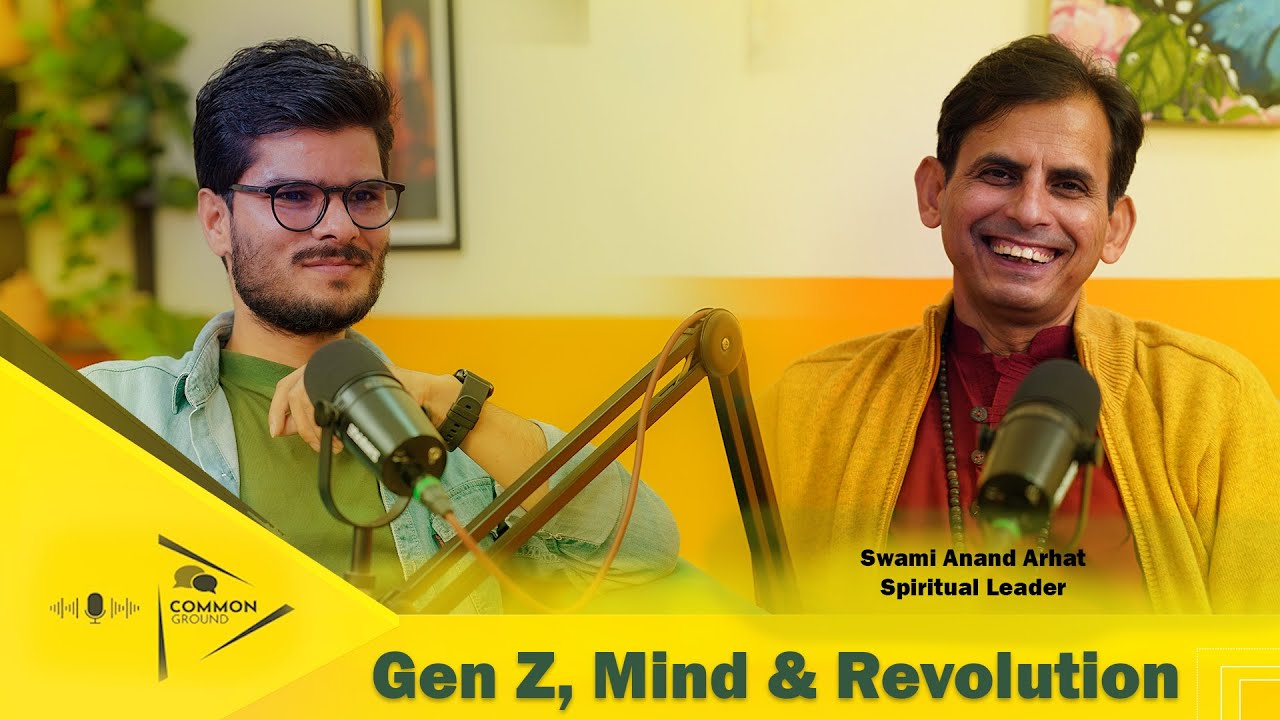
किन भयो Gen Z आन्दोलन? The Game of Mind & Reflection | Common Ground with Swami Anand Arhat EP02
Keywords
Summary
138 words
Critical Evaluation
Value of the Information & Strength of the Argument
The value of the information lies in its unique perspective, combining spiritual insights with observations on contemporary social issues. The argumentation is largely anecdotal and based on personal experience, which may resonate with viewers but lacks empirical support. The speaker uses metaphors and analogies to explain complex ideas, making them accessible, but the reasoning is not always systematic. The discussion on the Gen Z movement provides a reflective, non-violent perspective, emphasizing inner change as a precursor to outer change. However, the lack of concrete data or references weakens the overall argumentative strength.
Scientific Rigor, Source Quality, Title Accuracy
The scientific rigor is moderate; the speaker references concepts like epigenetics and mindfulness but does not provide detailed sources. The title accurately reflects the content, focusing on the Gen Z movement and mental reflection. The sources mentioned include ‘The 48 Laws of Power’ by Robert Greene and ‘The Oxford Book of Happiness’, but they are not thoroughly explored. The discussion is more philosophical than scientific, and the lack of verifiable references reduces its reliability. The title is appropriate and does not overpromise.
189 words
Title / Content Match
The title accurately reflects the content, focusing on the Gen Z movement and mental reflection from a spiritual perspective.
Quality & Reliability
6/10
The discussion is based on personal experience and spiritual insights, with references to psychological concepts and a few sources, but lacks empirical evidence and rigorous scientific backing.
Key Moments
Markers derived by PSI from the transcript: the creator did not define chapters.
- Introduction of the guest and topic
- Discussion on memory loss and selective attention
- Analysis of the Gen Z movement and its psychological roots
- Critique of political system and need for transparency
- Exploration of mindfulness and brain stimulation
- Discussion on epigenetics and lifestyle changes
- Reflections on the future of Nepal and youth
- Concluding thoughts on spirituality and social change
Cited Sources
- The 48 Laws of Power — Referenced in discussion about power and manipulation
- The Oxford Book of Happiness — Mentioned in context of happiness research
Concurring Sources
- The 48 Laws of Power — Supports discussion on power dynamics
Contribution & Novelties
The video offers a unique blend of spiritual and psychological perspectives on a contemporary social movement, which is not commonly found in mainstream discourse. It emphasizes the role of inner transformation in societal change, providing a counterpoint to purely political analyses.
Pour aller plus loin :
- Mindfulness-Based Stress Reduction — Relevant to the discussion on mindfulness and mental well-being.
- Epigenetics — Directly related to the speaker’s mention of lifestyle influencing genetic expression.
- Gen Z activism — Provides context on global youth movements.
82 words
Radar Profile
The radar profile shows moderate scores across all dimensions, indicating a balanced but not highly rigorous content. The highest score is in quantity of information, reflecting the lengthy discussion, while technical level and reliability are lower due to the lack of scientific depth.
💬 Sur les 0 commentaires analysés, aucune tendance n'a pu être dégagée.