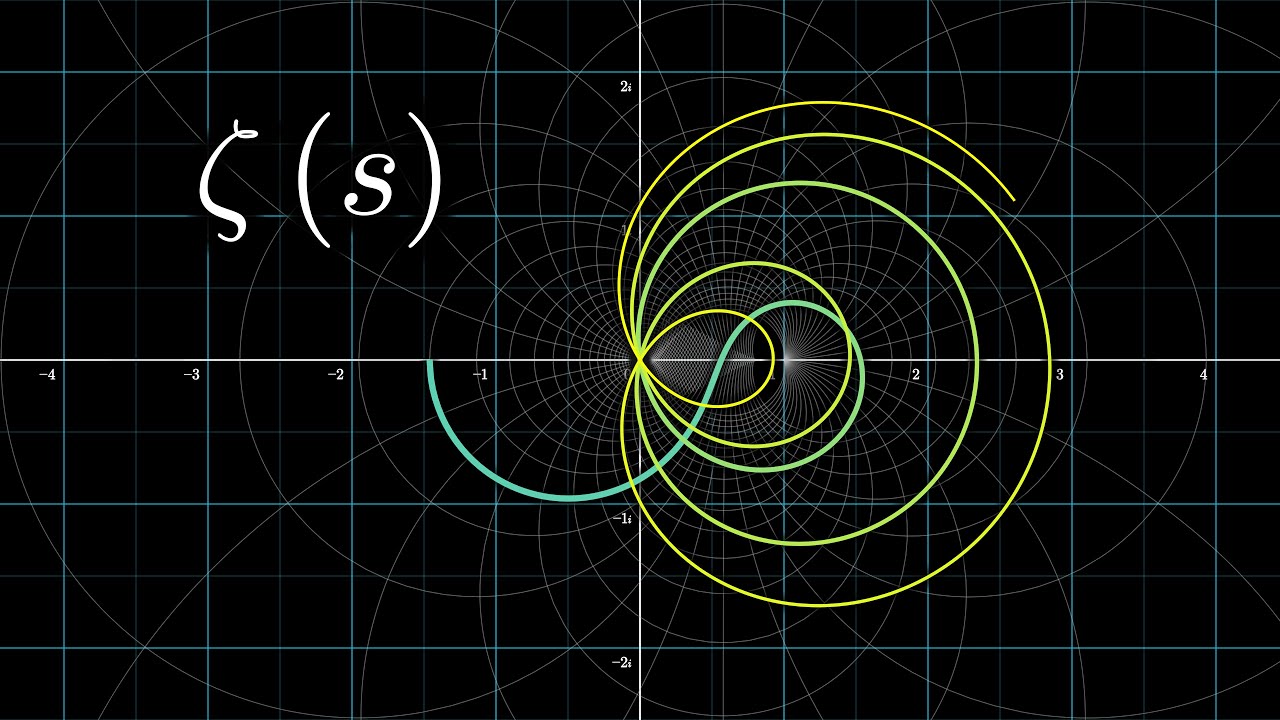
But what is the Riemann zeta function? Visualizing analytic continuation
Keywords
Summary
170 words
Critical Evaluation
Value of the Information & Strength of the Argument
The video excels in providing deep intuition for a highly abstract mathematical concept. It uses clear visual metaphors (grid transformations, angle preservation) to explain analytic continuation, making it accessible without sacrificing rigor. The argumentation is logical and well-structured, building from simple examples to the full definition of the zeta function. The explanation of why -1/12 is not a sum but a value of the analytic continuation is particularly valuable, as it addresses a common misconception. The video also motivates the Riemann hypothesis by showing its connection to prime numbers, though it does not delve into the details.
Scientific Rigor, Source Quality, Title Accuracy
The video is scientifically rigorous, with a clear and accurate presentation of complex analysis concepts. The creator, Grant Sanderson, is known for his careful research and attention to mathematical detail. The description provides links to further resources, including videos on complex exponentiation and a blog post by Terry Tao on the 1+2+3+… = -1/12 relationship. The title accurately reflects the content, and the video’s high quality is evidenced by its popularity and positive reception among mathematicians and educators.
190 words
Title / Content Match
The title accurately reflects the content: the video explains the Riemann zeta function and visualizes analytic continuation.
Quality & Reliability
9/10
The video is produced by a reputable mathematics educator (3Blue1Brown) known for rigorous and well-researched content. The explanation of analytic continuation is mathematically sound, and the visualizations accurately represent the concepts. The video includes references to further resources and acknowledges the complexity of the topic.
Key Moments
Markers derived by PSI from the transcript: the creator did not define chapters.
- Introduction to the Riemann zeta function and the million-dollar Riemann hypothesis.
- Definition of the zeta function as an infinite sum for s > 1.
- Introduction to complex exponentiation and its geometric interpretation.
- Visualizing complex functions as transformations of the complex plane.
- Visualizing the zeta function on the right half-plane and the need for analytic continuation.
- Explanation of analytic functions as angle-preserving transformations.
- Definition of analytic continuation and its uniqueness.
- Discussion of the Riemann hypothesis and the critical line.
- Clarification of the -1/12 result and its connection to analytic continuation.
- Sponsorship segment and final visualization of the derivative of the zeta function.
Cited Sources
- 3Blue1Brown Store — Posters and shirts related to the video.
- Zeta supporters — List of supporters for the video.
- Vince Rubinetti's website — Composer of the music used in the video.
- 3Blue1Brown video on complex exponentiation — Additional resource on complex exponentiation.
- Riemann zeta function music — Music track used in the video.
- 3Blue1Brown website — Home page of the channel.
- 3Blue1Brown Reddit — Community discussion.
- Mathologer video on complex exponentiation — Additional resource on complex exponentiation.
- 3Blue1Brown video 'What does it feel like to invent math' — Related video on mathematical invention.
Concurring Sources
- Riemann zeta function — Wikipedia article confirming the definition and properties of the zeta function.
- Analytic continuation — Wikipedia article explaining the concept of analytic continuation.
External References
Contribution & Novelties
The video’s original contribution lies in its visual and intuitive explanation of analytic continuation, a concept often presented abstractly. It demystifies the Riemann zeta function and the -1/12 result, making them accessible to a wider audience. The use of grid transformations to illustrate complex functions is a powerful pedagogical tool.
Pour aller plus loin :
- Riemann zeta function — Wikipedia article providing a comprehensive overview.
- Analytic continuation — Wikipedia article on the concept.
- Riemann hypothesis — Wikipedia article on the unsolved problem.
- Terry Tao’s blog post on 1+2+3+… — A detailed discussion of the -1/12 result.
96 words
Radar Profile
The radar profile shows high scores across all dimensions, with particularly strong performance in information quality and reliability. The video is both informative and technically sound, making it an excellent resource for learning about complex analysis.
💬 Très positif. Sur les 30 commentaires analysés, les spectateurs expriment une admiration unanime pour la clarté des explications et la beauté des visualisations, saluant le travail de vulgarisation de Grant Sanderson.