Differential equations, a tourist's guide | DE1
Keywords
Summary
153 words
Critical Evaluation
Value of the Information & Strength of the Argument
The video provides substantial value by demystifying differential equations through intuitive visualizations and relatable examples. The argumentation is solid: the presenter builds from simple to complex cases, clearly explaining each step. The use of the pendulum as a central example effectively illustrates key concepts like phase space and the limitations of analytical solutions. The romantic example, while whimsical, serves to reinforce the generality of the framework. The argument that numerical methods are often more practical than seeking analytical solutions is well-supported and relevant for modern applications.
Scientific Rigor, Source Quality, Title Accuracy
The scientific rigor is high. The mathematical derivations are accurate, and the presenter is transparent about approximations (e.g., small-angle approximation for the pendulum). The video includes a correction note for a minor typo, demonstrating attention to detail. Sources cited include Strogatz’s NYT article and recommended textbooks (Arnold, Strogatz), which are authoritative. The title accurately reflects the content: it is a conceptual tour, not a comprehensive course. The description provides additional resources, including interactive visualizations, which enhance the learning experience.
180 words
Title / Content Match
The title accurately reflects the content: a guided tour of differential equations, focusing on conceptual understanding rather than exhaustive problem-solving.
Quality & Reliability
9/10
High-quality exposition by a renowned mathematics educator, with clear derivations and visualizations. The content is mathematically sound, and the video includes a correction note for a minor typo. Sources are reputable (e.g., Strogatz's NYT article, Arnold's textbook).
Key Moments
Markers derived by PSI from the transcript: the creator did not define chapters.
- Introduction: ODEs as the language of physics, citing Strogatz.
- Simple example: object thrown upward, solving y'' = -g by integration.
- Pendulum example: deriving the equation of motion, noting the small-angle approximation.
- Discussion on the difficulty of solving ODEs analytically; introduction of numerical methods.
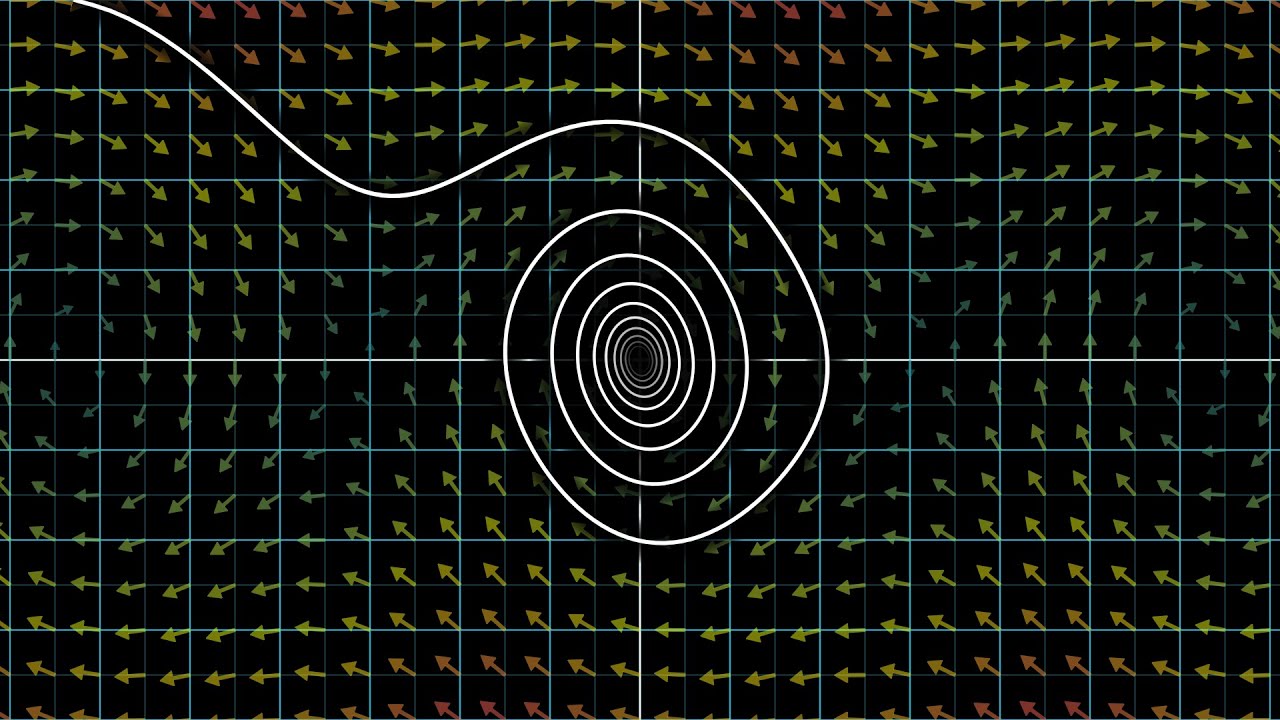
- Introduction of phase space and vector fields for the pendulum.
- Explanation of phase flow, fixed points, and stability.
- Romantic example: modeling love dynamics with ODEs, showing similar phase space structure.
- Preview of numerical methods: Euler's method and simulation.
Cited Sources
- Guest Column: Loves Me, Loves Me Not (Do the Math?) — Referenced as the source of the romantic example.
- The Tangled Tale of Phase Space — Recommended for understanding the history and concept of phase space.
- Tales from the Romeo and Juliet Phase Space — Interactive visualization based on the romantic example.
- Predator and Prey — Interactive visualization of a predator-prey model, related to phase space.
- Manim (GitHub repository) — The animation library used to create the video.
Concurring Sources
- Ordinary Differential Equations by Vladimir Arnold — Recommended in the video description as a standard textbook on ODEs.
- Nonlinear Dynamics and Chaos by Steven Strogatz — Recommended in the video description for further study of dynamical systems.
External References
Contribution & Novelties
The video’s original contribution lies in its pedagogical approach: it uses the pendulum as a recurring example to introduce phase space and vector fields, making abstract concepts tangible. It effectively argues for the practical importance of numerical methods over analytical solutions, a perspective often underemphasized in traditional courses. The romantic example, while not new, is presented in a way that highlights the universality of the framework.
Pour aller plus loin :
- Ordinary differential equation (Wikipedia) — Provides a comprehensive overview of ODEs, including definitions and solution methods.
- Phase space (Wikipedia) — Explains the concept of phase space in physics and mathematics, including its use in Hamiltonian mechanics.
- Euler method (Wikipedia) — Details the simplest numerical method for solving ODEs, which is briefly mentioned in the video.
- Nonlinear Dynamics and Chaos by Steven Strogatz — A recommended textbook that expands on the concepts of phase space and stability.
147 words
Radar Profile
The radar profile shows high scores in information quality and reliability, reflecting the video's strong educational value and accurate content. The technical level is moderate, suitable for a general audience with some calculus background. The quantity of information is substantial, covering multiple key concepts in a concise manner.
💬 Très positif. Sur les 30 commentaires analysés, les spectateurs expriment une admiration quasi unanime pour la clarté pédagogique et la beauté des visualisations, avec de nombreux témoignages d'apprentissage et d'inspiration.