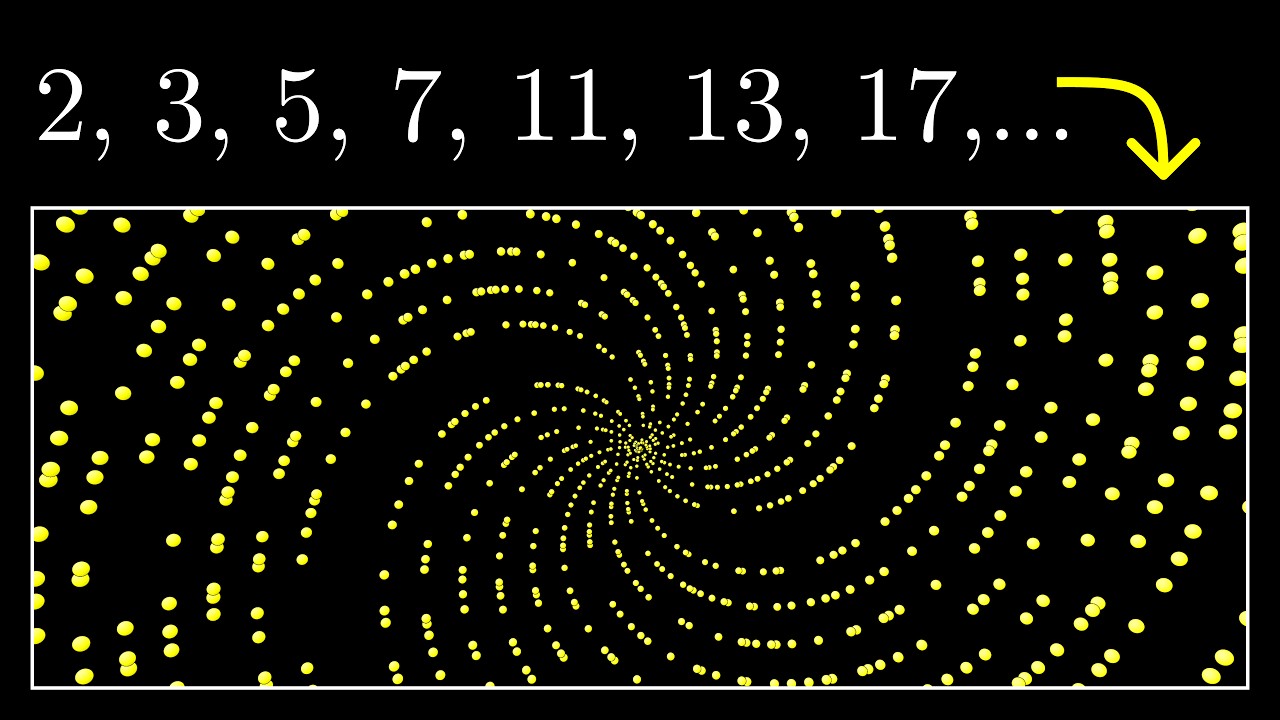
Why do prime numbers make these spirals? | Dirichlet’s theorem and pi approximations
Keywords
Summary
182 words
Critical Evaluation
Value of the Information & Strength of the Argument
The video provides a clear and compelling explanation of a complex mathematical phenomenon. The argumentation is well-structured, starting with a simple observation and progressively building to more advanced concepts. The use of visualizations is exceptional, making abstract ideas tangible. The creator also demonstrates intellectual rigor by acknowledging and correcting a historical inaccuracy in the video description. The connection between the visual patterns and the underlying number theory is made convincingly, and the explanation of Dirichlet’s theorem is accessible without oversimplifying the mathematics.
Scientific Rigor, Source Quality, Title Accuracy
The video demonstrates high scientific rigor. The creator cites the original Math Stack Exchange post and provides links to related videos and Dirichlet’s paper. The correction in the description shows a commitment to accuracy. The title accurately reflects the content, and the video’s content aligns with established mathematical knowledge. The sources cited are credible and relevant, and the creator’s use of them is appropriate.
161 words
Title / Content Match
The title accurately reflects the content, which explores the spiral patterns formed by prime numbers in polar coordinates and connects them to Dirichlet's theorem and rational approximations of pi.
Quality & Reliability
9/10
The video is produced by a reputable mathematics educator, with clear explanations and visualizations. The creator provides a detailed correction in the description regarding a historical inaccuracy, demonstrating intellectual honesty. The content aligns with established mathematical knowledge, and the sources cited are relevant and credible.
Key Moments
Markers derived by PSI from the transcript: the creator did not define chapters.
- Introduction to the spiral pattern formed by plotting primes in polar coordinates.
- Explanation that the spirals are not unique to primes; they appear for all integers due to rational approximations of 2π.
- Introduction to residue classes modulo 6 and why primes only appear in two of them.
- Explanation of the galactic spirals using the approximation 44/7 for 2π.
- Introduction to Euler's totient function and the count of allowable residue classes.
- Zooming out to see the radial lines and the approximation 355/113 for π.
- Statement of Dirichlet's theorem on arithmetic progressions and its historical context.
- Discussion of the value of playful exploration in mathematics and how it can lead to deep results.
Cited Sources
- Math Stack Exchange question and answer — The original question that inspired the video, and the answer by Greg Martin that explains the patterns.
- Dirichlet's paper (arXiv) — Reference to Dirichlet's original work on primes in arithmetic progressions.
- Mathologer video on rational approximations — Recommended for further understanding of rational approximations and continued fractions.
- Numberphile video on Ulam Spirals — Related video about another prime number pattern.
- 3Blue1Brown's manim library — The open-source Python library used to create the animations.
Concurring Sources
- Math Stack Exchange answer — The answer provides the mathematical explanation for the patterns, which the video elaborates on.
- Dirichlet's theorem on arithmetic progressions — Confirms the statement of the theorem and its historical development.
Dissenting Sources
- None — No discordant sources were identified. The video's content aligns with established mathematical knowledge.
External References
Contribution & Novelties
The video provides a novel and accessible explanation of a complex number theory result, connecting it to visual patterns and rational approximations. It emphasizes the value of playful exploration in mathematics, showing how a seemingly arbitrary question can lead to deep and important theorems. The creator also demonstrates intellectual honesty by correcting a historical inaccuracy in the description.
Pour aller plus loin :
- Dirichlet’s theorem on arithmetic progressions — Provides a comprehensive overview of the theorem and its proof.
- Euler’s totient function — Detailed explanation of the function and its properties.
- Continued fractions — Relevant to understanding rational approximations of π.
- Prime number theorem — Related to the distribution of primes and the historical context of Dirichlet’s work.
118 words
Radar Profile
The radar profile shows high scores across all dimensions, indicating a video that is both informative and reliable. The high quality of information and technical level reflect the depth of the mathematical content, while the strong fiabilite score is supported by the creator's transparency and use of credible sources.
💬 Très positif. Sur les 30 commentaires analysés, les spectateurs expriment une admiration unanime pour la clarté, la beauté et la profondeur de l'explication, avec de nombreux commentaires soulignant l'impact émotionnel et la valeur éducative de la vidéo.