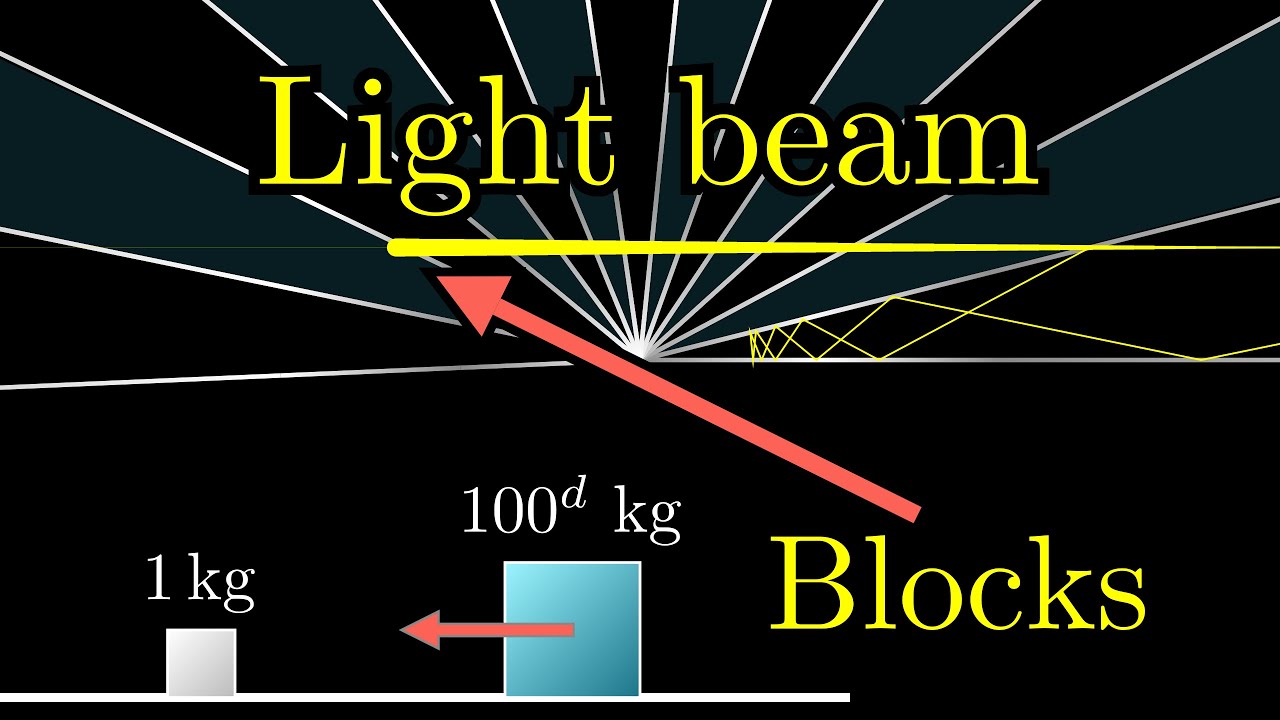
How colliding blocks act like a beam of light...to compute pi.
Keywords
Summary
159 words
Critical Evaluation
Value of the Information & Strength of the Argument
The video provides a highly valuable and elegant alternative explanation for the pi phenomenon, deepening the understanding beyond the previous solutions. The argumentation is rigorous and well-structured, building from the configuration space to the conservation laws and then to the optical analogy. The use of visual animations greatly aids comprehension. The presenter also acknowledges a minor error in the formula and provides a correction, demonstrating intellectual honesty. The connection to optics is not just superficial but is derived from the physics, making the argument solid.
Scientific Rigor, Source Quality, Title Accuracy
The scientific rigor is high. The video is based on a known mathematical result by Gregory Galperin, and the original paper is cited in the description. The derivation is mathematically sound, with the caveat of the arctan approximation, which is discussed in the comments and acknowledged in the video’s description. The title accurately reflects the content. The description provides links to the paper, an interactive simulation, and a blog post, which are relevant and credible. The video does not overstate its claims and provides a correction note, enhancing its reliability.
190 words
Title / Content Match
The title accurately reflects the content, which demonstrates an analogy between colliding blocks and light reflecting between mirrors to compute pi.
Quality & Reliability
9/10
The video is a rigorous mathematical exposition by a well-known educator, with a clear derivation and a correction note. It cites the original paper by Galperin and includes interactive resources. The reasoning is sound, though it relies on an approximation (arctan x ≈ x) that is acknowledged and discussed in the comments.
Key Moments
Markers derived by PSI from the transcript: the creator did not define chapters.
- Introduction to the mirror analogy and the problem of colliding blocks.
- Setting up the configuration space with positions of the blocks.
- Rescaling coordinates with square roots of masses.
- Deriving that energy conservation implies constant speed in configuration space.
- Showing that momentum conservation implies equal angles of incidence and reflection.
- Introducing the unfolding trick to count reflections.
- Deriving the formula floor(pi/theta) for the number of collisions.
- Connecting back to the appearance of pi and concluding with a quote.
Cited Sources
- Galperin's paper 'Playing pool with pi' — Original paper presenting the result and the solution.
- Interactive simulation by prajwalsouza — Interactive tool built after watching the video.
- NY Times blog post about the problem — Blog post discussing the problem.
- Looking Glass Universe channel — Related channel mentioned in the video.
- 3Blue1Brown store — Merchandise, including the plushie pi shown.
- 3Blue1Brown website — Home page for the channel.
- Music by Vincent Rubinetti on Bandcamp — Music used in the video.
- Music on Spotify — Streaming version of the music.
- 3Blue1Brown on Reddit — Community discussion.
- 3Blue1Brown on Twitter — Social media.
- 3Blue1Brown on Instagram — Social media.
- 3Blue1Brown on Facebook — Social media.
- Patreon page — Support page.
- 3Blue1Brown subscription page — Subscribe link.
- Special thanks supporters — List of supporters.
Concurring Sources
- Galperin's paper — The original paper confirms the result and the method.
- Interactive simulation — Allows users to verify the behavior.
Dissenting Sources
- Commenter correction — A commenter pointed out that the formula should be ceil(pi/theta)-1, which the video creator acknowledged in the description.
Contribution & Novelties
This video provides a novel and elegant perspective on the block collision problem by drawing a deep analogy with geometric optics. It demonstrates how a change of coordinates can transform a dynamical problem into a purely geometric one, and how the unfolding trick simplifies counting reflections. This approach not only explains the appearance of pi but also offers a more intuitive understanding of the system’s behavior.
Pour aller plus loin :
- Configuration space — The space of all possible positions of a system, central to the video’s approach.
- Phase space — A related concept that includes momenta, as mentioned in the comments.
- Galperin’s paper — The original source of the result, providing deeper mathematical details.
- Unfolding (geometry) — The technique of reflecting the world instead of the beam, used to count reflections.
- Normal number — A concept related to the caveat about the approximation, as discussed in the comments.
149 words
Radar Profile
The radar profile shows very high scores in information quality and reliability, with slightly lower but still strong scores in information quantity and technical level. This indicates a video that is both informative and trustworthy, with a moderate technical depth suitable for a general audience.
💬 Très positif. Sur les 30 commentaires analysés, l'enthousiasme est unanime, avec des éloges pour la clarté, l'élégance et la beauté de l'explication, et de nombreux commentaires soulignent la satisfaction du son des claquements.