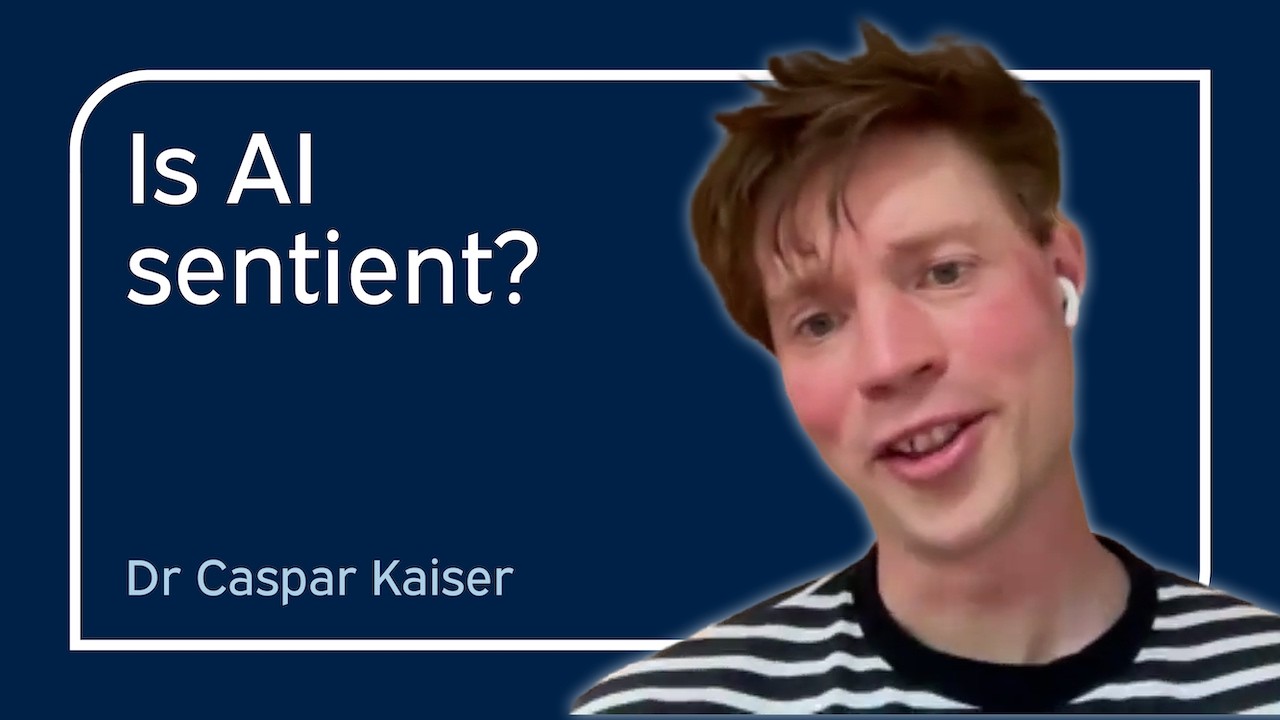
Is AI sentient? | Caspar Kaiser | University of Oxford
Keywords
Summary
177 words
Critical Evaluation
Value of the Information & Strength of the Argument
The presentation offers valuable insights into the emerging field of AI sentience and wellbeing, bridging computer science and empirical wellbeing research. Kaiser’s argumentation is structured and nuanced, acknowledging uncertainties and alternative viewpoints. He uses analogies (synapse counts vs. parameters) and cites specific studies to support his claims. The lie detector methodology is innovative and addresses the problem of untruthful self-reports. However, the evidence is preliminary, and the speaker himself notes that the field is rapidly evolving. The argument that AI welfare weight will soon dominate human welfare is speculative and relies on assumptions about future scaling and sentience.
Scientific Rigor, Source Quality, Title Accuracy
Kaiser demonstrates scientific rigor by referencing multiple studies and papers, including those on introspection, pain avoidance, and lie detection. He also mentions a paper by Derek Shiller and others from Rethink Priorities that reaches similar conclusions, as well as a contrasting paper by Cameron Buck. The title accurately reflects the content. The talk is a seminar presentation, so it is not peer-reviewed, but it is grounded in ongoing research. The speaker is transparent about the limitations and uncertainties of his findings.
194 words
Title / Content Match
The title accurately reflects the content, which focuses on the question of AI sentience and its implications for wellbeing.
Quality & Reliability
7/10
Presentation by an academic researcher (associate professor at Warwick, research fellow at Oxford) with references to ongoing research and literature. Claims are appropriately hedged, and the speaker acknowledges uncertainty and alternative views. However, the talk is a seminar presentation, not a peer-reviewed publication, and some claims rely on speculative extrapolation.
Chapters
Cited Sources
- Introspection in LLMs (paper 1) — Cited as evidence that LLMs can introspect and predict their own decision-making.
- Introspection in LLMs (paper 2) — Second paper on introspection, part of the increasing literature.
- Pain avoidance in LLMs (Keeling, Li et al., 2024) — Early paper showing LLMs behave as if they are pain-avoidant.
- Related results on moral patienthood — Additional papers showing models behave as if they are moral patients.
- METR (Model Evaluation and Threat Research) — Data on task length completion probability for LLMs over time.
- Lie detection papers — Papers on training classifiers on internal activations to detect truthfulness.
- Shiller et al. (Rethink Priorities) — Paper with similar conclusions on LLM sentience.
- Buck (Cameron Buck) — Paper with opposing conclusion on LLM sentience.
Concurring Sources
- Shiller et al. (Rethink Priorities) — Reaches similar conclusions about current LLM sentience.
Dissenting Sources
- Buck (Cameron Buck) — Presents evidence suggesting a higher probability of LLM sentience, contrasting with the speaker's findings.
Contribution & Novelties
The talk contributes to the emerging field of AI wellbeing by proposing empirical methods to assess AI sentience and welfare, such as using lie detectors on internal activations and analyzing self-reports. It highlights the potential for digital minds to be studied more easily than biological ones and calls for interdisciplinary collaboration. The speaker’s approach of treating AI welfare as a serious empirical question is novel.
Pour aller plus loin :
- AI alignment — Relevant to ensuring AI systems act in accordance with human values.
- Theory of mind — Related to the ability to attribute mental states to others, including AI.
- Moral patienthood — Concept central to the talk’s argument about AI welfare.
112 words
Radar Profile
The radar profile shows high scores in information quantity and quality, with moderate technical level and reliability. This suggests a well-informed presentation with solid content, though not extremely technical or highly reliable due to its speculative nature.