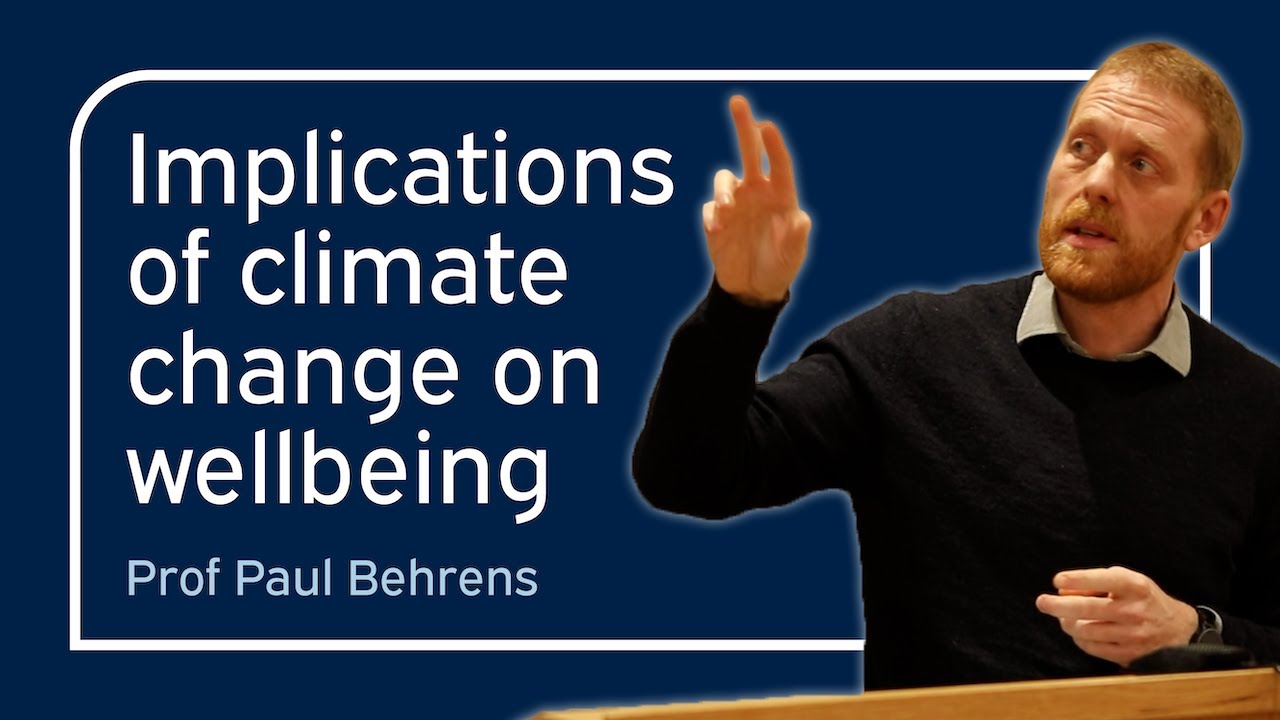
Implications of climate change on wellbeing | Paul Behrens | University of Oxford
Keywords
Summary
171 words
Critical Evaluation
Value of the Information & Strength of the Argument
The talk provides valuable insights into the intersection of climate change and wellbeing, synthesizing recent research and highlighting gaps in current modeling. The argumentation is solid, drawing on peer-reviewed sources and IPCC reports. The speaker effectively demonstrates that wellbeing impacts are underestimated and that current models fail to capture many important dimensions. He also offers a balanced view by acknowledging uncertainties and the potential for positive outcomes from climate action.
Scientific Rigor, Source Quality, Title Accuracy
The presentation is scientifically rigorous, referencing IPCC reports, peer-reviewed papers, and national assessments. The speaker is transparent about the limitations of models and the need for better integration of wellbeing. The title accurately reflects the content. No specific sources are listed in the description, but the talk references several key papers and reports.
138 words
Title / Content Match
The title accurately reflects the content, which focuses on the implications of climate change for wellbeing.
Quality & Reliability
8/10
The speaker is a recognized academic (Oxford) and the presentation references peer-reviewed literature and IPCC reports. However, it is a seminar talk, not a peer-reviewed publication, and some claims are presented without full citations.
Chapters
Cited Sources
- IPCC Assessment Reports (AR3, AR6) — Burning ember diagrams showing risk thresholds
- UK Climate Change Risk Assessment (CCRA3) — National risk assessment showing increased risks
- Paper by Inga Shrivever (2025) — Systematic review of wellbeing components in climate models
- Weitzman's critique of IAMs — Critique of using cost-benefit analysis for climate change
- Science expose on BECCS in models — How models select for bioenergy carbon capture and storage
Concurring Sources
- IPCC AR6 WGII — Reports on impacts, adaptation, and vulnerability, supporting the underestimation of risks.
- UK Climate Change Risk Assessment 2022 — National assessment showing increased risks, consistent with the talk.
Dissenting Sources
- Bill Gates' 'Tough Truths' — Gates downplays the severity of climate change impacts, contrasting with the speaker's emphasis on severe and underestimated risks.
Contribution & Novelties
This talk provides a clear synthesis of recent research on climate change impacts on wellbeing, highlighting the systemic underestimation of risks and the inadequacy of current models. It offers a critical perspective on IAMs and suggests alternative approaches. The speaker’s emphasis on the need to integrate wellbeing into climate policy is a valuable contribution.
Pour aller plus loin :
- IPCC Sixth Assessment Report — Comprehensive assessment of climate change impacts, including on wellbeing.
- DICE model — Example of an integrated assessment model critiqued in the talk.
- Wellbeing Research Centre — Research center hosting the seminar, relevant to wellbeing research.
99 words
Radar Profile
The radar profile shows high scores in information quantity, quality, technical level, and reliability, indicating a well-researched and informative presentation. The lowest score is in technical level, but it remains high, reflecting the advanced nature of the content.