Modulo 3 parte 2 Nuevas tecnologías en la educación
Keywords
Summary
206 words
Critical Evaluation
Value of the Information & Strength of the Argument
The video offers a clear and structured introduction to key concepts in educational technology, such as the data-information-knowledge hierarchy and the TIC-TAC-TEP framework. The presenter uses relatable examples (e.g., smoking and lung damage) to illustrate abstract ideas, which aids understanding. However, the argumentation is largely anecdotal and opinion-based, lacking empirical evidence or citations to research. The presenter makes claims about learning theories (e.g., multimodal learning) without referencing studies, and his critique of multiple intelligences is presented as fact without supporting sources. While the content is pedagogically useful for beginners, its scientific rigor is limited.
Scientific Rigor, Source Quality, Title Accuracy
The video does not cite any external sources, and the description contains no links. The presenter mentions his own article on ‘digital territory’ but does not provide a reference. The title accurately reflects the content, which is a lecture on new technologies in education. The video is part of a course, so it is not intended as a scientific publication, but rather as an educational resource. The lack of citations and reliance on personal experience reduce its scientific credibility.
188 words
Title / Content Match
The title accurately reflects the content, which is the second part of module 3 on new technologies in education.
Quality & Reliability
6/10
The video provides a coherent overview of educational technology concepts, but relies heavily on personal opinion and lacks citations to external sources. The presenter's claims about learning theories (e.g., multimodal learning) are presented without scientific references, and the video is a lecture for a specific course, not a peer-reviewed or evidence-based presentation.
Key Moments
Markers derived by PSI from the transcript: the creator did not define chapters.
- Introduction and overview of the session.
- Explanation of data, information, and knowledge.
- Introduction to TIC, TAC, and TEP.
- Discussion on the shift from traditional to active education.
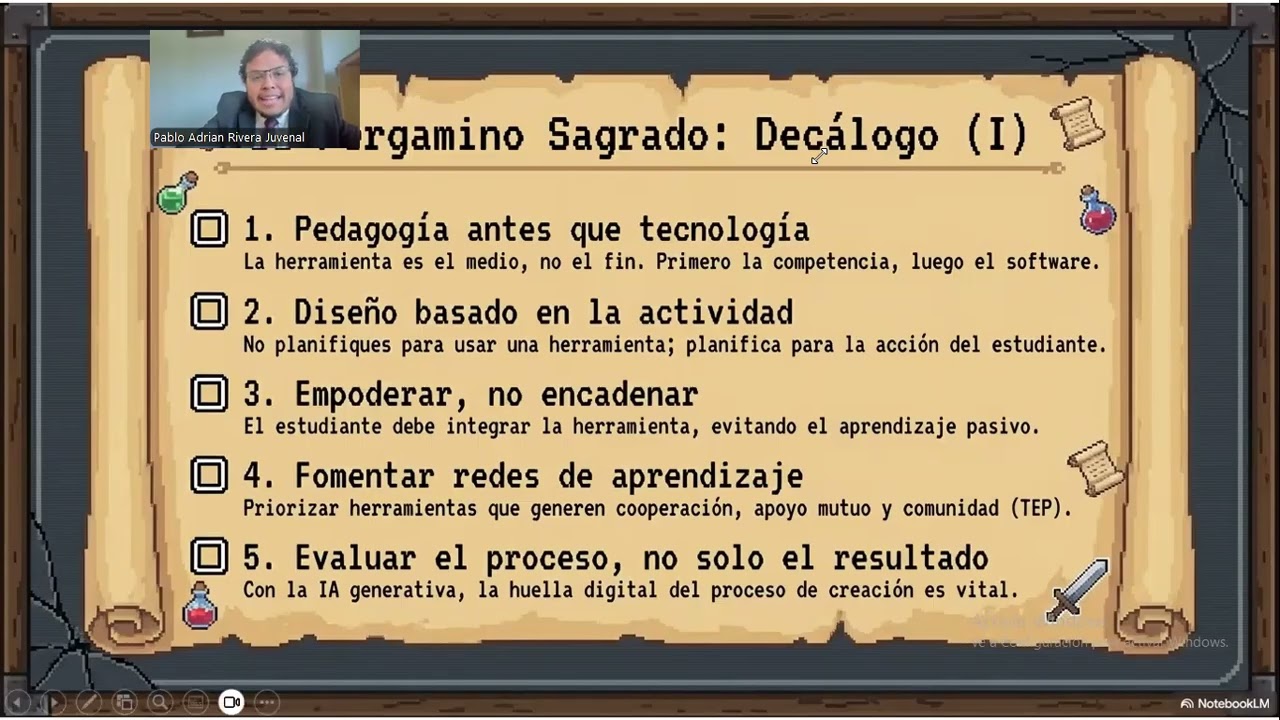
- Principles for using technology in education.
- Explanation of multimodal learning and multimodal education.
- Introduction to digital territory and techno-feudalism.
Contribution & Novelties
The video provides a practical framework for educators to integrate technology into their teaching, emphasizing the importance of moving from passive to active learning. It introduces concepts like ‘curation knowledge’ and ’extended mind’ in an accessible way. However, it does not present original research or novel findings; it synthesizes existing ideas for a specific audience.
Pour aller plus loin :
- Multimodal learning — Overview of multimodal learning theories.
- Extended mind thesis — Philosophical concept of cognitive extension.
- Techno-feudalism — Discussion of digital power concentration.
84 words
Radar Profile
The radar profile shows moderate scores across all dimensions, indicating a balanced but not exceptional video. The quantity of information is adequate, but the quality and reliability are limited by the lack of citations. The technical level is low, making it accessible to beginners, but it may not satisfy advanced learners.