Laboratorio de Innovación Social, parte 2, módulo 2 (tercera versión)
Keywords
Summary
215 words
Critical Evaluation
Value of the Information & Strength of the Argument
The video provides a clear and structured explanation of the ladder of participation, a key concept in social innovation. The instructor uses relatable examples to illustrate each stage, making the content accessible. However, the argumentation relies heavily on anecdotal evidence and personal experiences rather than empirical research. The discussion of internal and external agents is valuable, but the lack of references to academic literature weakens the scientific foundation. The interactive elements, such as student contributions, add practical insights but are not systematically integrated into a rigorous framework.
Scientific Rigor, Source Quality, Title Accuracy
The video does not cite any formal sources, and the description contains no links. The instructor mentions concepts like ‘microgestión’ and refers to the movie ‘Flaming Hot’ but does not provide verifiable references. The title accurately reflects the content, which is a continuation of a module on social innovation. The lack of citations and reliance on personal stories reduce the scientific rigor, but the content is coherent and aligns with established theories of participatory development.
177 words
Title / Content Match
The title accurately describes the content: a second part of a module on social innovation, focusing on the ladder of participation and group dynamics.
Quality & Reliability
6/10
The video is a lecture that presents theoretical concepts (e.g., the ladder of participation) with practical examples, but lacks citations to academic sources and relies on anecdotal evidence. The content is coherent and aligns with established social innovation frameworks, but the lack of verifiable references and the informal tone reduce its scientific rigor.
Key Moments
Markers derived by PSI from the transcript: the creator did not define chapters.
- Introduction to the session and recap of group vs. community distinction.
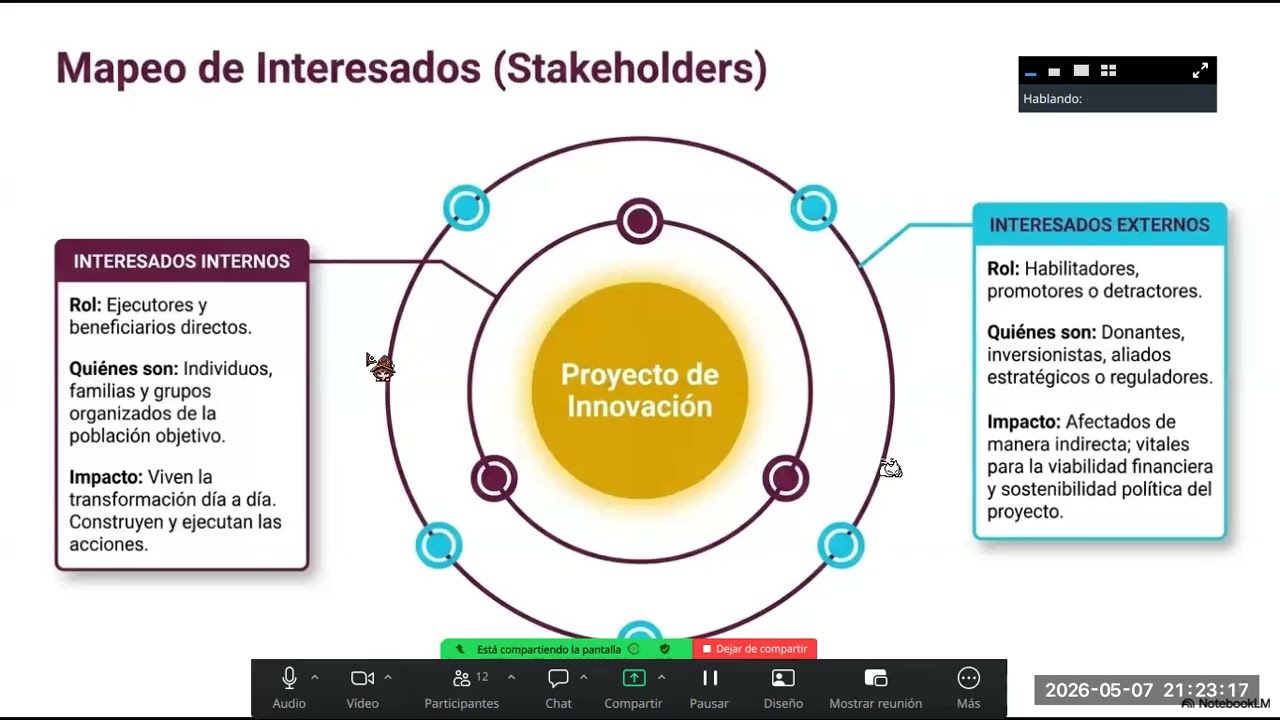
- Discussion of internal and external agents in social innovation projects.
- Warning against assistentialist approaches and example of prison food.
- Introduction to the ladder of participation and its stages.
- Explanation of the first stage: passivity and micro-management.
- Second stage: information supply, with example of making popcorn.
- Third stage: consultation, with examples of monthly meetings and the Flaming Hot story.
- Fourth stage: incentives, and discussion of non-monetary rewards.
- Examples of incentives from students and the rat plague in New York.
- Conclusion and assignment instructions for students.
Contribution & Novelties
The video offers a practical, example-driven explanation of the ladder of participation, which is useful for students of social innovation. It emphasizes the importance of gradual progression and the need to understand the specific incentives of a community. The discussion of internal vs. external agents is a valuable addition to the framework.
Pour aller plus loin :
- Arnstein’s Ladder of Citizen Participation — This is a foundational model for understanding levels of participation, directly related to the ladder discussed.
- Participatory Action Research — This approach emphasizes the involvement of community members in research and action, aligning with the video’s call for consultation and empowerment.
- Self-Determination Theory — This theory explains intrinsic and extrinsic motivation, relevant to the discussion of incentives and recognition.
122 words
Radar Profile
The radar profile shows moderate scores across all dimensions, indicating a balanced but not exceptional video. The quantity of information is relatively high, but the quality and reliability are moderate due to lack of citations. The technical level is moderate, suitable for an introductory audience. Overall, the video is informative but not highly rigorous.