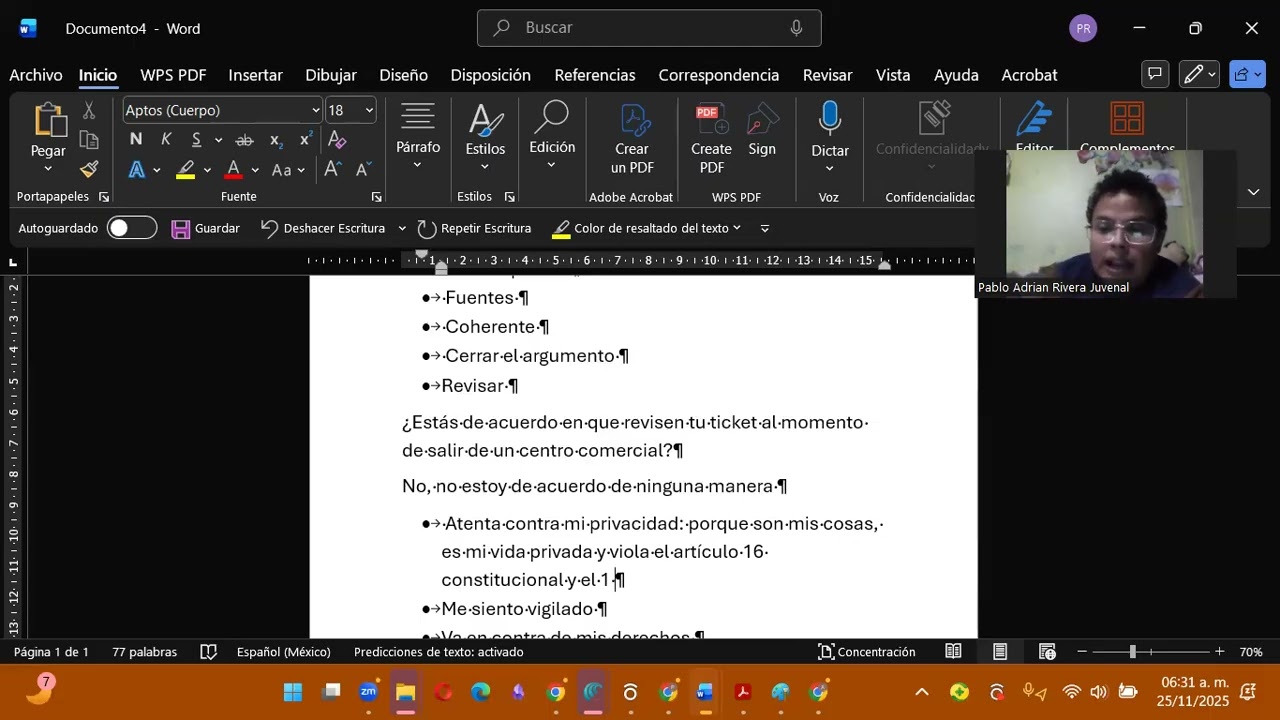
Ejemplo de construcción de argumentos
Keywords
Summary
135 words
Critical Evaluation
Value of the Information & Strength of the Argument
The video provides a clear, step-by-step methodology for constructing arguments, which is valuable for educational purposes. The author demonstrates the process with a concrete example, making it easy to follow. However, the argumentation is not deeply rigorous; the example is somewhat superficial and the sources are not thoroughly examined. The author acknowledges improvisation and does not provide a fully polished argument. The value lies in the pedagogical approach rather than in the depth of the argument itself.
Scientific Rigor, Source Quality, Title Accuracy
The video references several argumentation models (Weston, Toulmin, Perelman) and philosophical concepts (Kant, Foucault), but these are mentioned briefly without detailed explanation or citation. The legal references (Mexican Constitution articles) are specific but not verified in the video. The title accurately describes the content, which is a tutorial on argument construction. The overall scientific rigor is moderate, suitable for an introductory tutorial but not for advanced academic work.
160 words
Title / Content Match
The title accurately reflects the content: a practical example of building an argument.
Quality & Reliability
6/10
The video is a practical tutorial on argument construction, based on recognized argumentation models (Weston, Toulmin, Perelman, Aristotelian rhetoric). The author demonstrates a step-by-step process with a concrete example, but the content is largely informal and relies on personal knowledge rather than rigorous academic citations. The legal references are specific to Mexico and are mentioned without detailed verification.
Key Moments
Markers derived by PSI from the transcript: the creator did not define chapters.
- Introduction and overview of argumentation models
- Key elements: stance, sources, coherence, closure, revision
- Choosing a topic: receipt checking at shopping malls
- Developing points: privacy, surveillance, rights, dignity
- Incorporating sources: Mexican Constitution, Kant, Foucault
- Structuring the argument: introduction, development, conclusion
- Closing the argument and addressing potential counterarguments
- Revision and final tips
Cited Sources
- Weston's argumentation model — Mentioned as a basis for argument construction, particularly arguments from authority.
- Toulmin's model of argumentation — Referenced for the concepts of assertion and evidence.
- Perelman's argumentation theory — Mentioned as a model for argumentation.
- Aristotelian rhetoric — Referenced as a classical foundation.
- Foucault's 'Discipline and Punish' — Cited for the concept of the panopticon and surveillance society.
- Kant's 'Critique of Practical Reason' — Cited for the principle of treating humans as ends in themselves.
- Mexican Constitution, Article 1 — Cited for recognition of human rights.
- Mexican Constitution, Article 16 — Cited for protection against molestation without judicial order.
Concurring Sources
- Weston, A. (2000). A Rulebook for Arguments — Provides guidelines for constructing arguments, consistent with the video's approach.
- Toulmin, S. (1958). The Uses of Argument — Foundational work on argumentation models.
Dissenting Sources
- Potential counterarguments on privacy vs. security — The video does not address the security perspective, which could be a point of debate.
Contribution & Novelties
The video offers a practical, step-by-step guide to constructing arguments, which is useful for students and beginners. It integrates various argumentation models and philosophical concepts, but does not introduce new theoretical insights. The example is relatable and demonstrates the process clearly.
Pour aller plus loin :
- Argumentation theory — Overview of the field.
- Toulmin method — Detailed explanation of Toulmin’s model.
- Panopticon — Foucault’s concept of surveillance.
- Categorical imperative — Kant’s ethical principle.
73 words
Radar Profile
The radar profile shows moderate scores across all dimensions, indicating a balanced but not exceptional tutorial. The video provides useful information but lacks depth and rigorous sourcing.