Hackathon 2 - Data curation and unsupervised analysis of the diffraction data - Houston
Keywords
Summary
138 words
Critical Evaluation
Value of the Information & Strength of the Argument
The video provides valuable hands-on experience in using digital twins for scientific data analysis, demonstrating a practical workflow for 4D-STEM data. The argumentation is based on direct demonstration and practical problem-solving, with clear explanations of the tools and methods. The presenter encourages participants to explore and discover patterns, fostering an interactive learning environment. The value lies in the transferable skills and the open-source nature of the tools used.
Scientific Rigor, Source Quality, Title Accuracy
The video is scientifically rigorous in its methodology, using established simulation tools and open-source software. However, it does not cite specific scientific sources or publications, relying instead on the workshop context and the tools themselves. The title accurately reflects the content, which is a hackathon session focused on data curation and unsupervised analysis. No comments were provided for analysis.
142 words
Title / Content Match
The title accurately describes the content: a hackathon session on data curation and unsupervised analysis of diffraction data.
Quality & Reliability
7/10
The video is a hands-on tutorial from a workshop, demonstrating practical use of open-source tools (asynchroscopy, digital twin) for 4D-STEM data analysis. It is technically sound and reproducible, but lacks formal citations and peer review.
Key Moments
Markers derived by PSI from the transcript: the creator did not define chapters.
- Introduction to the hackathon and digital twin setup
- Installing dependencies and starting the digital twin server
- Loading packages and connecting to device servers
- Acquiring overview image and discussing particle characteristics
- Demonstrating how to obtain diffraction patterns from individual particles
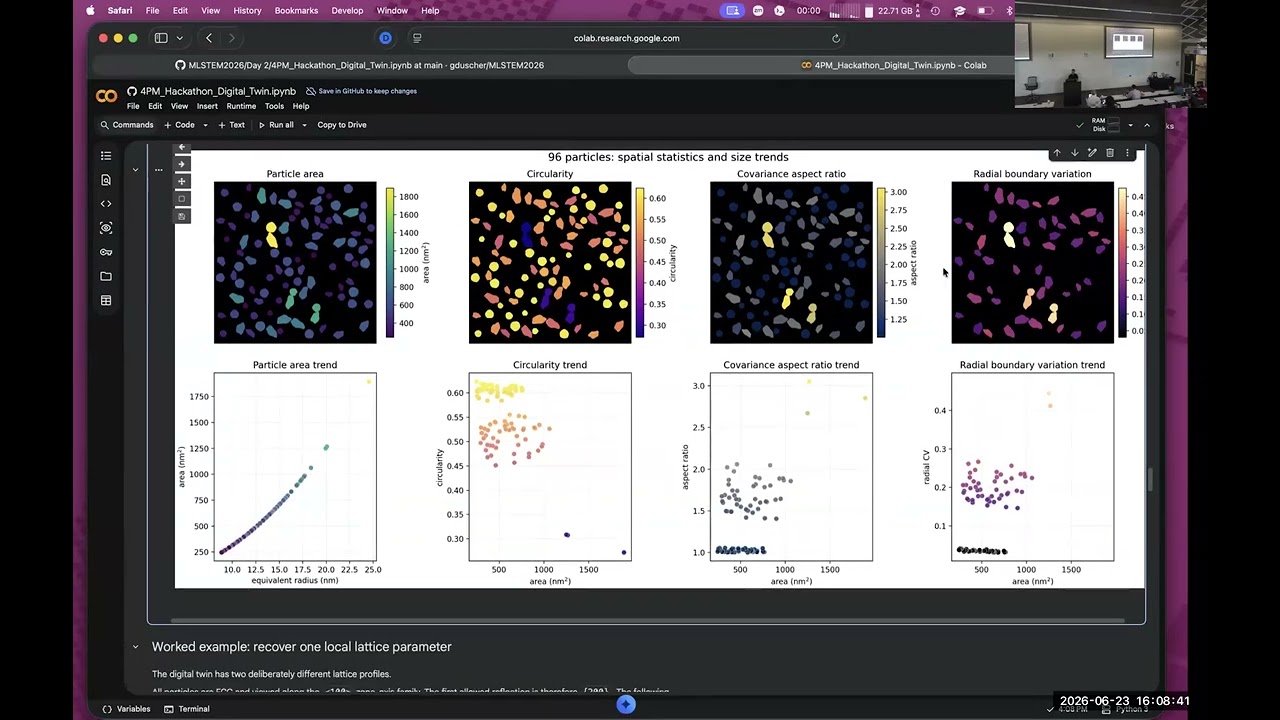
- Providing tools for particle segmentation and lattice parameter extraction
- Presenting the four hackathon exercises
- Revealing the differences in lattice parameters between oval and circular particles
- Discussion of patterns and invitation to run solutions on real microscope
Cited Sources
- asynchroscopy GitHub repository — The digital twin and data acquisition tools are based on asynchroscopy.
- ABTEM — Used for simulating diffraction patterns.
- Atomic Simulation Environment (ASE) — Used for atomic simulations.
Concurring Sources
- asynchroscopy GitHub repository — The digital twin and data acquisition tools are based on asynchroscopy.
Contribution & Novelties
The video demonstrates a novel approach to teaching and performing 4D-STEM data analysis using a digital twin, which allows for hands-on experimentation without the need for a physical microscope. This approach is highly scalable and accessible, enabling researchers to develop and test analysis algorithms in a simulated environment before applying them to real data. The hackathon format encourages active learning and problem-solving, with a focus on unsupervised analysis and pattern discovery.
Pour aller plus loin :
- 4D-STEM — Overview of 4D-STEM technique.
- Digital twin — Concept of digital twins in engineering.
- asynchroscopy documentation — Official documentation for the asynchroscopy library.
- ABTEM — Simulation tool for electron microscopy.
- Atomic Simulation Environment — Tool for atomic-scale simulations.
115 words
Radar Profile
The radar profile shows high scores in technical level and information quality, reflecting the advanced nature of the content and its practical value. The lower score in information quantity is due to the short duration and focused scope. Overall, the video is a solid technical resource for those interested in 4D-STEM data analysis.