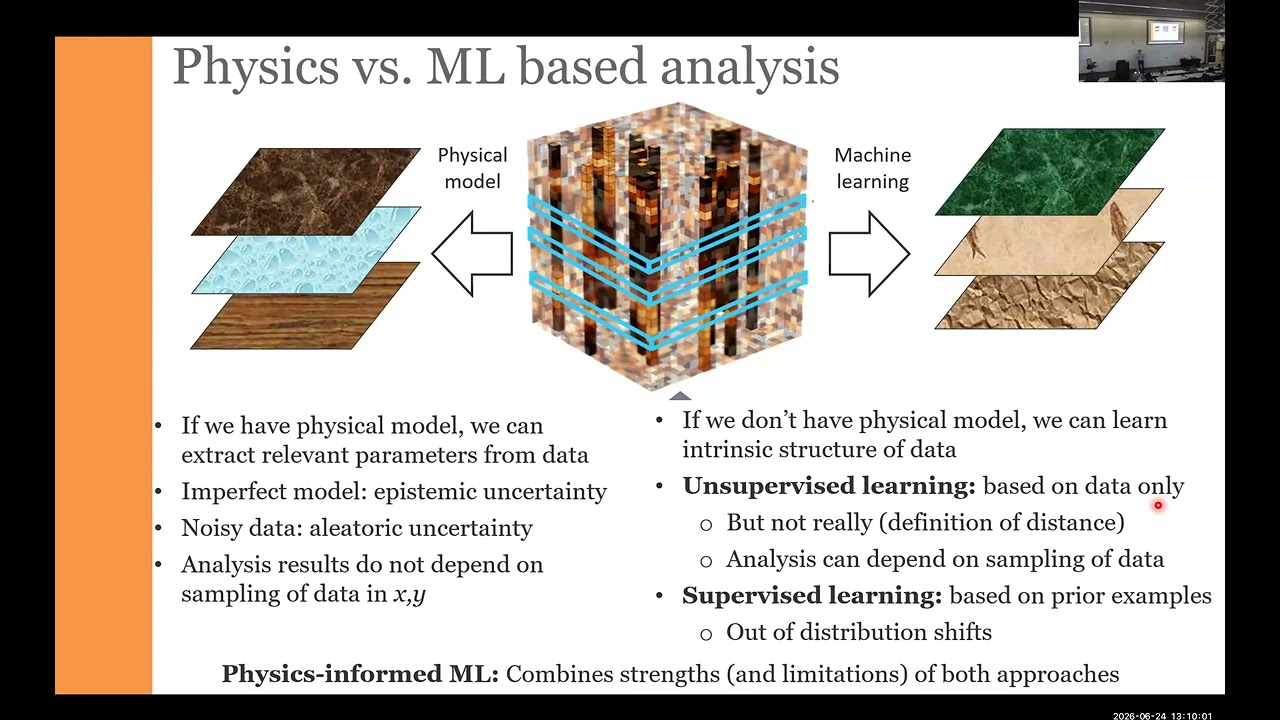
Day 3 - Machine Learning of Spectroscopic Datasets - Kalinin
Keywords
Summary
178 words
Critical Evaluation
Value of the Information & Strength of the Argument
The lecture provides valuable insights into the practical application of machine learning to scientific data. The speaker’s argumentation is solid, grounded in his extensive experience and clear examples. He effectively argues that linear methods are often the most appropriate for physical data, and he explains the underlying assumptions and limitations of each technique. The emphasis on physics-first thinking is a valuable perspective that challenges the trend of always using the latest complex models. The lecture is well-structured, building from basic concepts to more advanced topics, and the examples help illustrate the abstract ideas.
Scientific Rigor, Source Quality, Title Accuracy
The lecture demonstrates scientific rigor through its logical structure and the speaker’s evident expertise. However, it lacks formal citations to specific sources, which is a limitation for a scientific lecture. The speaker mentions historical developments and methods but does not provide references. The title accurately reflects the content, and the lecture stays on topic. The speaker’s informal style, while engaging, occasionally lacks precision, but overall the content is reliable.
177 words
Title / Content Match
The title accurately reflects the content: a lecture on applying machine learning to spectroscopic datasets, specifically in electron microscopy.
Quality & Reliability
8/10
The lecture is presented by a leading expert in machine learning for microscopy, with deep domain knowledge and practical experience. The content is technically accurate, well-structured, and grounded in established methods (PCA, ICA, etc.). The speaker provides clear explanations and caveats, demonstrating scientific rigor. Minor limitations include the lack of formal citations and the informal delivery style.
Key Moments
Markers derived by PSI from the transcript: the creator did not define chapters.
- Introduction: The speaker sets the stage, discussing the evolution of data analysis in microscopy and the role of machine learning.
- The speaker emphasizes the importance of physical intuition over coding skills, and introduces the concept of 'operational semantics'.
- Discussion on why linear methods are preferred in many physical systems, and the principle that if a solution exists and is unique, the method doesn't matter.
- Introduction to general linear unmixing, with an example from EELS data on interfaces.
- Explanation of principal component analysis (PCA), its history, and its application in microscopy.
- Discussion on interpreting PCA results, including the use of scree plots and spatial correlation functions.
- Comparison of PCA and clustering methods, and when each is appropriate.
- Introduction to independent component analysis (ICA), its assumptions, and its potential applications.
- The speaker discusses the 'onion' approach to data analysis, removing layers of complexity with physics-informed methods.
Cited Sources
- No formal sources cited in the video — The lecture does not explicitly cite any sources.
Concurring Sources
- Machine learning in electron microscopy — This review article discusses the application of machine learning to electron microscopy, supporting the lecture's themes.
Dissenting Sources
- Deep learning in microscopy — This article emphasizes the use of deep learning models, which contrasts with the lecture's advocacy for simpler linear methods.
Contribution & Novelties
The lecture provides a clear and practical perspective on applying machine learning to spectroscopic data, emphasizing the importance of physical intuition and the use of simple linear models. It offers a valuable framework for researchers, highlighting the pitfalls of blindly using complex models. The speaker’s experience adds credibility to the advice.
Pour aller plus loin :
- Principal component analysis — A foundational method discussed in the lecture.
- Independent component analysis — Another key method, with its assumptions and applications.
- Hyperspectral imaging — The type of data discussed, with its challenges and analysis techniques.
93 words
Radar Profile
The radar profile shows high scores across all dimensions, indicating a well-rounded and reliable lecture. The strongest aspects are the quality and quantity of information, as well as the technical level, reflecting the speaker's expertise. The global reliability is also high, though slightly lower due to the lack of formal citations.