Day 1 - Physics from STEM data - Kalinin
Keywords
Summary
167 words
Critical Evaluation
Value of the Information & Strength of the Argument
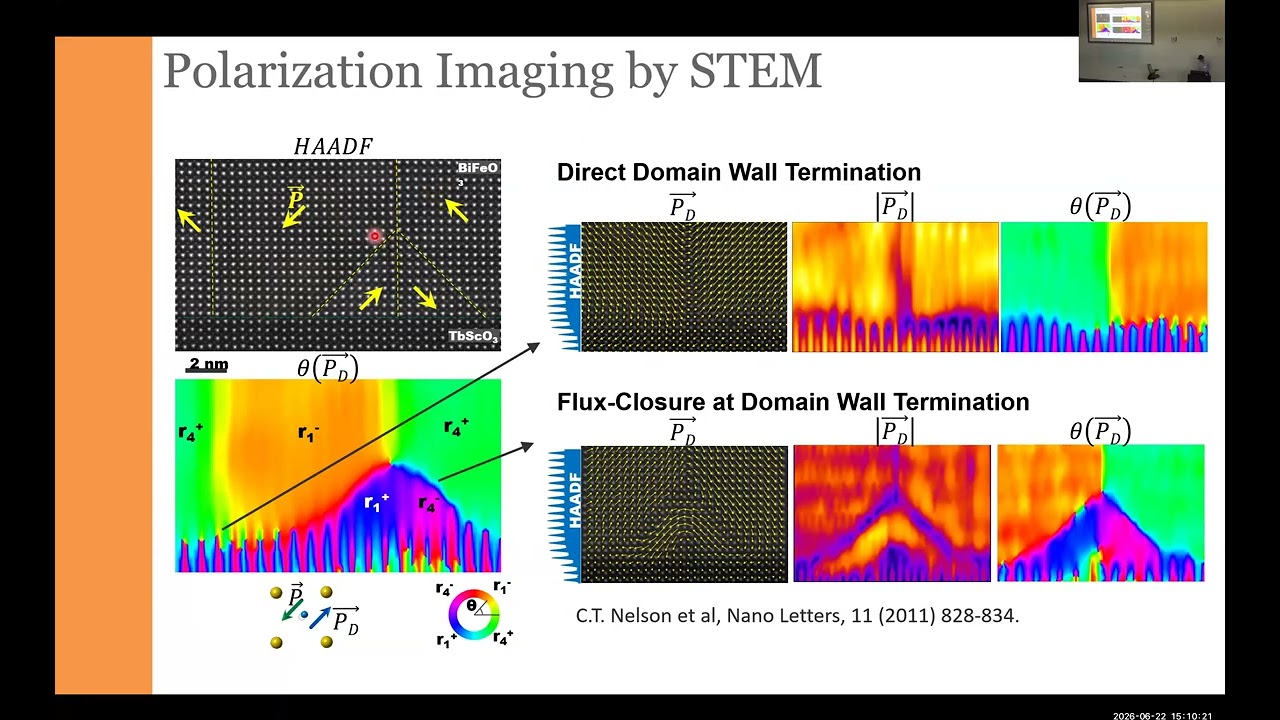
The value of the information is high, as it provides a comprehensive overview of how STEM data can be used to extract physical order parameters such as polarization and octahedral tilts. The speaker presents concrete examples, including polarization mapping in ferroelectrics and the observation of polarization vortices, which illustrate the power of the technique. The argumentation is solid, with logical progression from data acquisition to interpretation, and the speaker acknowledges limitations, such as the difficulty in measuring out-of-plane components and the presence of unknown variables. The discussion of chemical strain and its link to oxygen stoichiometry is particularly insightful, offering a practical method for quantifying defects. The speaker also addresses the importance of understanding image formation physics to avoid misinterpretation, which adds to the credibility of the content.
Scientific Rigor, Source Quality, Title Accuracy
The scientific rigor is generally high, with the speaker referencing established concepts like Goodenough-Kanamori rules and morphotropic phase boundaries. However, specific sources are not cited within the talk, and the description only provides a brief overview. The title accurately reflects the content, which is a tutorial on extracting physics from STEM data. The speaker’s expertise is evident, and the content aligns with current research trends. The lack of explicit citations is a minor weakness, but the overall presentation is scientifically sound.
224 words
Title / Content Match
The title accurately reflects the content, which is a lecture on extracting physical information from scanning transmission electron microscopy data.
Quality & Reliability
8/10
The content is presented by an expert in the field, with a clear pedagogical structure and references to established scientific concepts. The arguments are logically consistent, and the speaker acknowledges limitations and uncertainties. However, the lack of explicit citations and the informal style slightly reduce the score.
Key Moments
Markers derived by PSI from the transcript: the creator did not define chapters.
- Introduction to quantitative STEM and its ability to determine atomic positions with picometer precision.
- Discussion on how bond lengths and angles can reveal chemical and physical properties, referencing Goodenough-Kanamori rules.
- Explanation of chemical strain and its use to measure oxygen vacancies.
- Importance of calibrating the microscope and understanding image formation to avoid artifacts.
- Mapping polarization fields in ferroelectrics by measuring atomic displacements.
- Observation of polarization vortices and their significance.
- Visualization of octahedral tilts and their effect on atomic column shapes.
- Discussion on the transition from observation to physical models and the role of order parameters.
- Example of measuring lattice expansion and polarization at an interface, revealing space charge effects.
- Analysis of morphotropic phase boundaries and the observation of localized structural distortions.
Contribution & Novelties
The talk provides a clear and accessible introduction to the emerging field of quantitative STEM analysis, highlighting its potential to reveal atomic-scale physics that is inaccessible by traditional scattering methods. The speaker’s emphasis on the importance of data calibration and the need for physical models to interpret observations is particularly valuable. The examples of polarization mapping and chemical strain measurement illustrate the practical applications of the technique.
Pour aller plus loin :
- Scanning transmission electron microscopy — Provides background on the technique.
- Ferroelectricity — Relevant to the discussion of polarization mapping.
- Goodenough–Kanamori rules — Explains the relationship between bond angles and magnetic properties.
- Morphotropic phase boundary — Discusses the phenomenon mentioned in the talk.
114 words
Radar Profile
The radar profile shows high scores across all dimensions, indicating a well-rounded and informative presentation. The slightly lower score in 'fiabilite_globale' reflects the lack of explicit citations, but the overall quality is strong.