Day 5 - Decision Making in Microscopy - Kalinin
Keywords
Summary
165 words
Critical Evaluation
Value of the Information & Strength of the Argument
The lecture provides valuable insights into the practical challenges of implementing automated decision-making in scientific experimentation. Kalinin’s argumentation is solid, grounded in his extensive experience and illustrated with concrete examples from microscopy. He effectively conveys that the main difficulty lies not in the algorithms themselves but in correctly formulating the problem—defining state, actions, rewards, and values. The discussion on the distinction between objective and reward, and between reward and value, is particularly illuminating. The use of the coin-toss example to illustrate the role of priors is effective. The lecture also offers practical guidance on when to automate decisions versus when to rely on human judgment, considering costs and benefits. Overall, the content is highly relevant for researchers aiming to apply machine learning to experimental sciences.
Scientific Rigor, Source Quality, Title Accuracy
The lecture is scientifically rigorous in its conceptual explanations, but it lacks formal citations or references to specific literature. The speaker draws on his own research and collaborations, but no external sources are mentioned. The title accurately reflects the content, and the lecture is well-structured. The absence of citations is typical for a tutorial-style lecture, but it limits the ability to verify claims independently. The speaker’s authority and the logical coherence of the presentation contribute to the overall reliability.
219 words
Title / Content Match
The title accurately reflects the content: the lecture focuses on decision-making frameworks for automated microscopy.
Quality & Reliability
8/10
The lecture is given by a recognized expert in the field, with clear conceptual explanations and practical examples. However, it is a tutorial/lecture without formal citations or peer-reviewed references, and the content is based on the speaker's experience and perspective.
Key Moments
Markers derived by PSI from the transcript: the creator did not define chapters.
- Introduction and announcements about feedback and social media.
- Introduction to decision-making for automated experimentation; contrast with agentic approaches.
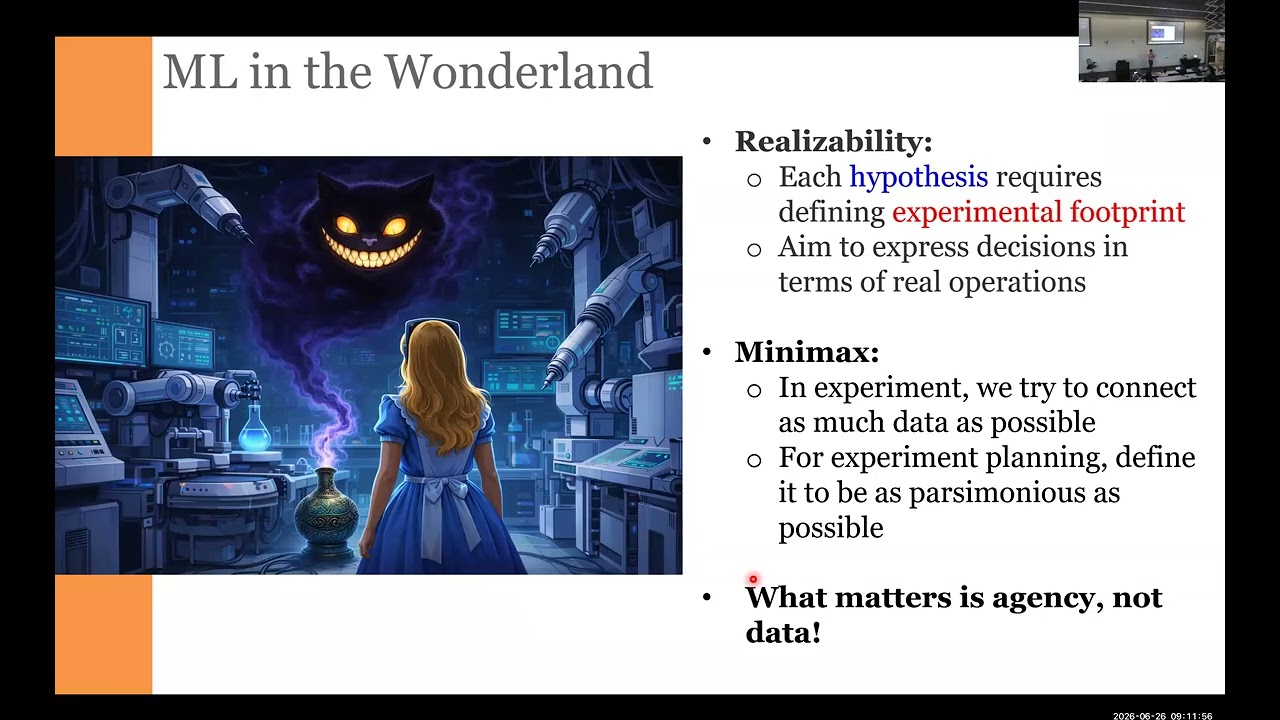
- Discussion on the importance of defining state variables, rewards, and values over algorithms.
- Explanation of the two axes: decision-making (human vs AI) and execution (human vs automated).
- Introduction to key concepts: objective, reward, value, action, state, policy.
- Examples of fixed-policy experiments in microscopy.
- Discussion on probabilistic thinking, priors, and beliefs; data does not speak for itself.
- Conclusion and preview of next lecture on deep kernel learning.
Contribution & Novelties
The lecture provides a clear and practical framework for thinking about decision-making in automated experimentation, emphasizing the often-overlooked aspect of problem formulation. It bridges the gap between machine learning theory and experimental practice, offering insights that are not typically found in textbooks. The discussion on reward engineering and the distinction between objective and reward is particularly valuable.
Pour aller plus loin :
- Bayesian optimization — A key framework mentioned for optimizing experiments.
- Reinforcement learning — A broader framework for sequential decision-making.
- Multi-armed bandit — A simple decision-making model discussed in the lecture.
- Gaussian process — The underlying model for Bayesian optimization.
- Active learning — Related to the idea of choosing experiments to learn efficiently.
114 words
Radar Profile
The radar profile shows high scores in information quantity, quality, and technical level, with a slightly lower but still high score in reliability. This indicates a content-rich and technically sound lecture, though the lack of formal citations slightly reduces the reliability score.