Day 1 - Welcome And Introduction
Keywords
Summary
163 words
Critical Evaluation
Value of the Information & Strength of the Argument
The video provides valuable insights into the intersection of machine learning and electron microscopy, a niche but rapidly evolving field. The speaker’s argumentation is coherent and well-supported by historical context and practical examples. He effectively makes the case for the necessity of ML in handling the data deluge and accelerating scientific discovery. The emphasis on the unique opportunity for ML agents to directly control instruments, as opposed to merely analyzing data, is a compelling and forward-looking perspective. The argument that physics is the best ML and that ML should fill gaps is a nuanced and pragmatic stance. The presentation is persuasive, though it remains at a conceptual level, lacking detailed technical depth.
Scientific Rigor, Source Quality, Title Accuracy
The speaker demonstrates scientific rigor by referencing historical developments and specific examples, such as the evolution of aberration correction and the potential for atom-by-atom manipulation. He mentions recent papers from Google and Future House, but does not provide specific citations. The title accurately reflects the content, as it is indeed a welcome and introduction. The video is a lecture, not a peer-reviewed source, but the speaker’s expertise and the context of a summer school lend credibility. No external sources are cited in the description, so the evaluation relies on the speaker’s authority and the internal consistency of the content.
226 words
Title / Content Match
The title accurately reflects the content: a welcome and introduction to the summer school, outlining objectives, structure, and key concepts.
Quality & Reliability
8/10
The video is an introductory lecture by an experienced researcher (20 years in the field) and co-organizer, presenting the goals and structure of a summer school on machine learning for electron microscopy. It includes historical context, current challenges, and a clear vision. The content is credible and well-structured, though it is a presentation of ideas rather than a detailed technical exposition.
Key Moments
Markers derived by PSI from the transcript: the creator did not define chapters.
- Welcome and introduction to the summer school, mention of participants worldwide.
- Historical context: from astronomical observations to modern microscopy.
- Development of aberration-corrected electron microscopy and its capabilities.
- Challenge of large data volumes and the need for machine learning.
- Three levels of ML use: post-acquisition, real-time analytics, and direct control.
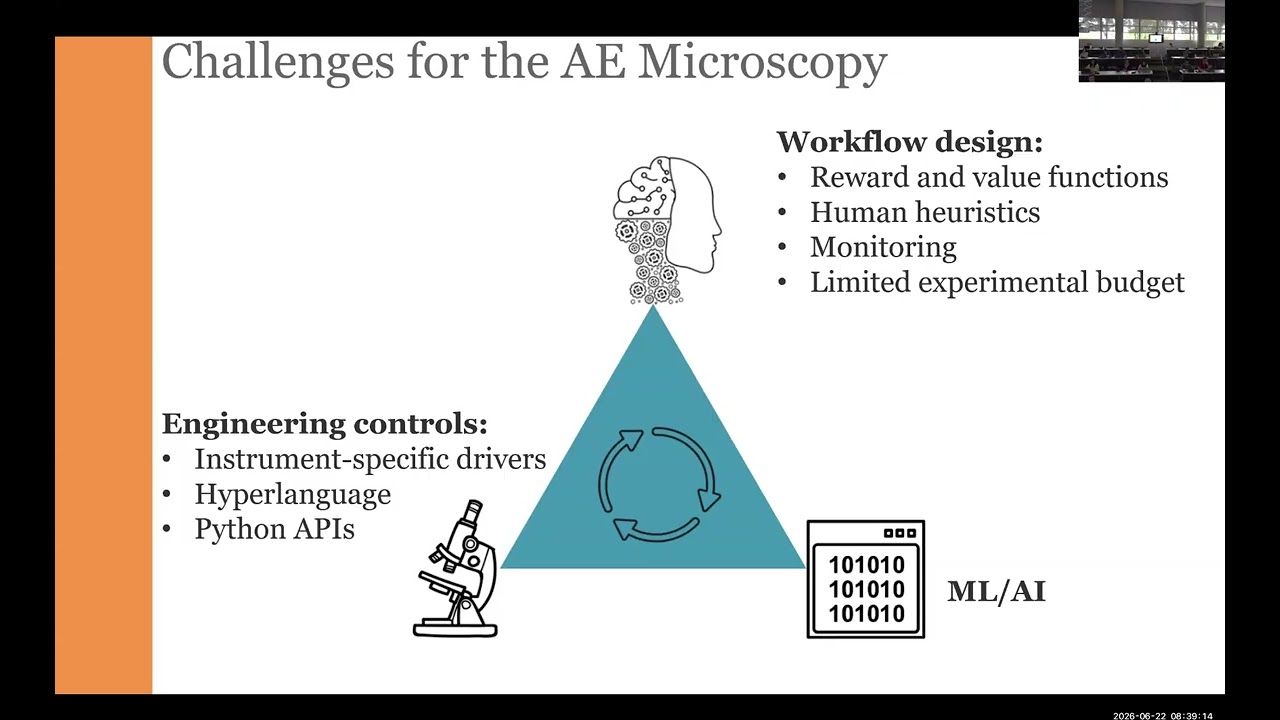
- Importance of APIs and orchestrators for connecting ML to instruments.
- Optimal planning and the goal of minimizing data acquisition.
- Integration of multiple tools and cloud computing in microscopy.
- Examples of operational systems: remote operation and real-time analysis.
- School structure: lectures, demos, and hackathons; principles of ML in physical sciences.
Contribution & Novelties
The video provides a clear vision for integrating machine learning into electron microscopy, emphasizing the shift from post-acquisition analysis to real-time control. It introduces the concept of ‘optimal planning’ as a distinct ML paradigm, contrasting with the big-data approach. The speaker’s four principles offer a pragmatic framework for researchers. The mention of recent papers from Google and Future House indicates the cutting-edge nature of the field.
Pour aller plus loin :
- Machine learning for electron microscopy — General overview of ML concepts.
- Aberration-corrected electron microscopy — Background on the technology discussed.
- Application programming interface — Explanation of APIs, key to connecting ML to instruments.
104 words
Radar Profile
The radar profile shows high scores in quality and reliability, with moderate scores in quantity and technical level. This reflects a well-structured introductory lecture that is credible but not deeply technical, suitable for a broad audience.