Day 1 - Introduction to Neural Networks for Images - Heon
Keywords
Summary
122 words
Critical Evaluation
Value of the Information & Strength of the Argument
The lecture provides a solid conceptual foundation for understanding neural networks, particularly for image processing. The speaker uses clear analogies (e.g., walking downhill for gradient descent) and visual examples (e.g., filters detecting patterns) to explain complex ideas. The argumentation is logical and progressive, building from simple to complex concepts. However, the presentation is introductory and does not delve into mathematical derivations or advanced topics, which limits its depth. The speaker also mentions practical tips like data augmentation and framework choices, adding practical value.
Scientific Rigor, Source Quality, Title Accuracy
The lecture is scientifically accurate in its explanations, though it does not cite specific sources or references. The speaker relies on established knowledge in the field, and the content aligns with standard textbooks and courses on neural networks. The title accurately reflects the content, as it is indeed an introduction to neural networks for images. The lack of explicit citations is a minor weakness, but the information is reliable and consistent with mainstream deep learning education.
174 words
Title / Content Match
The title accurately reflects the content: a foundational introduction to neural networks for image processing.
Quality & Reliability
7/10
The lecture provides a clear and accurate overview of neural networks, from basic neurons to CNNs, with correct explanations of key concepts like activation functions, loss functions, and gradient descent. The content is technically sound but lacks depth in mathematical derivations and does not cite specific sources. The speaker demonstrates good pedagogical clarity, but the presentation is introductory and fast-paced.
Key Moments
Markers derived by PSI from the transcript: the creator did not define chapters.
- Introduction and overview of the lecture
- Supervised vs. unsupervised learning, classification vs. regression
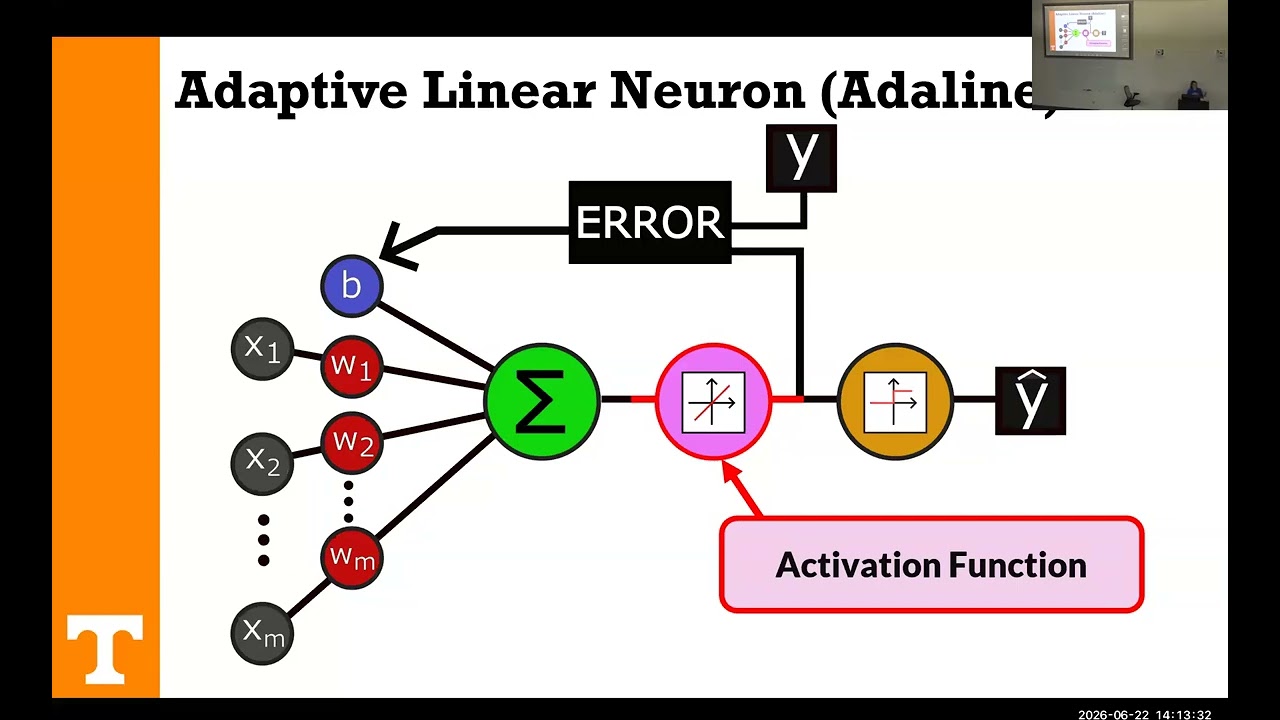
- Binary linear neuron and its limitations
- Activation functions and their role in introducing nonlinearity
- Loss functions and gradient descent for training
- Fully connected networks and backpropagation
- Introduction to convolutional neural networks and their architecture
- Practical implementation with TensorFlow and PyTorch
Contribution & Novelties
The lecture offers a clear and concise introduction to neural networks for image processing, making complex concepts accessible to beginners. It bridges the gap between theory and practice by discussing frameworks like TensorFlow and PyTorch. The speaker’s teaching style is engaging, with practical examples and analogies.
Pour aller plus loin :
- Convolutional neural network — Wikipedia article providing a comprehensive overview of CNNs.
- Gradient descent — Wikipedia article explaining the optimization algorithm used in training.
- Backpropagation — Wikipedia article detailing the algorithm for updating weights in neural networks.
88 words
Radar Profile
The radar profile shows a balanced performance across all dimensions, with slightly higher scores in quality of information and technical level, indicating a solid educational resource. The lower score in quantity of information reflects the introductory nature of the lecture, which covers a broad range of topics but at a surface level.