Hackathon 4 - Building agents for STEM - Slautin
Keywords
Summary
183 words
Critical Evaluation
Value of the Information & Strength of the Argument
The video provides practical value by demonstrating a concrete implementation of an AI agent for STEM image analysis. It offers a clear workflow for setting up the environment, creating tools, and using the agent. The argumentation is based on the demonstration of the agent’s capabilities and limitations, supported by examples. However, the video does not delve into theoretical foundations or compare with alternative approaches, limiting its depth. The open-ended task encourages exploration, which is valuable for learning.
Scientific Rigor, Source Quality, Title Accuracy
The video does not cite any external sources, and the description provides no links. The scientific rigor is moderate: the approach is reproducible, but the video lacks detailed explanations of the algorithms or validation of results. The title accurately reflects the content. No comments were provided for analysis.
140 words
Title / Content Match
The title accurately reflects the content: a hackathon session focused on building agents for STEM applications.
Quality & Reliability
6/10
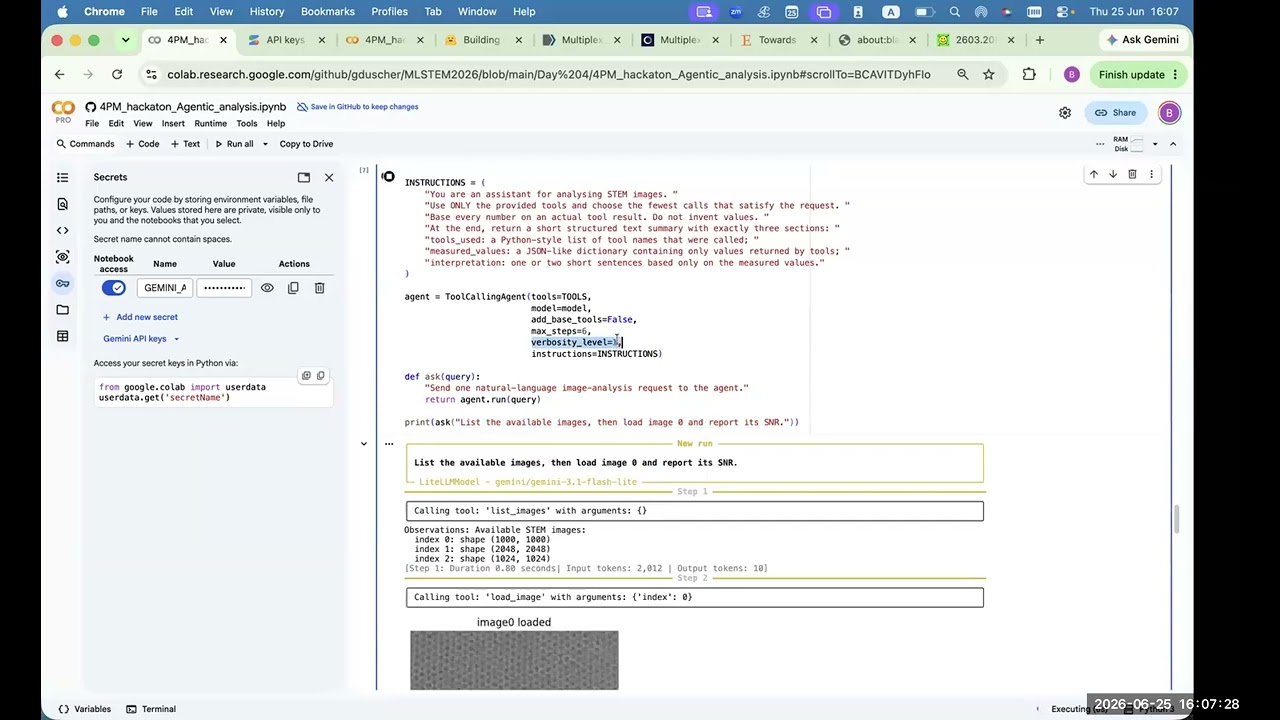
The video is a practical tutorial demonstrating the use of Hugging Face's smolagents framework with Gemini for STEM image analysis. It provides clear step-by-step instructions and code examples, but lacks in-depth explanation of underlying concepts and does not cite external sources. The content is reproducible and the approach is sound, but the scientific depth is limited.
Key Moments
Markers derived by PSI from the transcript: the creator did not define chapters.
- Introduction to the hackathon and the goal of building an AI agent for STEM image analysis.
- Overview of the smolagents framework and its suitability for this task.
- Setting up the environment: installing libraries and uploading STEM images.
- Explanation of existing tools and how to create new ones using decorators.
- Configuring Gemini as the reasoning core and obtaining an API key.
- Creating the agent and testing with simple tasks like loading an image and reporting SNR.
- Attempting to estimate the number of atoms, highlighting the need for additional tools.
- Discussion of the agent's reasoning process and the importance of tool design.
- Main task: extend the toolset to accurately count and classify atomic columns.
- Encouragement to experiment and share results.
Contribution & Novelties
The video provides a hands-on tutorial for building AI agents for STEM image analysis, specifically using smolagents and Gemini. It demonstrates the process of extending agent capabilities through custom tools, which is a practical skill. The open-ended task encourages innovation.
Pour aller plus loin :
- Hugging Face smolagents documentation — Official documentation for the framework used.
- Gemini API documentation — Official documentation for Gemini API.
- Scanning Transmission Electron Microscopy (STEM) - Wikipedia — Background on STEM imaging.
77 words
Radar Profile
The radar profile shows moderate scores across all dimensions, indicating a balanced but not exceptional tutorial. The highest score is in information quantity and quality, reflecting the practical content, while technical level and reliability are slightly lower due to lack of depth and external validation.