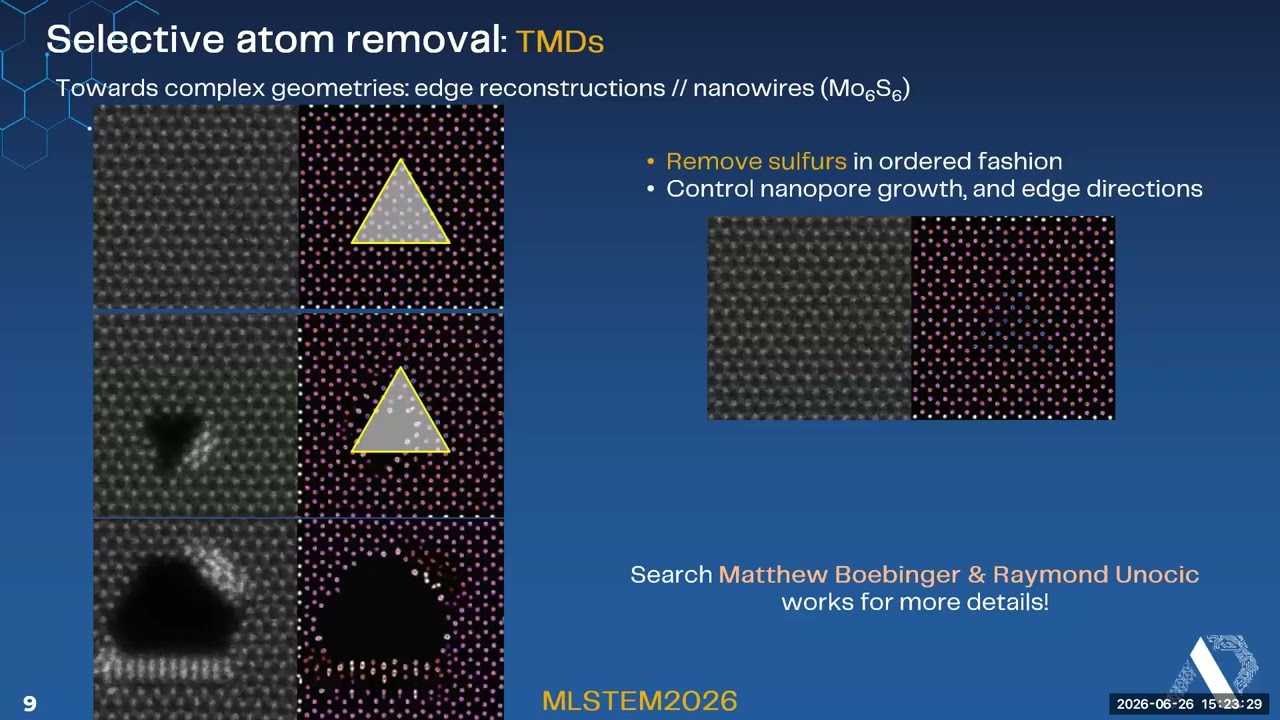
Day 5 - Atomic Fabrication with STEM (guest lecture) - Roccapriore
Keywords
Summary
139 words
Critical Evaluation
Value of the Information & Strength of the Argument
The talk provides valuable insights into the state-of-the-art and challenges of atomic fabrication using STEM. The speaker’s firsthand experience lends credibility, and he presents concrete examples of automated manipulation and the importance of data-driven approaches. The argumentation is logical, progressing from motivations to technical details to future prospects. However, some claims are made without rigorous evidence, and the talk is more of an expert opinion than a systematic review. The discussion of machine learning applications is particularly valuable, highlighting the potential of small data and domain-specific models.
Scientific Rigor, Source Quality, Title Accuracy
The talk is based on the speaker’s own research and experience, but specific sources are not explicitly cited. The description mentions no external links. The title accurately reflects the content. The speaker references work by other groups (e.g., Oak Ridge, Vienna) but does not provide specific citations. The lack of formal references reduces the scientific rigor, but the speaker’s expertise and the technical detail compensate somewhat. The title is appropriate and not misleading.
175 words
Title / Content Match
The title accurately reflects the content: a guest lecture on atomic fabrication using STEM, delivered by Kevin Roccapriore.
Quality & Reliability
7/10
The speaker is a domain expert (founder/CEO of AtomQ, former staff at Oak Ridge National Laboratory) and presents technical details of atomic manipulation using STEM, including specific examples and challenges. However, the talk is largely a personal account and vision, with limited formal citations or peer-reviewed references, and some claims are presented without detailed evidence.
Key Moments
Markers derived by PSI from the transcript: the creator did not define chapters.
- Introduction: Kevin Roccapriore introduces himself and the topic of deterministic atomic manufacturing using STEM.
- Motivations: Discusses why atomic manipulation is important for quantum computing and semiconductor industries.
- Historical background: Reviews early experiments in atomic manipulation with electron beams.
- Data-driven approach: Explains how machine learning and data collection can improve beam placement and manipulation.
- Challenges: Discusses issues like beam-induced distortions, precision requirements, and contamination.
- Custom controller: Describes building a custom scan controller to achieve better precision.
- Future outlook: Concludes with the commercial potential and remaining challenges.
Contribution & Novelties
The talk provides a unique perspective on the commercialization of atomic fabrication, emphasizing the transition from manual to automated, data-driven methods. It highlights the importance of precise beam positioning and the use of machine learning for real-time decision-making. The speaker’s experience in founding a startup based on this technology adds practical insights not commonly found in academic presentations.
Pour aller plus loin :
- Scanning transmission electron microscopy — Provides background on STEM techniques.
- Atomic manipulation — Overview of atomic-scale manipulation methods.
- Machine learning in materials science — Discusses applications of ML in materials research.
94 words
Radar Profile
The radar profile shows high scores in technical level and information quality, reflecting the expert-level content and detailed explanations. The lower score in information quantity suggests the talk is focused rather than broad. Overall, the talk is technically strong but could benefit from more explicit sourcing.