Day 3 - Introduction to Spectroscopy - Duscher
Keywords
Summary
157 words
Critical Evaluation
Value of the Information & Strength of the Argument
The lecture provides valuable practical knowledge for researchers and students in electron microscopy, bridging theory and hands-on data analysis. The instructor explains complex concepts clearly, using analogies and real-world examples. The argumentation is solid, grounded in established physics and practical experience. He also addresses common pitfalls in quantification, such as background subtraction and cross-section selection, and offers solutions based on his own research.
Scientific Rigor, Source Quality, Title Accuracy
The scientific rigor is high, with references to standard theories and practices in EELS and EDS. The instructor mentions specific sources, such as the NIST cross-sections and the work of the Nellist group, and discusses the limitations of current methods. The title accurately reflects the content, which is an introductory lecture on spectroscopy. The lecture is well-structured and provides a comprehensive overview of the topic.
143 words
Title / Content Match
The title accurately reflects the content, which is an introductory lecture on spectroscopy for electron microscopy.
Quality & Reliability
8/10
The lecture is given by an expert in the field, with detailed technical explanations and references to established scientific concepts. The content is consistent with current knowledge in electron microscopy and spectroscopy.
Key Moments
Markers derived by PSI from the transcript: the creator did not define chapters.
- Introduction and setup of Google Colab environment with PyTEMlib.
- Overview of electron interactions: elastic, inelastic, phonons, and energy loss.
- Explanation of time-dependent processes in inelastic scattering and the ground state assumption.
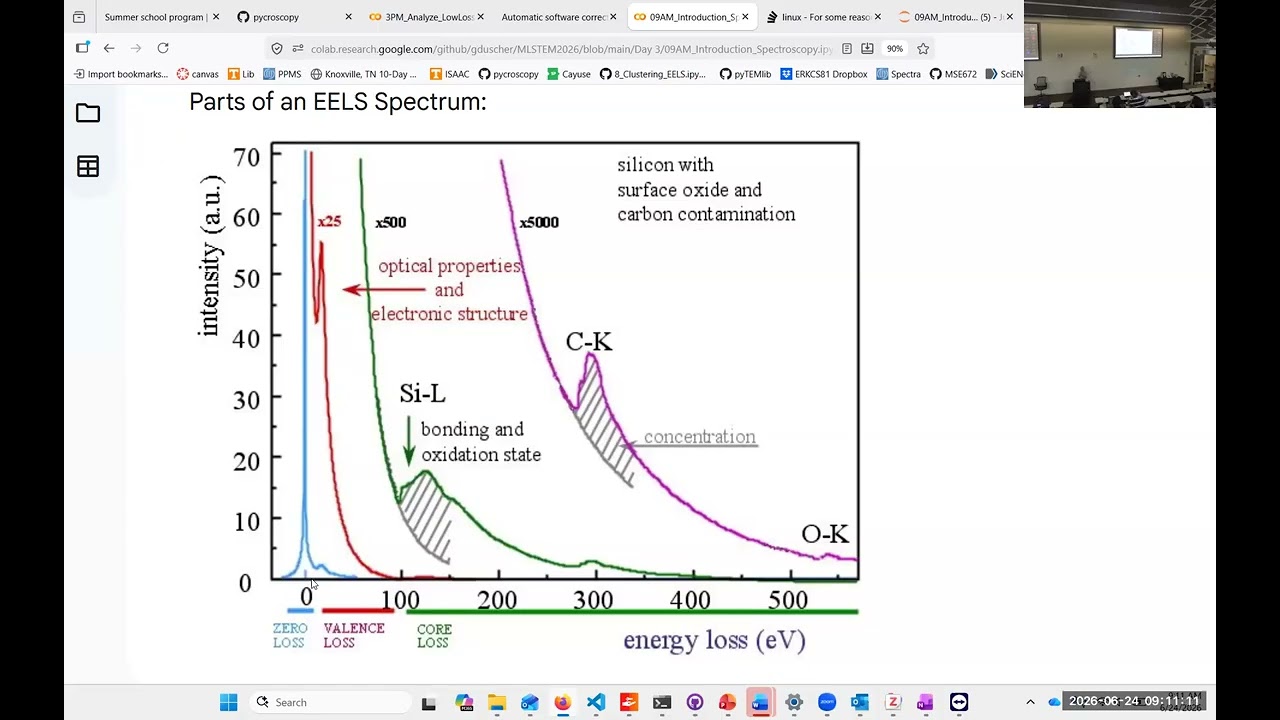
- Discussion of energy loss regions: zero-loss, low-loss, and core-loss, and their applications.
- Explanation of monochromators and aberration correctors, and their roles in energy and spatial resolution.
- Introduction to the dielectric function and its relation to the low-loss spectrum.
- Discussion of core-loss spectroscopy and the use of cross-sections for quantification.
- Explanation of the model-based analysis approach for EELS quantification.
- Introduction to EDS and the competing processes of X-ray emission and Auger electrons.
- Practical demonstration of fitting cross-sections to determine atomic density and thickness.
Cited Sources
- PyTEMlib — Library used for analysis in the lecture.
- NIST cross-sections — Cross-sections used for EELS quantification.
Concurring Sources
- Electron Energy Loss Spectroscopy — General reference for EELS.
Contribution & Novelties
The lecture provides a practical, hands-on approach to EELS and EDS analysis using Python, which is valuable for researchers. It emphasizes the importance of accurate cross-sections and model-based fitting for reliable quantification. The instructor shares his experience and insights, making the content accessible yet rigorous.
Pour aller plus loin :
- Electron energy loss spectroscopy — Overview of EELS principles and applications.
- Energy-dispersive X-ray spectroscopy — Basics of EDS and its use in elemental analysis.
- Dielectric function — Theoretical background for interpreting low-loss spectra.
83 words
Radar Profile
The radar profile shows high scores across all dimensions, indicating a well-balanced and comprehensive lecture. The high technical level and information quality are particularly notable, making it suitable for an audience with some background in physics or materials science.
💬 Sur les 0 commentaires analysés, aucune tendance n'est disponible.