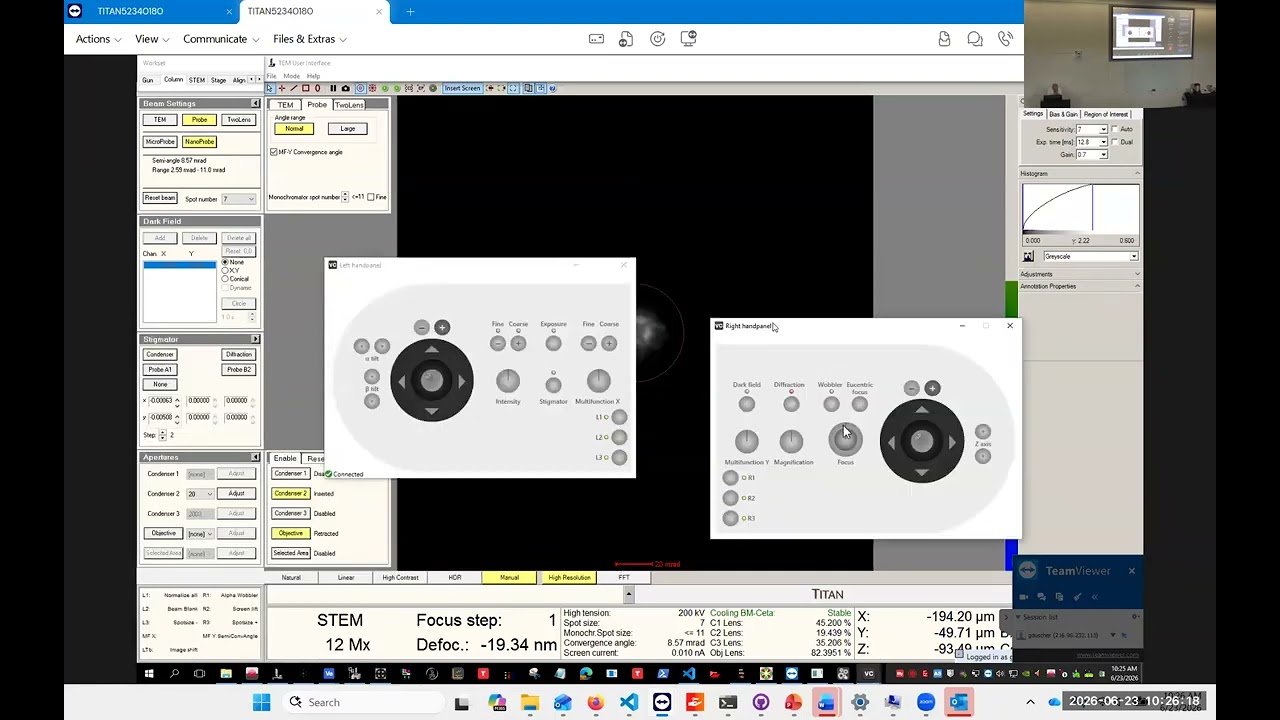
Day 2 - Remote Diffraction Acquisition in STEM - Duscher
Keywords
Summary
132 words
Critical Evaluation
Value of the Information & Strength of the Argument
The video provides valuable practical insights into the operation of a STEM for CBED acquisition, including real-time troubleshooting and adjustments. The argumentation is based on direct observation and experience, with clear explanations of the phenomena observed. The presenter demonstrates a deep understanding of the physics involved, such as excitation errors and the effects of convergence angle on diffraction patterns. The value lies in the authentic, hands-on demonstration that bridges theory and practice, though the informal style and occasional technical issues may reduce the clarity for less experienced viewers.
Scientific Rigor, Source Quality, Title Accuracy
The scientific rigor is high, as the presenter is an expert and the demonstration is based on established principles of electron microscopy. However, no external sources are cited in the video or description, so the quality of sources cannot be assessed. The title accurately reflects the content, which is a remote diffraction acquisition session. The video is a tutorial/demonstration, and the lack of formal citations is typical for such content, but it limits the ability to verify claims independently.
182 words
Title / Content Match
The title accurately describes the content: a remote diffraction acquisition session in STEM, led by Duscher.
Quality & Reliability
7/10
The video is a live demonstration by an expert operator, showing real-time adjustments and troubleshooting. The scientific content is accurate and well-explained, but the informal and spontaneous nature, with some technical glitches, slightly reduces the overall reliability.
Key Moments
Markers derived by PSI from the transcript: the creator did not define chapters.
- Introduction and overview of the session: acquiring CBED patterns remotely.
- Opening the column valve and initial camera setup; encountering a bug.
- Acquiring first diffraction pattern and observing a hole in the sample.
- Moving to a thicker region of the FIB sample and zooming out.
- Tilting the sample to align with the zone axis; observing Kikuchi lines.
- Scanning in a small area to improve pattern clarity; observing four-fold symmetry.
- Discussion of the HAADF detector and its effect on the diffraction pattern.
- Adjusting the convergence angle to make the diffraction discs just touch.
- Detailed observation of excitation errors and their dependence on sample thickness.
- Attempting to align the beam using aperture shifts and diffraction shift.
Contribution & Novelties
This video provides a unique, real-time demonstration of remote CBED acquisition, highlighting practical challenges and solutions. It offers valuable insights into the alignment process and the interpretation of diffraction patterns, which is not commonly found in formal literature.
Pour aller plus loin :
- Convergent beam electron diffraction - Wikipedia — Provides a theoretical background on CBED.
- 4D STEM - Wikipedia — Overview of 4D STEM techniques.
- Scanning transmission electron microscopy - Wikipedia — General principles of STEM.
77 words
Radar Profile
The radar profile shows high scores in technical level and information quantity, indicating a dense, expert-level tutorial. The lower scores in reliability and quality reflect the informal, unedited nature of the live demonstration, which may include errors or unclear explanations.