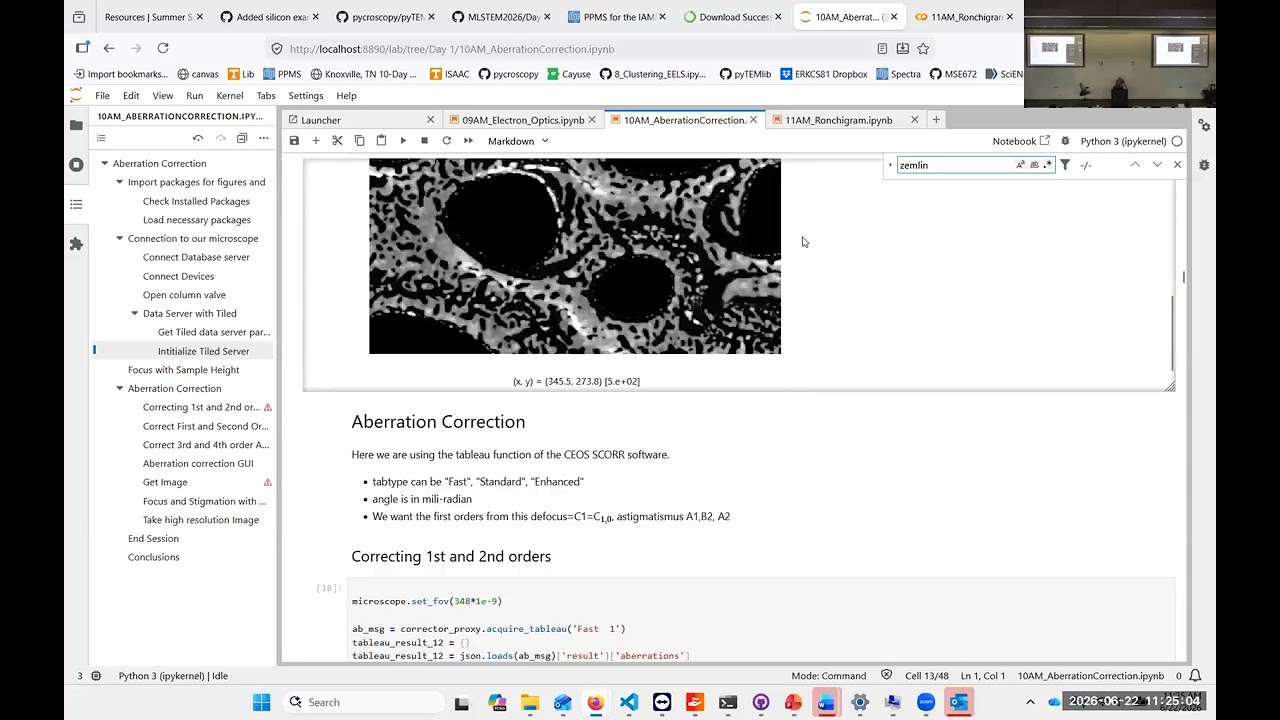
Day 1 - Simulation of Ronchigrams - Duscher
Keywords
Summary
181 words
Critical Evaluation
Value of the Information & Strength of the Argument
The lecture provides valuable insights into the practical use of Ronchigrams in STEM, bridging theoretical concepts with hands-on simulation. The presenter effectively demonstrates the counter-intuitive relationship between aperture size and probe size, and how aberrations manifest in the Ronchigram. The argumentation is solid, grounded in well-established physics of electron microscopy. The use of Python simulations enhances understanding and allows viewers to experiment themselves. The lecture is particularly valuable for its practical tips on microscope alignment and monitoring system stability via the Ronchigram. However, the informal delivery and occasional technical interruptions may detract from the clarity for some viewers.
Scientific Rigor, Source Quality, Title Accuracy
The scientific rigor is high, as the content is based on established principles of aberration theory and electron optics. The presenter references the work of Samlin (likely a typo for ‘Sawyer’ or ‘Sawyer’?) and recommends a book by Ross Ernie on aberration-corrected imaging. However, no specific citations are given in the video, and the sources are mentioned only in passing. The title accurately reflects the content, which is a simulation of Ronchigrams. The lecture is part of a summer school, so the target audience is likely graduate students or researchers, but the content is presented at a high technical level.
213 words
Title / Content Match
The title accurately reflects the content, which is a simulation of Ronchigrams as part of a summer school on machine learning in the nanoworld.
Quality & Reliability
8/10
The lecture is a technical tutorial by an expert in the field, based on established principles of electron microscopy and aberration theory. The content is consistent with known physics, and the presenter demonstrates hands-on simulation using Python. However, the video is a live lecture with informal delivery and some technical interruptions, and no formal citations are provided in the video itself.
Key Moments
Markers derived by PSI from the transcript: the creator did not define chapters.
- Introduction to the counter-intuitive relationship between aperture size and probe dimensions.
- Demonstration of aperture size effect on probe intensity and tails using simulations.
- Explanation of the diffraction limit and the role of aberration correction for contrast.
- Introduction to the aberration function and its calculation using the Samlin tableau.
- Visualization of aberrations in Ronchigrams: astigmatism and three-fold astigmatism.
- Discussion on the face plate and the importance of choosing the correct aperture size.
- Explanation of the Hessian matrix and its relation to magnification in defocused Ronchigrams.
- Demonstration of infinite magnification rings and their relation to aberrations.
- Use of polar coordinates to distinguish radial and axial infinite magnification.
- Calculation of probe shape from Ronchigram and aperture using inverse Fourier transform.
Cited Sources
- Aberration-Corrected Imaging in Transmission Electron Microscopy (book) — Recommended by the presenter for understanding the Samlin tableau and aberration correction.
Concurring Sources
- Aberration-Corrected Imaging in Transmission Electron Microscopy (book) — Recommended by the presenter for understanding the Samlin tableau and aberration correction.
Contribution & Novelties
The lecture provides a practical, hands-on approach to simulating Ronchigrams and understanding their role in STEM probe formation. It emphasizes the counter-intuitive relationship between aperture size and probe dimensions, and demonstrates how aberrations manifest visually. The use of Python simulations in Google Colab makes the concepts accessible and reproducible. The discussion on using the Ronchigram to monitor microscope stability and the potential for machine learning to automate alignment is forward-looking.
Pour aller plus loin :
- Scanning transmission electron microscopy — Overview of STEM and its principles.
- Aberration-corrected transmission electron microscopy — Details on aberration correction and its impact.
- Ronchigram — Explanation of the Ronchigram and its applications.
107 words
Radar Profile
The radar profile shows high scores in technical level and information quality, indicating a dense, expert-level tutorial. The lower score in quantity of information relative to the others suggests the lecture is focused and not overly broad. Overall, the profile reflects a highly specialized and reliable educational resource.
💬 No comments were provided for analysis.