Day 5 - Reward Functions for Decision Making - Kalinin
Keywords
Summary
160 words
Critical Evaluation
Value of the Information & Strength of the Argument
The lecture provides valuable insights into the practical application of Bayesian optimization, emphasizing the critical role of reward function design. The speaker argues convincingly that defining the right reward function is the most challenging and important part of the process, while the optimization machinery itself is well-established. He supports this with examples from microscopy and chemistry, and discusses the historical development of the field, including the shift from specialized expertise to accessible tools. The argumentation is solid, grounded in both theoretical understanding and practical experience, and the speaker’s authority in the field lends credibility to the claims.
Scientific Rigor, Source Quality, Title Accuracy
The lecture demonstrates scientific rigor by clearly explaining the mathematical foundations of Gaussian processes and Bayesian optimization, and by referencing key works such as the paper by Nando de Freitas on ‘Taking the human out of the loop’ (2015). The speaker also mentions the book ‘The Structure of Scientific Revolutions’ by Thomas Kuhn, providing a philosophical context. The title accurately reflects the content, focusing on reward functions and decision making. The lecture is well-structured and the sources cited are appropriate, though it is a lecture rather than a peer-reviewed publication.
202 words
Title / Content Match
The title accurately reflects the content, focusing on reward functions and decision making, with a deep dive into Gaussian processes and Bayesian optimization.
Quality & Reliability
8/10
The lecture is given by an expert in the field, Sergei Kalinin, and presents established concepts in Bayesian optimization and Gaussian processes with clear explanations and practical examples. The content is scientifically sound, though it is a lecture rather than a peer-reviewed source.
Key Moments
Markers derived by PSI from the transcript: the creator did not define chapters.
- Introduction to the lecture topic: Gaussian processes and Bayesian optimization.
- Contrast between bandit problems and continuous optimization in microscopy.
- Explanation of myopic vs non-myopic decision making.
- Importance of defining a scalar reward function from high-dimensional data.
- Introduction to Bayesian optimization and its relation to Gaussian processes.
- Discussion on the history of Gaussian processes and the role of kernels.
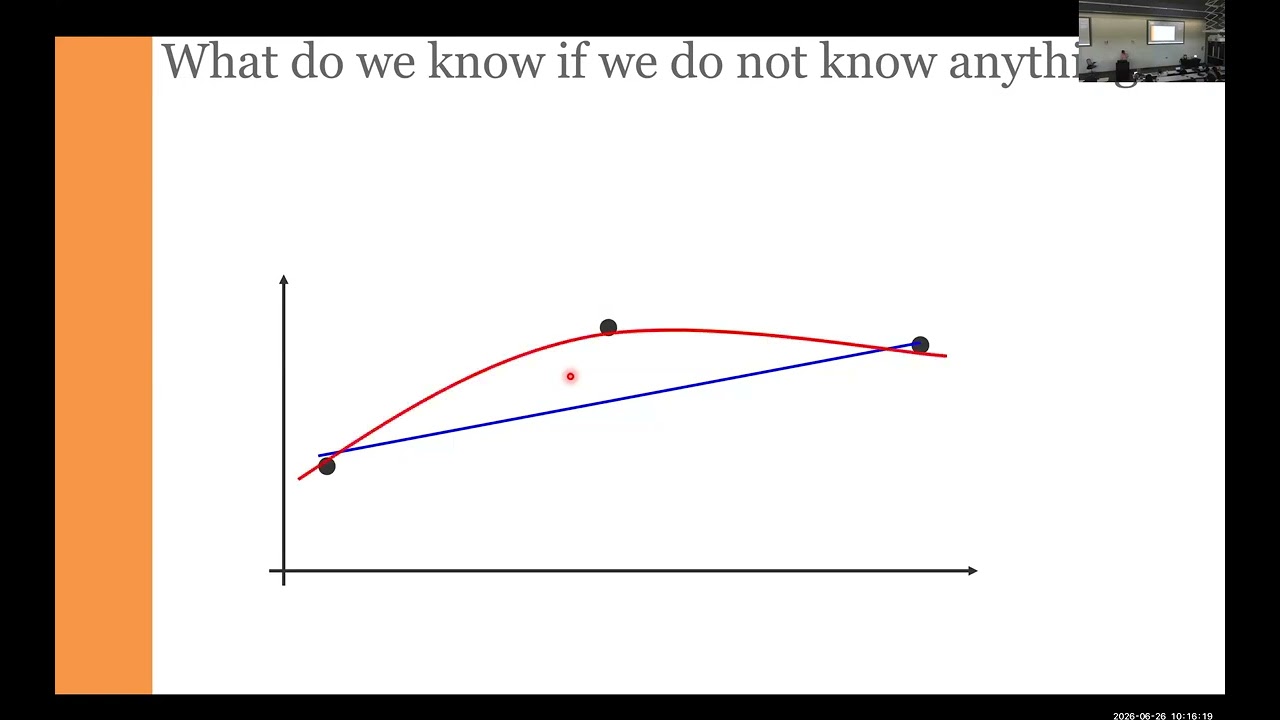
- Illustration of how Gaussian processes provide predictions and uncertainties.
- Explanation of acquisition functions and the balance between exploration and exploitation.
- Step-by-step outline of the Bayesian optimization loop.
- Conclusion and remarks on the accessibility of Bayesian optimization tools.
Cited Sources
- Taking the human out of the loop: A review of Bayesian optimization — Referenced as a famous paper in Bayesian optimization.
- The Structure of Scientific Revolutions — Mentioned in the context of scientific paradigm shifts.
Concurring Sources
- Taking the human out of the loop: A review of Bayesian optimization — The paper is a seminal review that aligns with the lecture's content.
Contribution & Novelties
The lecture provides a clear and accessible explanation of Bayesian optimization and Gaussian processes, emphasizing the practical importance of reward function design. It bridges theory and application, offering insights from the speaker’s experience in automated experimentation. The discussion on the historical development of the field and the philosophical underpinnings of scientific belief adds depth.
Pour aller plus loin :
- Bayesian optimization — Overview of the method and its applications.
- Gaussian process — Mathematical foundation and examples.
- Acquisition function — Detailed explanation of different acquisition functions.
85 words
Radar Profile
The radar profile shows high scores in quality of information and technical level, indicating a technically rich and reliable lecture. The quantity of information is also high, but the overall score is slightly lower due to the lecture format and lack of peer review.