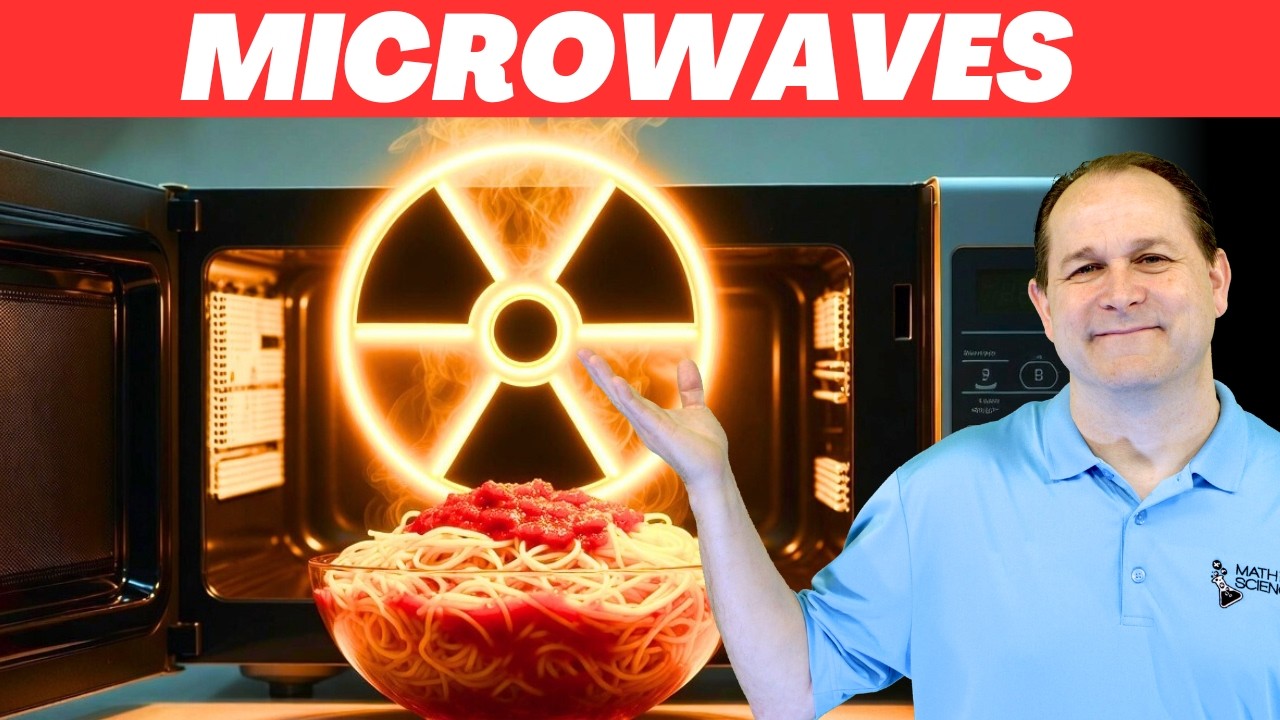
Are Microwaves Dangerous & How do they Work?
Keywords
Summary
121 words
Critical Evaluation
Value of the Information & Strength of the Argument
The video provides a high-value explanation of a common household appliance, demystifying the physics behind it. The argumentation is solid, building from fundamental concepts (electromagnetic waves, resonance) to the specific mechanism of dipole rotation. The use of analogies (swing, opera singer) effectively aids understanding. The presenter carefully distinguishes between ionizing and non-ionizing radiation, correctly stating that microwaves lack the photon energy to damage DNA. The historical anecdote adds interest but is presented without critical sourcing. Overall, the reasoning is clear, logical, and scientifically accurate.
Scientific Rigor, Source Quality, Title Accuracy
The scientific rigor is high: the physics of microwave heating is accurately described, and the presenter correctly emphasizes the role of water molecules and resonance. However, the video does not cite specific sources, relying on general scientific knowledge. The title accurately reflects the content, which addresses both the mechanism and safety. The video is well-structured and the explanations are precise. The lack of citations is a minor weakness, but the content aligns with established scientific consensus.
175 words
Title / Content Match
The title accurately reflects the content, which covers both the working principles and safety aspects of microwave ovens.
Quality & Reliability
8/10
The video provides a thorough and accurate explanation of microwave oven operation, grounded in established physics (electromagnetic spectrum, resonance, dipole rotation). The presenter uses clear analogies and avoids overstatement. However, the video lacks citations to primary sources, and the historical anecdote about Percy Spencer is presented without nuance. Overall, the scientific content is reliable and well-explained.
Key Moments
Markers derived by PSI from the transcript: the creator did not define chapters.
- Historical anecdote: Percy Spencer's discovery of microwave heating with a magnetron.
- Introduction to the electromagnetic spectrum and the wavelength of microwaves (12 cm).
- Explanation of electromagnetic waves and Maxwell's equations.
- Concept of resonance explained with pendulum and opera singer analogies.
- Detailed structure of water molecule: bent shape and polarity.
- How the oscillating electric field causes water molecules to rotate (dipole rotation).
- Additional molecular stretching and bending, and conversion to heat.
- Safety discussion: ionizing vs. non-ionizing radiation, photon energy.
- Why microwaves do not make food radioactive.
- Practical tips for even heating and myth-busting (e.g., exploding eggs).
Concurring Sources
- Microwave oven - Wikipedia — Confirms the operating frequency of 2.45 GHz and the mechanism of dielectric heating.
- Dielectric heating - Wikipedia — Supports the explanation of dipole rotation and molecular friction as the primary heating mechanism.
Contribution & Novelties
The video offers a clear and engaging explanation of microwave oven operation, making complex physics accessible. It effectively combines historical context, fundamental physics, and practical safety information. The emphasis on resonance and dipole rotation provides a solid understanding of the heating mechanism.
Pour aller plus loin :
- Microwave oven - Wikipedia — Overview of microwave oven history, components, and safety.
- Dielectric heating - Wikipedia — Detailed explanation of the physical principle behind microwave heating.
- Electromagnetic spectrum - Wikipedia — Context for where microwaves fit in the spectrum.
- Photon - Wikipedia — Explanation of photon energy and quantization, relevant to the safety discussion.
102 words
Radar Profile
The radar profile shows high scores across all dimensions, indicating a well-rounded and reliable educational video. The slight dip in 'niveau_technique' reflects the accessible approach, but the content remains scientifically accurate.
💬 Très positif. Sur les 30 commentaires analysés, les spectateurs expriment une admiration unanime pour la clarté des explications et la qualité pédagogique, certains mentionnant un impact durable sur leur compréhension.