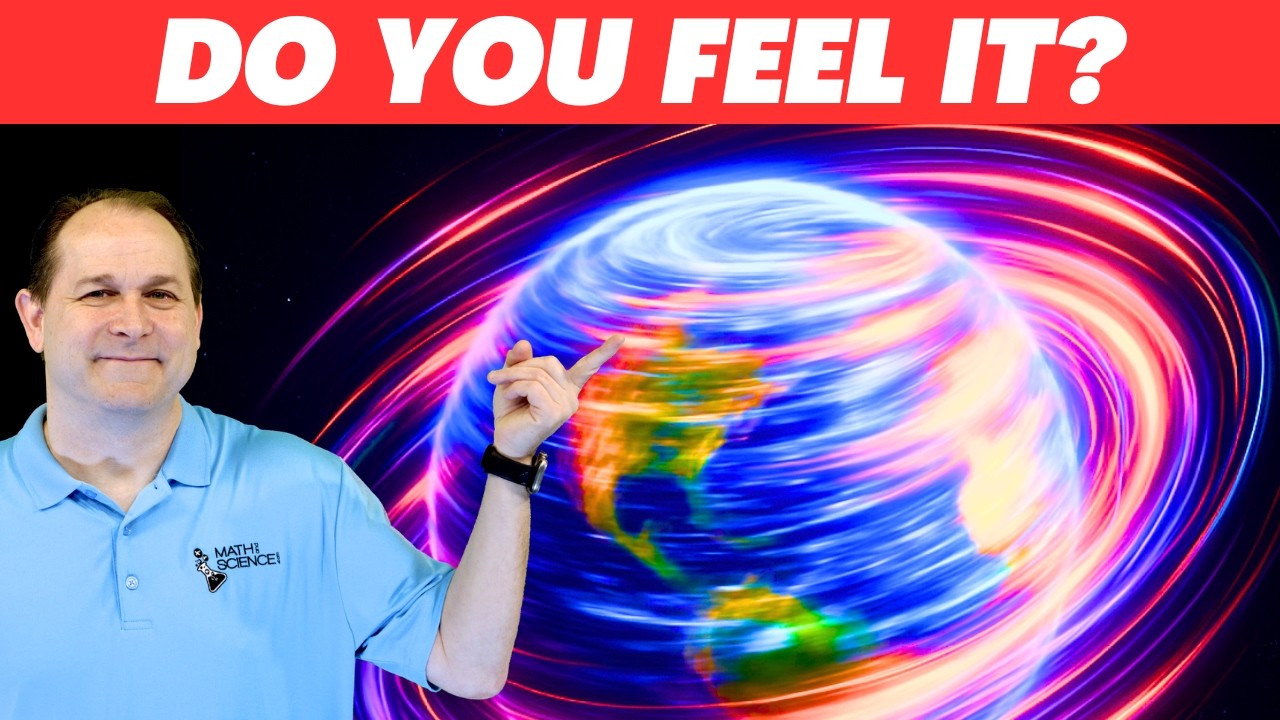
Why don't we FEEL the Earth Spinning @ 1,000 mph?
Keywords
Summary
178 words
Critical Evaluation
Value of the Information & Strength of the Argument
The video provides a clear and valuable explanation of a common physics question. It effectively uses analogies and visual props to illustrate abstract concepts like inertia and reference frames. The argumentation is logically structured, building from the observation of high speed to the explanation via Newton’s laws. It correctly distinguishes between velocity and acceleration, and explains why constant velocity is imperceptible. The discussion of centripetal force and gravity adds depth, addressing the circular motion aspect. The video successfully debunks the misconception that we should feel the Earth’s rotation, and it does so with scientific accuracy.
104 words
Title / Content Match
The title accurately reflects the content, which directly addresses why we don't feel Earth's rotation.
Quality & Reliability
8/10
The video provides a clear and accurate explanation of basic physics concepts (inertia, reference frames, acceleration) and correctly addresses common misconceptions. The reasoning is sound and aligns with established scientific principles. However, it lacks citations to specific sources and does not delve into advanced nuances, which slightly reduces the score.
Key Moments
Markers derived by PSI from the transcript: the creator did not define chapters.
- Introduction: Why don't we feel Earth's rotation despite moving at 1,000 mph?
- Explanation of tangential speed at the equator and poles.
- Introduction to Newton's first law of motion (inertia).
- Explanation of why constant velocity is imperceptible.
- Discussion of acceleration and why we feel forces only during acceleration.
- Thought experiment: spacecraft moving at constant velocity.
- Explanation of circular motion and centripetal force.
- What would happen if Earth stopped rotating or gravity disappeared.
- Conclusion and summary.
Contribution & Novelties
The video provides a clear and engaging explanation of a fundamental physics concept, making it accessible to a general audience. It effectively uses analogies and visual demonstrations to convey why we don’t feel Earth’s rotation. The explanation of inertia and reference frames is particularly well done. The video also addresses common misconceptions and provides a solid foundation for understanding Newton’s laws.
Pour aller plus loin :
- Newton’s laws of motion — Overview of the three laws, including the first law of inertia.
- Centripetal force — Explanation of the force that keeps objects moving in circular paths.
- Fictitious force — Discussion of forces perceived in rotating reference frames, such as centrifugal force.
111 words
Radar Profile
The radar profile shows a balanced performance across all dimensions, with slightly higher scores in quality and reliability, and lower in quantity and technical depth. This indicates a well-explained but not overly detailed video, suitable for a general audience.
💬 Très positif. Sur les 30 commentaires analysés, la grande majorité exprime une appréciation enthousiaste, saluant la clarté de l'explication et son caractère pédagogique, avec quelques remarques humoristiques sur la sensation de rotation après consommation d'alcool.