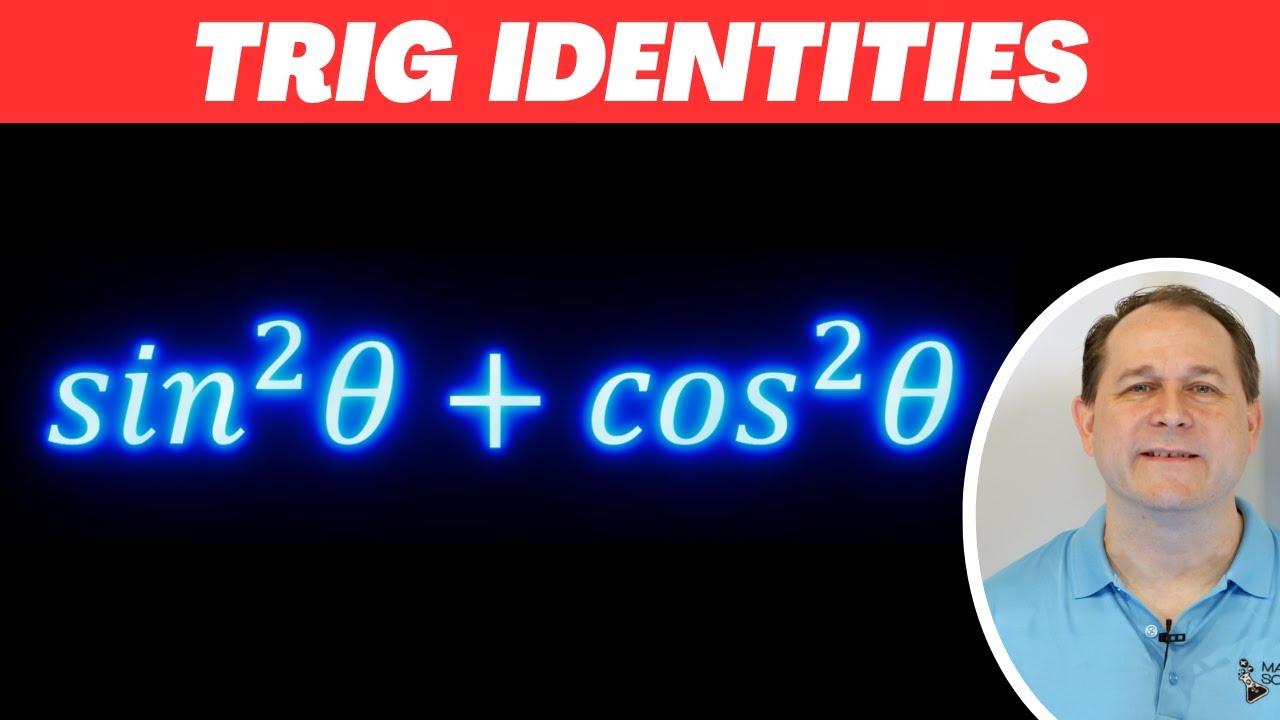
Trig Identities EXPLAINED: Definition, Proofs & Practice
Keywords
Summary
116 words
Critical Evaluation
Value of the Information & Strength of the Argument
The video provides substantial value by demystifying trigonometric identities through clear, step-by-step worked examples. The instructor’s argumentation is solid: he justifies each manipulation by referencing fundamental identities and algebraic rules, ensuring that every step is legal and logical. He emphasizes understanding over rote memorization, offering the ’trig rainbow’ as a mnemonic and encouraging students to take incremental steps rather than expecting to see the final answer immediately. The examples progress in complexity, building confidence and illustrating common patterns. The explanation of why certain substitutions work (e.g., replacing 1 with sin²+cos²) is particularly effective. The only minor weakness is that some identities are stated as previously proven without re-derivation, but this is acceptable for a practice-focused lesson.
Scientific Rigor, Source Quality, Title Accuracy
The scientific rigor is high: the mathematical content is accurate and the derivations are consistent with standard trigonometric principles. The instructor does not cite external sources, but this is typical for a tutorial video; the content is self-contained and relies on established mathematical knowledge. The title accurately reflects the content, which covers definitions, proofs (though some are referenced), and practice. The video’s structure is clear, with a logical progression from basic identities to more complex applications. No comments were provided for analysis, so no public reception trends can be assessed.
221 words
Title / Content Match
The title accurately reflects the content: the video explains trigonometric identities, their definitions, proofs (though some are referenced from previous lessons), and provides practice problems.
Quality & Reliability
8/10
The video is a clear, step-by-step tutorial on trigonometric identities, with logical derivations and practical examples. The instructor emphasizes understanding over memorization and provides multiple worked problems. The content is mathematically sound and aligns with standard textbook treatments. Minor limitations include a lack of formal proofs for all identities (some are stated as previously proven) and no external sources cited, but the pedagogical approach is solid.
Key Moments
Markers derived by PSI from the transcript: the creator did not define chapters.
- Introduction: overview of fundamental identities and the goal of using them in problem-solving.
- Review of reciprocal identities and the 'trig rainbow' mnemonic.
- Discussion of even-odd and cofunction identities, referencing previous proofs.
- Review of Pythagorean identities and their derivation from the unit circle.
- Problem 1: Simplify sin(θ)sec(θ) to tan(θ).
- Problem 2: Simplify tan(x)/sin(x) to sec(x).
- Problem 3: Simplify (1-sinθ)(1+sinθ) to cos²θ using FOIL and Pythagorean identity.
- Problem 4: Simplify cos(α)csc(α)tan(α) to 1.
- Problem 5: Rewrite sec(θ) in terms of only sin(θ) using Pythagorean identity.
- Conclusion: emphasis on practice and pattern recognition.
Contribution & Novelties
The video’s original contribution lies in its pedagogical approach: it demystifies trigonometric identities by emphasizing a systematic, step-by-step method for simplification, reinforced by a memorable mnemonic (’trig rainbow’). It does not introduce new mathematical results but offers a clear, practical guide for students. The focus on ’taking the first legal step’ and recognizing patterns is a valuable heuristic.
Pour aller plus loin :
- Trigonometric identities - Wikipedia — Comprehensive reference for all standard identities.
- Pythagorean theorem - Wikipedia — Foundational theorem used to derive Pythagorean identities.
- Unit circle - Wikipedia — Geometric basis for defining trigonometric functions and identities.
99 words
Radar Profile
The radar profile shows a balanced performance across all dimensions, with slightly lower scores in technical depth and source rigor, reflecting the tutorial's focus on practice rather than advanced theory or external references. The high scores in information quantity and quality indicate a comprehensive and clear presentation.