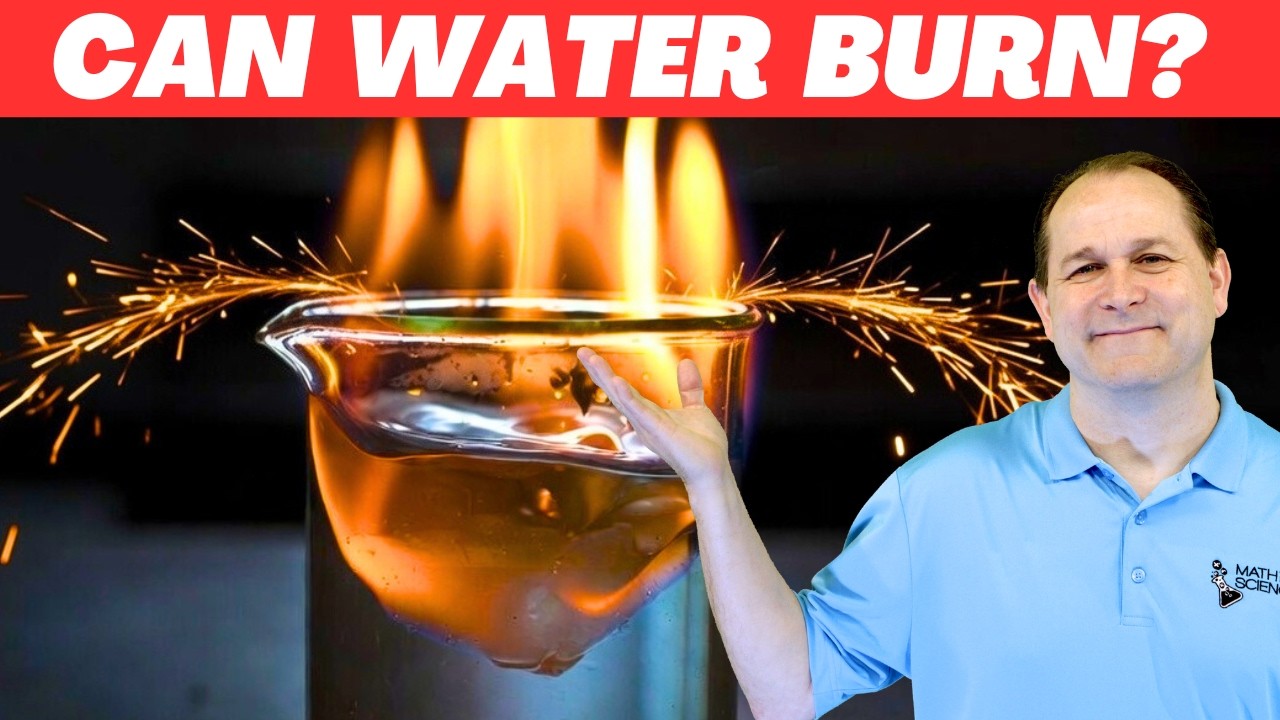
If Water Contains Hydrogen, Why Can't we Burn it?
Keywords
Summary
143 words
Critical Evaluation
Value of the Information & Strength of the Argument
The core explanation of water’s non-flammability is clear and scientifically accurate, using the concept of chemical stability and the exothermic nature of hydrogen combustion. The argument is logically presented and accessible. However, the video’s value is diminished by the inclusion of several unrelated segments that are not developed in depth. The argumentation for the main topic is solid, but the overall structure is disjointed, reducing the impact of the educational content.
Scientific Rigor, Source Quality, Title Accuracy
The video does not cite any external sources, relying on general scientific knowledge. The title is accurate for the main topic, but the content includes many tangents that are not reflected in the title. The scientific rigor is adequate for the main explanation, but the lack of citations and the superficial treatment of additional topics reduce the overall reliability. No comments were provided for analysis.
151 words
Title / Content Match
The title accurately reflects the main topic, which is addressed in the first part of the video, though the video later diverges into unrelated subjects.
Quality & Reliability
7/10
The video provides a scientifically accurate explanation of why water is non-flammable, using the example of the Space Shuttle main engines and the stability of the water molecule. The content is well-structured and accessible, but it lacks citations to primary sources and includes several unrelated tangents (simulation hypothesis, Jupiter, atomic orbitals, AM/FM radio) that dilute the focus.
Key Moments
Markers derived by PSI from the transcript: the creator did not define chapters.
- Introduction: question about burning water
- Explanation that water is already burned hydrogen
- Space shuttle example: hydrogen and oxygen combustion produces water
- Chemical reaction: 2H2 + O2 -> 2H2O, energy release
- Water molecule stability and lower energy state
- Transition to simulation hypothesis
- Jupiter's role in protecting Earth
- Atomic orbitals and quantum mechanics
- AM vs FM radio explanation
Contribution & Novelties
The video offers a clear and intuitive explanation of why water is non-flammable, using the concept of chemical stability and the example of the Space Shuttle. It effectively communicates the idea that water is the product of combustion and thus cannot be burned further. The main novelty is the pedagogical approach, but the video does not present new scientific information.
Pour aller plus loin :
- Combustion — Provides a general overview of combustion processes.
- Water (molecule) — Details the properties and stability of water.
- Chemical stability — Explains the concept of stability in chemical compounds.
95 words
Radar Profile
The radar profile shows moderate scores across all dimensions, with slightly higher quality and reliability scores compared to quantity and technical level. This indicates a scientifically accurate but not deeply detailed video, suitable for a general audience.