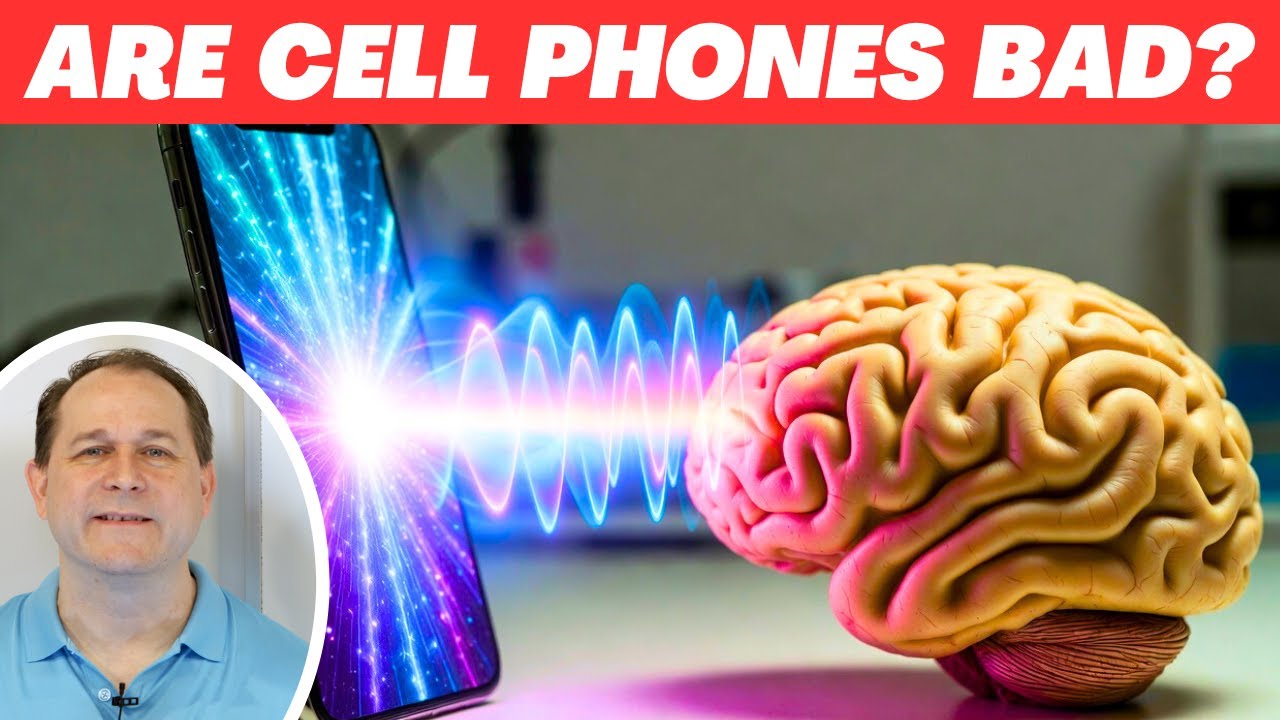
The Truth Behind Cell Phones, 5G & Cancer
Keywords
Summary
188 words
Critical Evaluation
Value of the Information & Strength of the Argument
The video provides a solid, physics-based explanation of why cell phone radiation is unlikely to cause cancer. It effectively uses Planck’s equation to quantify photon energies and compares them to the energy required to break DNA bonds. The argument is logical and well-structured, building from basic concepts to a clear conclusion. The host also addresses common misconceptions, such as the confusion between electromagnetic radiation and radioactivity. However, the video does not delve into all proposed non-thermal mechanisms, such as oxidative stress or calcium channel effects, which some researchers have suggested. The reliance on epidemiological studies is appropriate, but the video could have provided more detail on the limitations of these studies. Overall, the argumentation is strong and persuasive, but not exhaustive.
Scientific Rigor, Source Quality, Title Accuracy
The video demonstrates scientific rigor by grounding its explanation in established physics and citing large-scale epidemiological studies. The host accurately describes the electromagnetic spectrum and the concept of ionizing radiation. The sources cited, including the Cosmos study and the Million Women Study, are well-known and reputable. However, the video does not provide direct references or links to these studies, which would enhance credibility. The title accurately reflects the content, and the video stays on topic throughout. The host’s tone is measured and avoids sensationalism, which adds to the overall reliability. The lack of detailed citations is a minor weakness, but the information presented aligns with the scientific consensus.
244 words
Title / Content Match
The title accurately reflects the content, which addresses the question of whether cell phones and 5G cause cancer.
Quality & Reliability
8/10
The video provides a clear, physics-based explanation of why cell phone radiation is non-ionizing and cannot directly damage DNA. It cites major epidemiological studies (Cosmos, Million Women Study) and aligns with scientific consensus. However, it lacks detailed citations and does not address all potential non-thermal effects comprehensively.
Key Moments
Markers derived by PSI from the transcript: the creator did not define chapters.
- Introduction: The question of whether cell phones and 5G cause cancer.
- Historical context: Cell phones since the 1980s, stable brain cancer rates.
- Electromagnetic spectrum: Where cell phone frequencies lie.
- Why higher frequencies are needed for data: 4G vs 5G.
- Photon energy and Planck's equation: E=hf.
- Ionizing vs non-ionizing radiation: The threshold for DNA damage.
- Calculating photon energies for 4G and 5G: Millions of times too weak.
- Comparison with microwave ovens: Power and frequency differences.
- Radioactivity vs electromagnetic radiation: Different dangers.
- Epidemiological evidence: Cosmos study and Million Women Study.
- Conclusion: No direct cancer risk, but further research warranted.
Cited Sources
- Cosmos study — European study following 290,000 cell phone users for 30 years, found no consistent link to brain cancer.
- Million Women Study — UK study tracking 790,000 women, found no link between cell phone use and brain cancer.
Concurring Sources
- World Health Organization: Electromagnetic fields and public health — WHO states that no adverse health effects have been established for mobile phone use.
- National Cancer Institute: Cell Phones and Cancer Risk — NCI reviews evidence and finds no consistent link between cell phone use and cancer.
Dissenting Sources
- Interphone Study — Some analyses suggested a possible increased risk of glioma for heavy users, though the authors noted potential biases.
Contribution & Novelties
The video provides a clear, accessible explanation of the physics behind cell phone radiation, using Planck’s equation to quantify photon energies and compare them to the energy required to damage DNA. It effectively debunks common fears by showing that 5G photons are still millions of times too weak to cause ionizing damage. The video also clarifies the distinction between electromagnetic radiation and radioactivity, which is often confused. Its novelty lies in its pedagogical approach, making complex physics understandable to a general audience.
Pour aller plus loin :
- Ionizing radiation — Provides background on the threshold for DNA damage.
- Specific Absorption Rate (SAR) — Relevant to how phone radiation is measured and regulated.
- Electromagnetic spectrum — Visualizes where cell phone frequencies lie relative to other radiation.
125 words
Radar Profile
The radar profile shows high scores in information quantity, quality, and reliability, with a slightly lower technical level, indicating that the video is informative and trustworthy but not overly technical. The balance suggests it is suitable for a general audience seeking a solid scientific overview.
💬 No comments were provided for analysis.