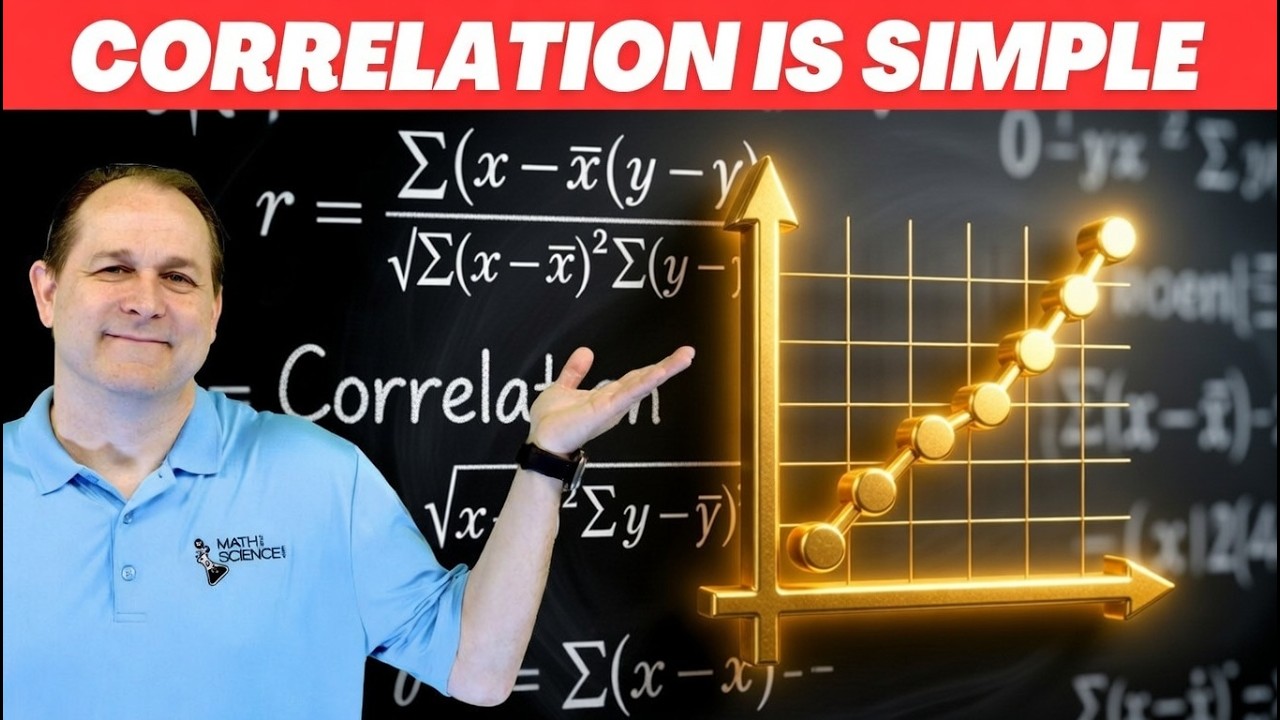
The TRUE Meaning of Correlation in Statistics
Keywords
Summary
195 words
Critical Evaluation
Value of the Information & Strength of the Argument
The video provides a solid explanation of the statistical significance of the correlation coefficient, which is a fundamental concept in statistics. It effectively builds on prior knowledge and uses intuitive examples (e.g., rolling dice, lightning strikes) to illustrate the role of chance. The argumentation is logical and clear, walking the viewer through the hypothesis testing framework step by step. The presenter emphasizes the importance of sample size and confidence levels, which is valuable for practical data analysis. However, the video does not delve into alternative methods (e.g., p-values, confidence intervals) or potential misinterpretations, which could be seen as a limitation. Overall, the content is informative and well-structured for an introductory statistics audience.
Scientific Rigor, Source Quality, Title Accuracy
The video is scientifically accurate in its presentation of hypothesis testing for correlation. It correctly uses the t-distribution and the test statistic formula. However, it does not cite any external sources or references, which is typical for educational videos but limits the ability to verify claims. The title is appropriate and matches the content, which focuses on the true meaning of correlation in statistics, specifically its statistical significance. The video does not include any advertising or sponsored content.
205 words
Title / Content Match
The title accurately reflects the content, which focuses on the true meaning of correlation in statistics, particularly its statistical significance.
Quality & Reliability
7/10
The video provides a clear and accurate explanation of the statistical significance of the correlation coefficient, including hypothesis testing and the t-distribution. The content is pedagogically sound, but it lacks citations to external sources and does not address potential pitfalls or limitations in depth.
Key Moments
Markers derived by PSI from the transcript: the creator did not define chapters.
- Introduction to the concept of statistical significance of the correlation coefficient.
- Review of correlation coefficient and its interpretation.
- Introduction to hypothesis testing for correlation.
- Explanation of null and alternative hypotheses.
- Introduction of the t-distribution and test statistic formula.
- Explanation of two-tailed test and rejection regions.
- Discussion on how sample size affects the test statistic.
- Summary of the importance of hypothesis testing in correlation.
Contribution & Novelties
The video provides a clear and accessible explanation of the statistical significance of the correlation coefficient, which is often misunderstood. It emphasizes the importance of hypothesis testing and confidence levels, which is a valuable addition to the understanding of correlation. The presenter’s intuitive explanation of how sample size and correlation magnitude interact is particularly helpful.
Pour aller plus loin :
- Pearson correlation coefficient — Provides a comprehensive overview of the correlation coefficient, its calculation, and interpretation.
- Statistical hypothesis testing — Explains the general framework of hypothesis testing, including null and alternative hypotheses, significance levels, and p-values.
- Student’s t-distribution — Details the t-distribution and its use in hypothesis testing when the sample size is small.
114 words
Radar Profile
The radar profile shows a balanced performance across all dimensions, with slightly higher scores in quality of information and technical level, indicating a solid educational resource. The lower score in quantity of information reflects the video's focused scope, while the overall reliability is good.