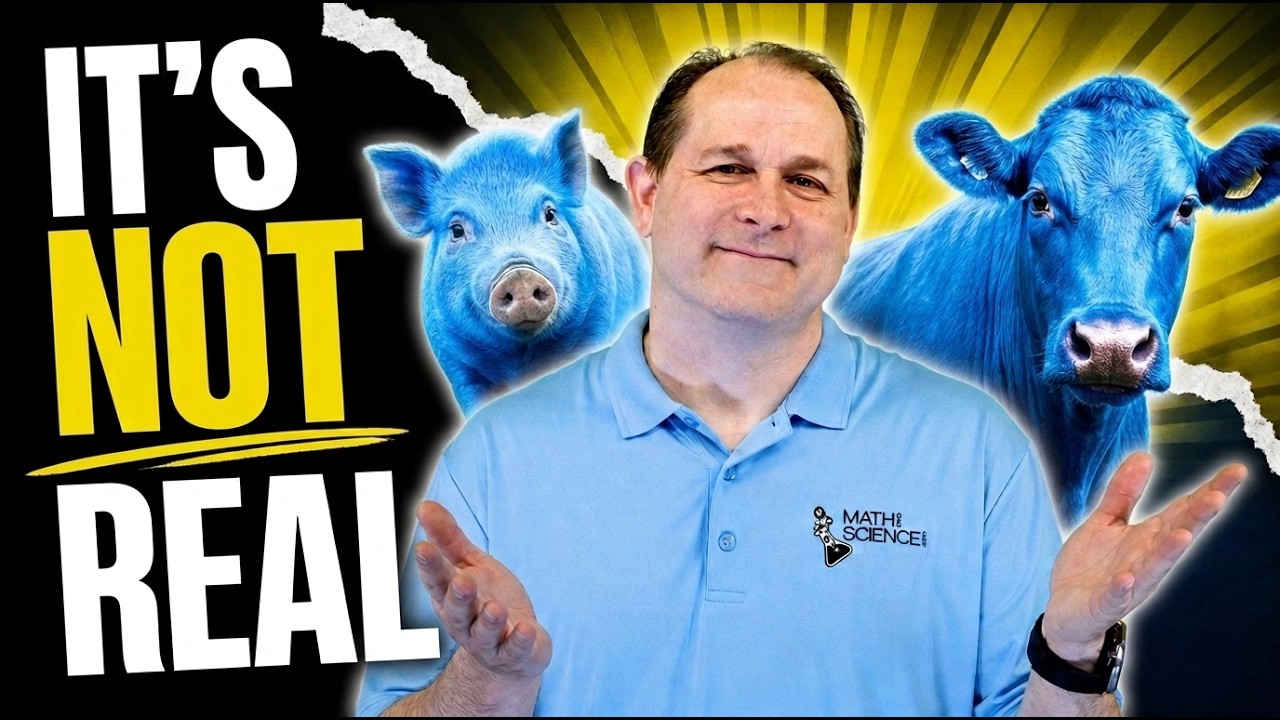
Blue is EVERYWHERE...So Why Are Almost No Animals Blue?
Keywords
Summary
170 words
Critical Evaluation
Value of the Information & Strength of the Argument
The video provides valuable information by clearly explaining the scientific principles behind color production, distinguishing between chemical pigments and structural colors. It effectively argues that blue is rare due to the high energy cost and molecular complexity required for true blue pigments, and that nature often resorts to physical tricks. The argumentation is solid, supported by examples and analogies, and the explanation of quantum mechanics is simplified but accurate. The video successfully conveys the wonder of nature’s solutions to this challenge.
Scientific Rigor, Source Quality, Title Accuracy
The scientific rigor is high; the video accurately explains concepts like conjugated systems, Rayleigh scattering, and interference. It cites specific examples (e.g., morpho butterfly, blue jay) and mentions the Obrina Olivewing butterfly as a unique case. The title is slightly misleading as it suggests blue is everywhere, but the content clarifies the rarity. The video does not cite external sources explicitly, but the information aligns with established scientific knowledge. The description mentions no specific references, but the content is reliable.
176 words
Title / Content Match
The title is slightly misleading as it suggests blue is everywhere, but the video actually explains why blue is rare in nature. However, the subtitle clarifies the focus, and the content directly addresses the question posed.
Quality & Reliability
8/10
The video provides a scientifically accurate explanation of color production in nature, covering both chemical (pigments) and physical (structural color) mechanisms. It correctly explains the quantum basis of color absorption, the rarity of blue pigments due to molecular complexity, and the role of structural coloration in animals like blue jays and morpho butterflies. The content is well-researched and aligns with established scientific knowledge, though it simplifies some concepts for a general audience.
Key Moments
Markers derived by PSI from the transcript: the creator did not define chapters.
- Introduction to the rarity of blue in nature.
- Explanation of color as electromagnetic radiation and quantum absorption.
- Why blue pigments are difficult to produce: extended conjugated systems and instability.
- Examples of blue in plants: anthocyanins and pH changes.
- Structural color in blue jays and morpho butterflies.
- Iridescence and the Obrina Olivewing butterfly as the only true blue pigment.
- Conclusion: blue is expensive for nature, and most blue is an illusion.
Cited Sources
- Math and Science - Official Website — Mentioned at the end of the video as a resource for further learning.
Concurring Sources
- Structural coloration in nature — Supports the explanation of structural color in blue jays and butterflies.
- Why is blue rare in nature? — Provides additional context on the rarity of blue pigments.
Contribution & Novelties
The video provides a comprehensive and accessible explanation of why blue is rare in nature, synthesizing chemistry and physics. It highlights the distinction between pigment-based and structural color, and emphasizes the evolutionary cost of blue pigments. The mention of the Obrina Olivewing butterfly as the only known true blue pigment is a notable fact.
Pour aller plus loin :
- Structural coloration — Overview of physical color production in nature.
- Rayleigh scattering — Explains why the sky is blue and its role in animal coloration.
- Anthocyanin — Pigments responsible for red, purple, and blue hues in plants.
96 words
Radar Profile
The radar profile shows high scores in information quality and reliability, with slightly lower scores in technical depth and quantity. This indicates a well-balanced, accurate, and accessible explanation suitable for a general audience, with a strong emphasis on scientific correctness.
💬 Positive. Sur les 30 commentaires analysés, la plupart expriment de l'intérêt et de l'appréciation pour la vidéo, avec des questions et des exemples supplémentaires, indiquant un accueil favorable.