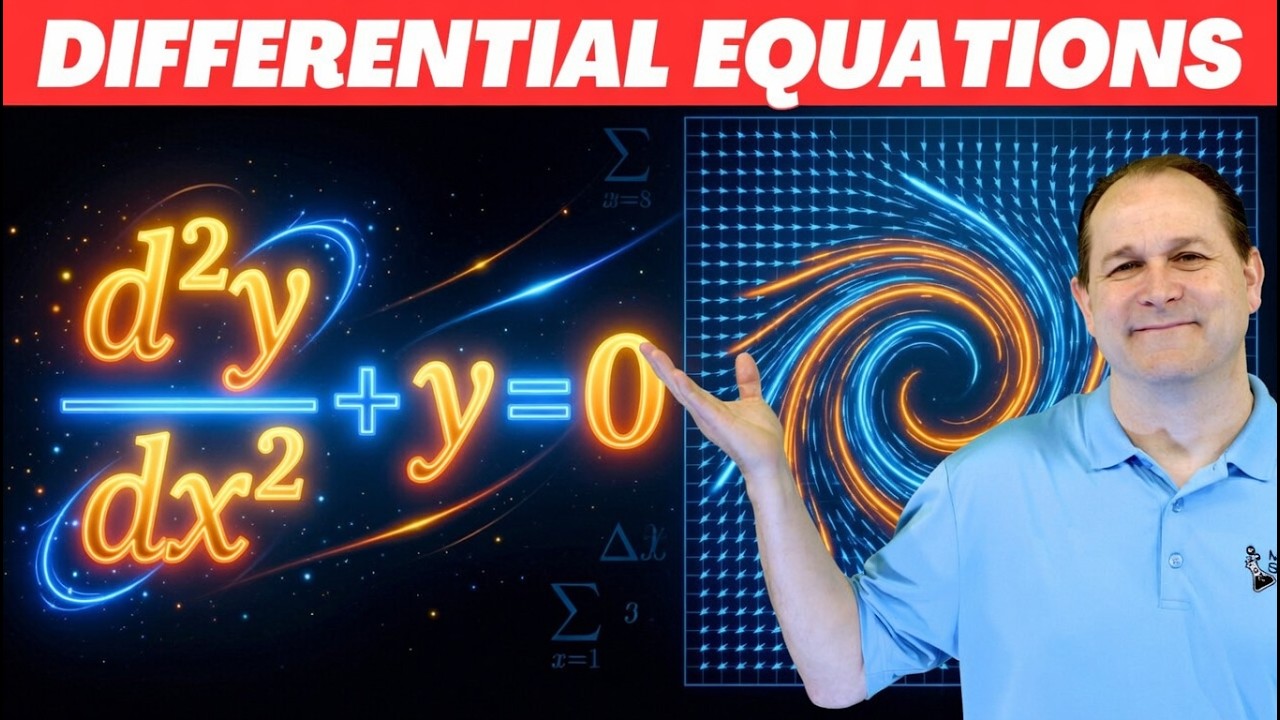
Intro to Differential Equations & What They Actually Mean
Keywords
Summary
164 words
Critical Evaluation
Value of the Information & Strength of the Argument
The video excels in pedagogical value, using a familiar physics equation (F=ma) to demystify differential equations and make the abstract concept tangible. The step-by-step derivation of the solution is clear and logical, reinforcing the idea that integration is the inverse operation of differentiation. The argumentation is solid, building from basic definitions to a concrete example, and effectively explains why constants of integration appear and how initial conditions refine the general solution to a specific one. The explanation of ordinary vs. partial differential equations is concise and sets appropriate expectations for the course.
Scientific Rigor, Source Quality, Title Accuracy
The scientific rigor is high for an introductory tutorial; the mathematical content is accurate and standard. However, the video does not cite any external sources, which is typical for educational content of this nature. The title accurately reflects the content, and the video delivers on its promise of explaining what differential equations are and how they are used. The presentation is well-structured, with clear definitions and examples, though it could benefit from mentioning real-world applications beyond physics, such as population dynamics or electrical circuits, to broaden the context.
195 words
Title / Content Match
The title accurately reflects the content: a beginner-friendly introduction to differential equations and their meaning.
Quality & Reliability
8/10
The video provides a clear, accurate introduction to differential equations, correctly explaining key concepts such as ordinary vs. partial differential equations, order, and the role of initial conditions. The pedagogical approach is sound, building from familiar physics (F=ma) to the general solution. No sources are cited, but the mathematical content is standard and correct.
Key Moments
Markers derived by PSI from the transcript: the creator did not define chapters.
- Introduction to differential equations and their importance in science.
- Definition of a differential equation as an equation involving a derivative.
- Introduction of F=ma as a differential equation.
- Explanation of acceleration as the second derivative of position.
- Distinction between ordinary and partial differential equations.
- Definition of the order of a differential equation.
- Solving the example ODE d²x/dt² = 30 by integrating twice.
- Introduction of constants of integration and the general solution.
- Explanation of initial conditions and particular solutions.
- Conclusion and summary of key concepts.
Contribution & Novelties
The video provides a clear and accessible introduction to differential equations, using a familiar physics example to bridge the gap between calculus and differential equations. Its novelty lies in the pedagogical approach, emphasizing the conceptual understanding of why differential equations are the language of science. It effectively demystifies the subject for beginners.
Pour aller plus loin :
- Differential equation - Wikipedia — Comprehensive overview of differential equations, including types and applications.
- Ordinary differential equation - Wikipedia — Detailed explanation of ODEs, their classification, and solution methods.
- Partial differential equation - Wikipedia — Introduction to PDEs, which are mentioned in the video as a more advanced topic.
- Newton’s laws of motion - Wikipedia — Background on F=ma, the foundational example used in the video.
- Initial value problem - Wikipedia — Explains the role of initial conditions in determining particular solutions.
139 words
Radar Profile
The radar profile shows a balanced performance across all dimensions, with slightly higher scores in quality and reliability, reflecting the accurate and well-structured content. The lower score in quantity of information is due to the introductory nature, which focuses on a single example rather than covering a wide range of topics.
💬 Très positif. Sur les 30 commentaires analysés, les spectateurs expriment une gratitude et une admiration massives pour la clarté et la pédagogie de l'instructeur, soulignant souvent que cette approche leur a permis de comprendre des concepts qu'ils n'avaient pas saisis auparavant.