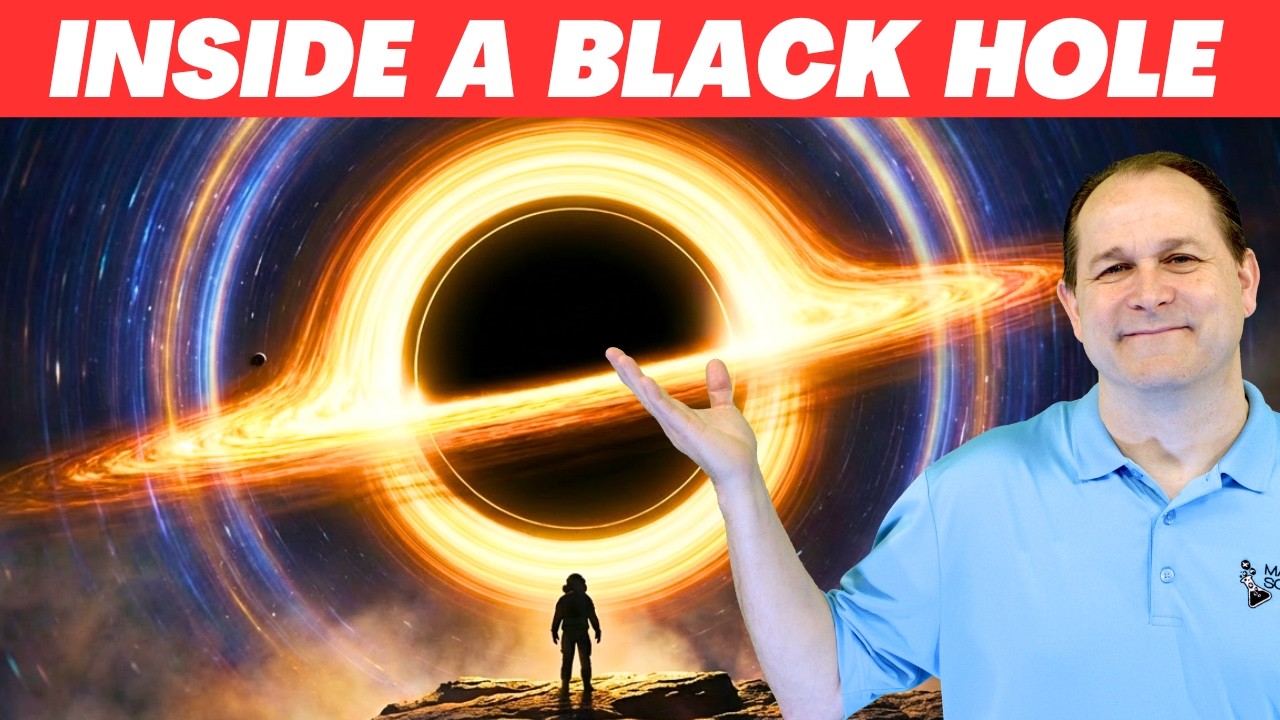
The Last 10 Seconds Before a Black Hole Destroys You
Keywords
Summary
115 words
Critical Evaluation
Value of the Information & Strength of the Argument
The video provides valuable information by clearly explaining complex concepts such as spacetime curvature, escape velocity, and the event horizon using accessible analogies. The argumentation is solid, grounded in general relativity, and avoids sensationalism. The host effectively distinguishes between what is known and what remains theoretical, such as quantum gravity. The step-by-step breakdown of the journey into a black hole is logical and well-structured, making the content both informative and engaging.
Scientific Rigor, Source Quality, Title Accuracy
The scientific rigor is high, with accurate explanations of general relativity and black hole physics. The video mentions historical figures like John Michell and Karl Schwarzschild, but does not cite specific sources or provide references. The title accurately reflects the content, focusing on the experience of falling into a black hole. The video is well-produced and maintains a clear focus on the physics, without digressions. The lack of explicit citations is a minor weakness, but the content aligns with established scientific knowledge.
168 words
Title / Content Match
The title is catchy and accurately reflects the content, which focuses on the experience of falling into a black hole, including the final moments.
Quality & Reliability
8/10
The video provides a solid, accurate overview of black hole physics based on general relativity, with correct explanations of event horizon, spaghettification, and time dilation. It avoids sensationalism and clearly separates fact from fiction. However, it lacks citations to primary sources and simplifies some concepts (e.g., quantum gravity) without depth.
Key Moments
Markers derived by PSI from the transcript: the creator did not define chapters.
- Introduction to the topic and fictional scenario of approaching a black hole
- Explanation of what a black hole is and the event horizon
- Discussion of spacetime curvature and how gravity affects light
- Formation of black holes from massive stars and supernovae
- Historical context: John Michell and Karl Schwarzschild
- Detailed explanation of the event horizon and escape velocity
- Differences between stellar-mass and supermassive black holes
- Spaghettification and tidal forces
- Observational effects: gravitational redshift and blueshift
- The singularity and the limits of current physics
Cited Sources
- No external sources cited in the video — The video does not reference any specific sources or provide links in the description.
Concurring Sources
- General relativity — The video's explanations of spacetime curvature and gravity align with this theory.
- Event horizon — The video's description of the event horizon matches the standard definition.
- Spaghettification — The video's explanation of tidal forces and spaghettification is consistent with this phenomenon.
Contribution & Novelties
The video offers a clear and engaging explanation of black hole physics, making complex concepts accessible to a general audience. It effectively combines a narrative approach with scientific accuracy, providing a comprehensive overview of what happens when falling into a black hole. The discussion of tidal forces and the differences between stellar and supermassive black holes adds depth.
Pour aller plus loin :
- General relativity — Foundational theory for understanding black holes.
- Event horizon — Key concept explained in the video.
- Spaghettification — The tidal stretching effect described.
- Schwarzschild metric — Mathematical solution for non-rotating black holes.
- Hawking radiation — Quantum effect near black holes, mentioned as a topic for further study.
112 words
Radar Profile
The radar profile shows high scores in information quantity, quality, and reliability, with a slightly lower technical level, indicating a well-balanced and accessible educational video.