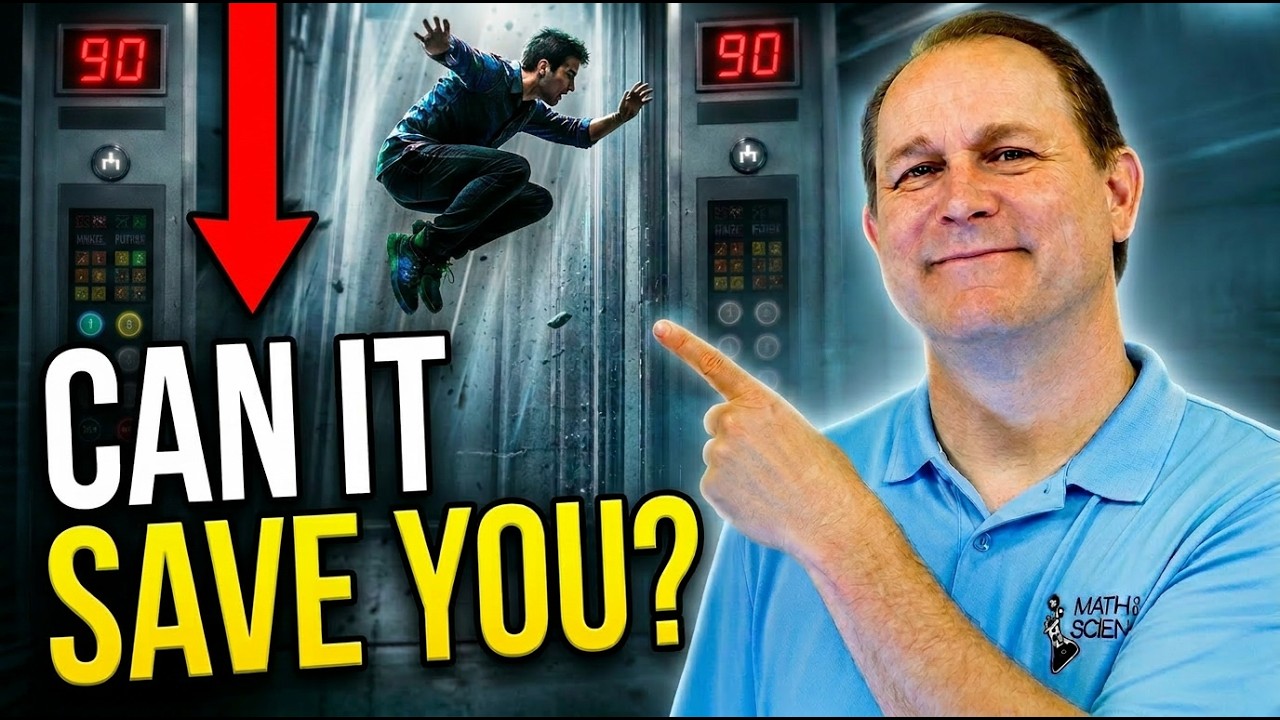
You Can Survive a Falling Elevator...Just Not By Jumping.
Keywords
Summary
194 words
Critical Evaluation
Value of the Information & Strength of the Argument
The video provides valuable information by clearly explaining the physics of free fall and inertia, and by debunking a common myth with quantitative reasoning. The argumentation is solid: it uses calculations (e.g., 67 mph after 3 seconds) and analogies (e.g., skateboard) to illustrate why jumping cannot work. It also incorporates biological constraints (ATP, muscle power) to reinforce the point. The reasoning is logical and easy to follow, making the content both educational and compelling.
Scientific Rigor, Source Quality, Title Accuracy
The video is scientifically rigorous in its explanation of physics and biology, but it does not cite specific sources or studies. The title accurately reflects the content. The video does not reference external sources, but the information presented is consistent with established physics and physiology. The lack of citations is a minor weakness, but the content is accurate and well-presented.
149 words
Title / Content Match
The title accurately reflects the content, which explores the physics and biology behind the myth of jumping in a falling elevator.
Quality & Reliability
8/10
The video provides a clear and accurate explanation of the physics of free fall, inertia, and the biological limits of jumping. It correctly debunks the myth of jumping in a falling elevator, using appropriate calculations and analogies. The content is well-structured and scientifically sound, though it lacks citations to primary sources.
Key Moments
Markers derived by PSI from the transcript: the creator did not define chapters.
- Introduction to the myth of jumping in a falling elevator.
- Explanation of free fall and velocity after a few seconds.
- Introduction to inertia and Newton's first law.
- Discussion of the required jump speed to cancel downward velocity.
- Biological limits: ATP and muscle power.
- Analysis of survival thresholds for different fall heights.
- The problem of timing and the difficulty of jumping in free fall.
- Modern elevator safety systems and conclusion.
Contribution & Novelties
The video offers a clear and engaging explanation of why jumping in a falling elevator is ineffective, combining physics and biology. It provides quantitative examples and analogies that make the concept accessible. The video does not present new scientific findings but synthesizes existing knowledge in an educational format.
Pour aller plus loin :
- Newton’s laws of motion — Foundation of inertia and motion.
- Free fall — Physics of falling objects.
- Adenosine triphosphate — Energy currency for muscle contraction.
78 words
Radar Profile
The radar profile shows high scores in quality of information and global reliability, with moderate scores in quantity and technical level. This indicates a well-explained and accurate video, but with limited depth and no external sources.
💬 The comments are generally positive and engaged, with many viewers sharing personal experiences and adding humorous remarks. The overall tone is balanced, with some critical points about elevator safety systems and the practicality of jumping.