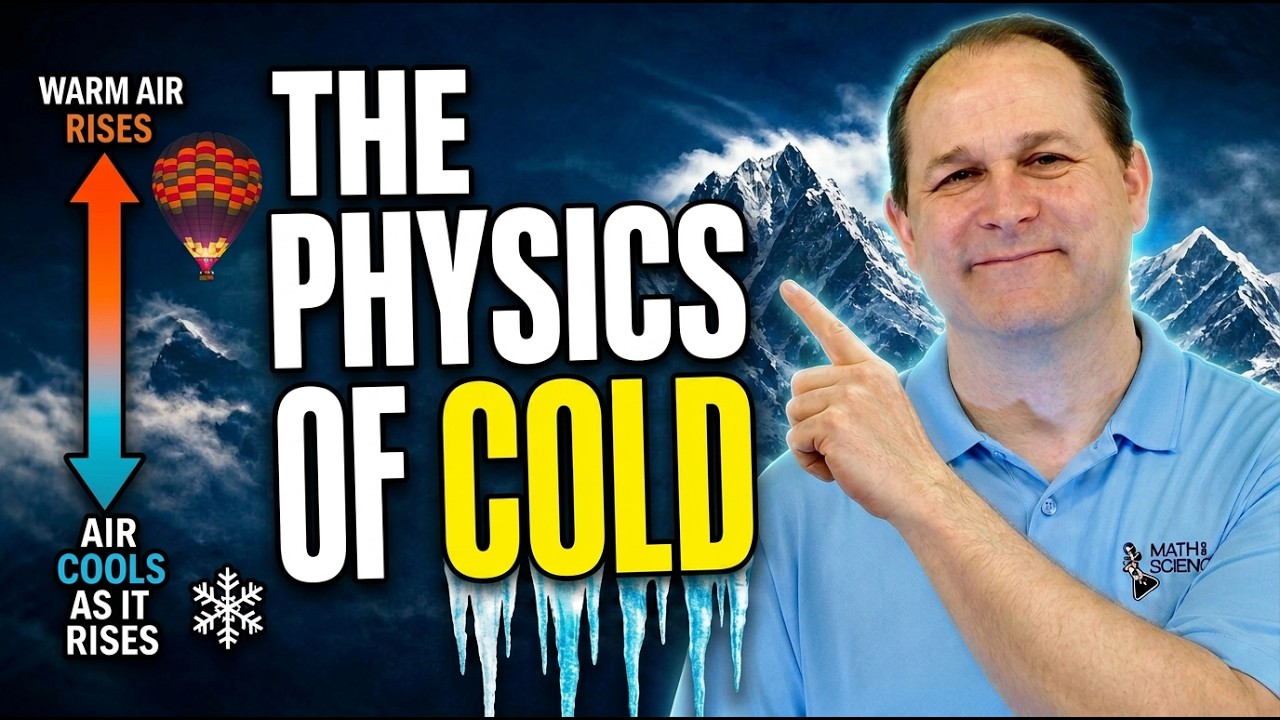
If Hot Air RISES...Why are Mountains so COLD?
Keywords
Summary
195 words
Critical Evaluation
Value of the Information & Strength of the Argument
The video provides a high-value explanation of a common scientific question, breaking down complex concepts into understandable parts. The argumentation is solid, building from basic principles of density and pressure to the specific phenomenon of adiabatic cooling. The use of analogies (piston, ping-pong paddle) and real-world examples (compressed air can, airplane flights) enhances comprehension. The presenter also addresses potential misconceptions and provides a clear, logical chain of reasoning. The explanation of why expanding gases cool is particularly well-done, using the conservation of energy and molecular collisions. The video also touches on the counterintuitive nature of temperature in the thermosphere, adding depth. Overall, the value is high for both general audiences and those with some scientific background.
Scientific Rigor, Source Quality, Title Accuracy
The video demonstrates strong scientific rigor, accurately explaining atmospheric physics concepts. The presenter does not cite specific external sources, but the content aligns with established scientific knowledge, such as the adiabatic lapse rate and the kinetic theory of gases. The title is perfectly matched to the content, posing a question that is thoroughly answered. The video is self-contained, using demonstrations and analogies rather than relying on external references. The lack of explicit citations is a minor weakness, but the accuracy of the information compensates for this. The video’s educational value is high, and it is suitable for a wide audience.
231 words
Title / Content Match
The title is a compelling question that directly matches the content, which thoroughly explains why mountaintops are cold despite hot air rising.
Quality & Reliability
9/10
The video provides a rigorous, step-by-step explanation of adiabatic cooling and atmospheric pressure, using correct physics principles and analogies. The presenter, Jason, is an experienced educator with a background in engineering and NASA, and the content aligns with established atmospheric science.
Key Moments
Markers derived by PSI from the transcript: the creator did not define chapters.
- Introduction: The paradox of hot air rising but mountaintops being cold.
- Explanation of why hot air rises: density and molecular collisions.
- Discussion of atmospheric pressure as the weight of the air column.
- Introduction of adiabatic cooling: expanding gases cool.
- Demonstration with compressed air can showing cooling on expansion.
- Analogies: piston and ping-pong paddle to explain energy transfer.
- Explanation of adiabatic lapse rate: 6.5°C per 1000 meters.
- Discussion of thin air at high altitudes and its effect on heat transfer.
- Thought experiment: thermosphere with few molecules but high energy.
- Conclusion: Summary of three-layered explanation and final thoughts.
Contribution & Novelties
The video offers a clear and engaging explanation of a common scientific question, using effective analogies and demonstrations. It stands out for its step-by-step approach, making complex physics accessible. The inclusion of the thermosphere thought experiment adds a novel perspective on temperature measurement.
Pour aller plus loin :
- Adiabatic process — Provides a formal definition and mathematical treatment of adiabatic cooling.
- Lapse rate — Details the environmental lapse rate and its variations.
- Kinetic theory of gases — Explains the molecular basis of temperature and pressure.
85 words
Radar Profile
The radar profile shows high scores across all dimensions, indicating a well-rounded and reliable educational video. The strong scores in information quantity and quality reflect the thorough explanation, while the technical level is appropriate for the target audience. The overall high reliability and global score confirm its excellence.
💬 Très positif. Sur les 30 commentaires analysés, les spectateurs expriment une gratitude marquée pour la clarté de l'explication, certains mentionnant son utilité pour leur enseignement ou leur propre compréhension, avec quelques suggestions mineures sur les visuels.