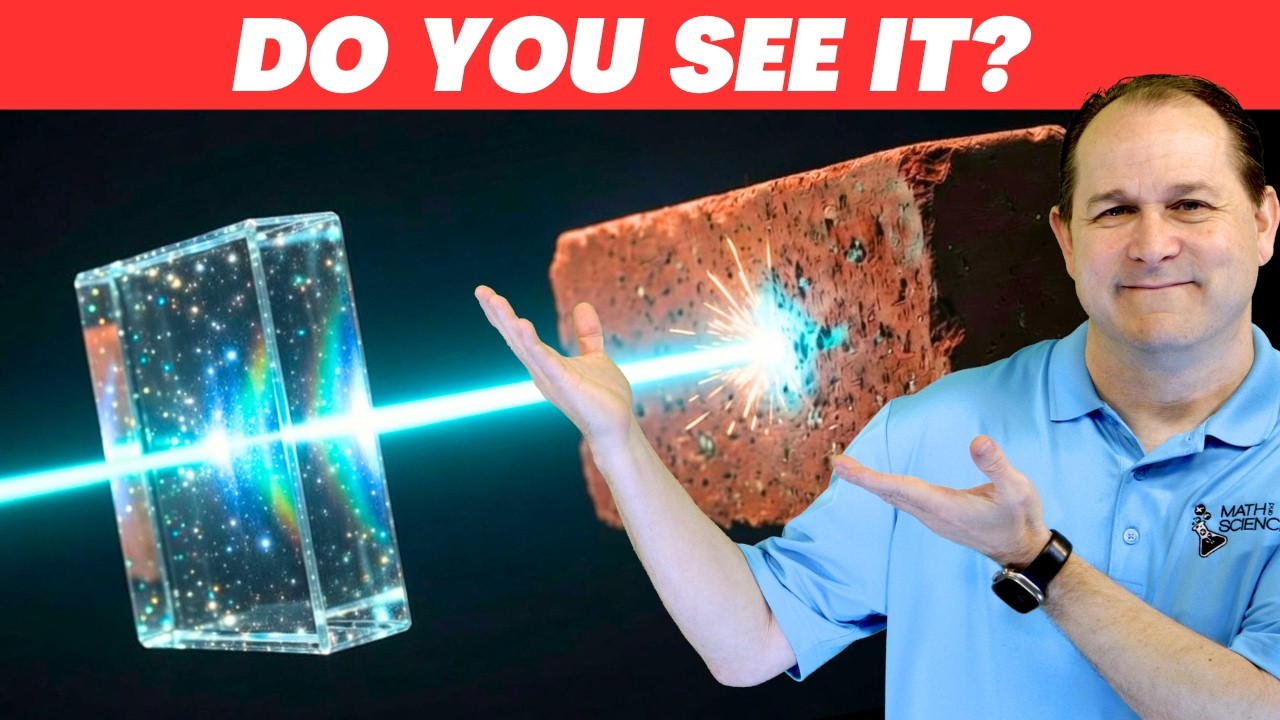
Why Can You See Through Glass... But NOT Through Brick?
Keywords
Summary
222 words
Critical Evaluation
Value of the Information & Strength of the Argument
The video provides a valuable and comprehensive explanation of a common phenomenon, breaking it down into accessible concepts. It effectively uses analogies like tuning forks and relay races to illustrate complex ideas. The argumentation is logical and builds progressively from macroscopic observations to quantum-level explanations, covering key factors such as electron energy levels, band gaps, and atomic ordering. The presenter supports claims with clear reasoning and examples, making the content both informative and convincing.
Scientific Rigor, Source Quality, Title Accuracy
The video demonstrates scientific rigor by accurately presenting established concepts in materials science and optics. It does not cite specific sources, but the explanations align with standard physics textbooks. The title accurately reflects the content, which directly addresses the question of why glass is transparent and brick is not. The video’s structure is coherent, and the presenter avoids overgeneralizations, acknowledging complexities like the role of impurities and temperature. Overall, the content is reliable and well-presented.
164 words
Title / Content Match
The title accurately reflects the content, which explains why some materials are transparent and others opaque, using glass and brick as examples.
Quality & Reliability
8/10
The video provides a solid, accurate explanation of the physics of transparency, covering key concepts like electron energy levels, band gaps, and scattering. It uses clear analogies and avoids major errors, though it simplifies some quantum mechanical details. The content is consistent with established scientific understanding, and the presenter is experienced in science education.
Key Moments
Markers derived by PSI from the transcript: the creator did not define chapters.
- Introduction: the question of transparency and opacity
- Observation that most gases and liquids are transparent, while solids are opaque
- Introduction to atomic-level interaction: photons and electron clouds
- Explanation of transparent materials: frequency mismatch and relay race
- Explanation of opaque materials: energy absorption and heat
- Introduction to electronic band structure and band gaps
- Metals: no band gap, absorption and re-emission, reflectivity
- Insulators: large band gap, transparency in ordered structures
- Role of atomic arrangement: crystals vs. disordered structures
- Why gases and liquids are transparent
- Color perception and mirrors
- Summary and conclusion
Contribution & Novelties
The video offers a clear and engaging explanation of a fundamental physics concept, making it accessible to a broad audience. It synthesizes multiple aspects of light-matter interaction, including band theory and scattering, into a coherent narrative. The use of analogies and real-world examples enhances understanding.
Pour aller plus loin :
- Band theory — Provides a more detailed mathematical treatment of energy bands and band gaps.
- Photon absorption and emission — Explains the quantum nature of light and its interaction with matter.
- Optical properties of materials — Covers transparency, opacity, and related phenomena in materials science.
95 words
Radar Profile
The radar profile shows high scores across all dimensions, indicating a well-rounded and reliable educational video. The strongest aspects are the quantity and quality of information, while the technical level is appropriately moderate for a general audience. The overall reliability is high, making it a trustworthy resource for understanding the physics of transparency.
💬 Très positif. Sur les 30 commentaires analysés, la grande majorité exprime une appréciation chaleureuse et des remerciements, avec plusieurs témoignages d'apprentissage réussi et de curiosité stimulée.