Keywords
Summary
200 words
Critical Evaluation
Value of the Information & Strength of the Argument
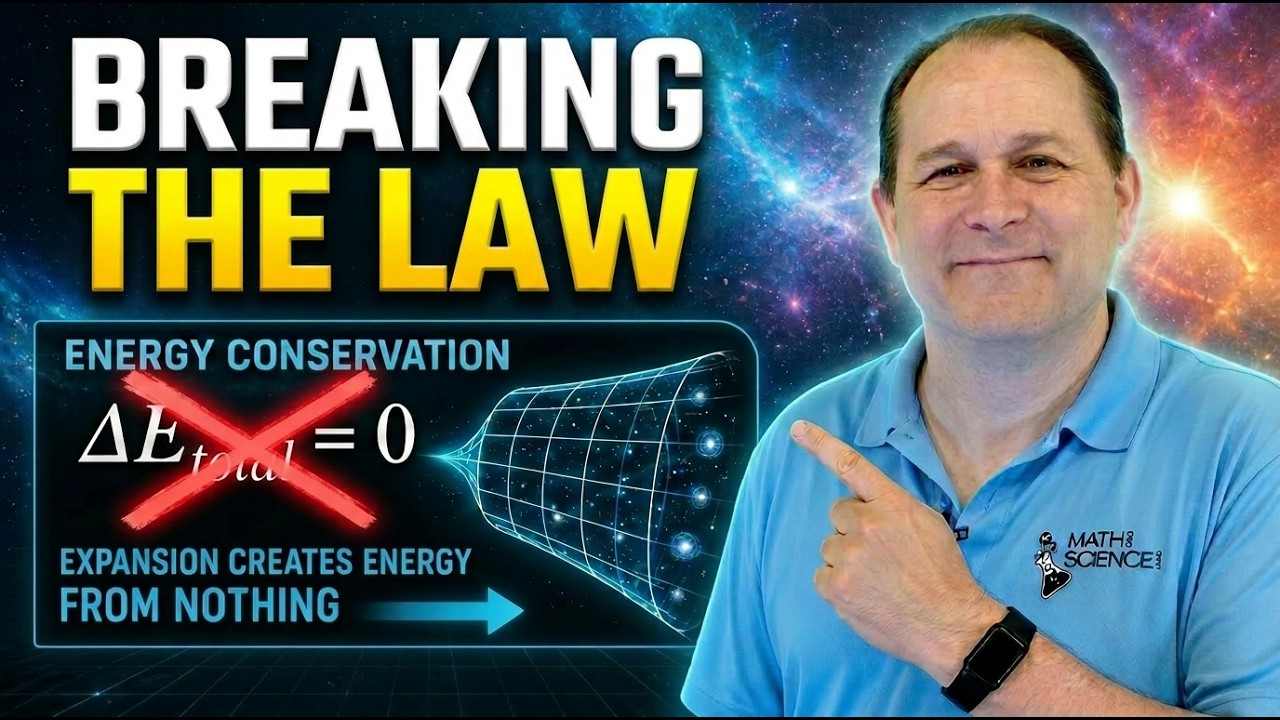
The video provides valuable information by clearly explaining complex concepts such as dark energy, virtual particles, and Hawking radiation in an accessible manner. It uses analogies and examples to illustrate abstract ideas, making them understandable for a general audience. The argumentation is solid, as it builds from classical examples to quantum and cosmological exceptions, and it correctly notes that these exceptions do not truly violate energy conservation but rather highlight the limitations of the law in certain contexts. The presentation is logical and well-structured, with a clear progression from familiar to exotic phenomena.
Scientific Rigor, Source Quality, Title Accuracy
The video demonstrates scientific rigor by accurately presenting established theories and experimental results, such as Noether’s theorem, the Casimir effect, and Hawking’s prediction. However, it does not cite specific sources or provide references, which limits its utility for viewers seeking further verification. The title is somewhat sensationalist but accurately reflects the content, which discusses apparent violations of energy conservation. The video’s content aligns well with the title, as it indeed explores cases where the law appears not to hold. The presentation is scientifically sound, though it simplifies some details for a general audience.
201 words
Title / Content Match
The title is somewhat sensationalist but accurately reflects the content, which discusses apparent violations of energy conservation in extreme conditions.
Quality & Reliability
7/10
The video presents a clear and accurate overview of the conservation of energy and its exceptions in cosmology and quantum mechanics, referencing established theories and experiments (Noether's theorem, dark energy, virtual particles, Casimir effect, Hawking radiation). However, it simplifies complex topics and does not provide citations or sources, limiting its depth for a scientific audience.
Key Moments
Markers derived by PSI from the transcript: the creator did not define chapters.
- Introduction to the law of conservation of energy and its classical examples.
- Explanation of Noether's theorem connecting energy conservation to time symmetry.
- Introduction to dark energy and the accelerating expansion of the universe.
- Discussion of dark energy density and the creation of energy as space expands.
- Explanation of how energy conservation fails globally in an expanding universe.
- Introduction to quantum vacuum and virtual particles.
- Explanation of energy-time uncertainty principle and borrowing energy.
- Discussion of the Casimir effect as experimental evidence for virtual particles.
- Introduction to Hawking radiation and black hole evaporation.
- Conclusion summarizing that energy conservation is an approximation with limits.
Contribution & Novelties
The video provides a clear and engaging synthesis of well-known physics concepts, but it does not present original research or novel insights. Its value lies in its educational approach, making complex ideas accessible to a broad audience. It effectively connects classical energy conservation to modern cosmological and quantum phenomena, offering a cohesive narrative that highlights the limits of fundamental laws.
Pour aller plus loin :
- Noether’s theorem — Foundational theorem linking symmetries to conservation laws.
- Dark energy — Overview of the mysterious force driving cosmic acceleration.
- Casimir effect — Experimental evidence for vacuum fluctuations.
- Hawking radiation — Theoretical prediction of black hole emission.
103 words
Radar Profile
The radar profile shows high scores in information quantity and technical level, reflecting the video's comprehensive coverage of advanced topics. The quality and reliability scores are slightly lower, indicating that while the content is accurate, it lacks depth and citations. Overall, the video is a valuable educational resource but not a rigorous scientific reference.
💬 Sur les 30 commentaires analysés, le climat est très positif, avec des éloges pour la clarté et la qualité de la présentation, et des discussions constructives sur les implications des concepts abordés.