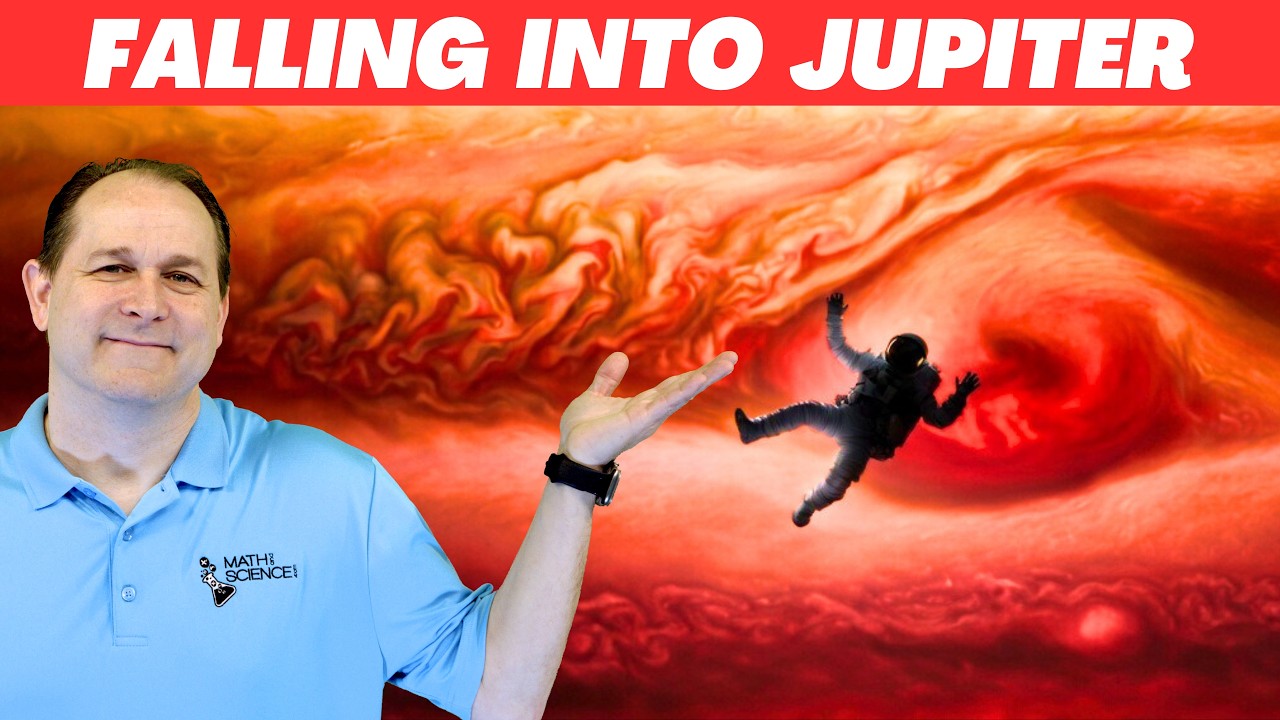
What Would it Actually Feel Like to Fall INTO Jupiter?
Keywords
Summary
234 words
Critical Evaluation
Value of the Information & Strength of the Argument
The video provides a rich, immersive description of the physical conditions one would encounter while falling into Jupiter, effectively combining scientific facts with vivid imagery. It covers a wide range of topics: Jupiter’s size and mass, its magnetic field and radiation belts, atmospheric composition and dynamics, pressure and temperature gradients, phase transitions to supercritical fluids and metallic hydrogen, and the nature of the core. The argumentation is solid, grounded in established planetary science, and clearly distinguishes between known data (e.g., Galileo probe measurements) and speculative ideas (e.g., cloud life). The use of analogies (e.g., Earth as a basketball, Jupiter as an 8-foot sphere) helps convey scale. The narrative is coherent and logically structured, following the descent from orbit to core, which enhances understanding. However, some simplifications are made for a general audience, and the discussion of supercritical fluids and metallic hydrogen could benefit from more detailed explanations. Overall, the video offers substantial educational value and a compelling thought experiment.
Scientific Rigor, Source Quality, Title Accuracy
The video demonstrates scientific rigor by referencing the Galileo probe’s actual measurements and current models of Jupiter’s interior. It accurately describes the pressure and temperature conditions, the transition to supercritical fluid, and the existence of metallic hydrogen, which are well-established in planetary science. The content is consistent with known facts, and speculative elements are clearly flagged as such. The title accurately reflects the content, which is a detailed thought experiment about the physical experience of falling into Jupiter. The video does not cite specific external sources, but it relies on widely accepted scientific knowledge. The production quality is high, with clear visuals and narration. No comments were provided for analysis, so no public reception trends can be assessed.
292 words
Title / Content Match
The title accurately reflects the content, which is a detailed thought experiment about the physical experience of falling into Jupiter.
Quality & Reliability
8/10
The video presents scientifically accurate information about Jupiter's atmosphere, pressure, temperature, and magnetic field, supported by references to the Galileo probe and current models. It clearly distinguishes between established facts and speculative elements (e.g., cloud life). The presentation is engaging and generally rigorous, though some simplifications are made for a general audience.
Key Moments
Markers derived by PSI from the transcript: the creator did not define chapters.
- Introduction: imagining falling into Jupiter, setting the stage.
- Jupiter's immense size and mass, comparison to Earth.
- Explanation of why Jupiter is not a star, fusion threshold.
- Jupiter's magnetic field and radiation belts, danger to spacecraft.
- Atmospheric bands and winds, speeds exceeding 400 mph.
- Descent into darkness, temperature rise, and internal heat.
- Pressure increases, transition to supercritical fluid.
- Galileo probe descent, loss of contact, and findings.
- Approaching the core, metallic hydrogen, and magnetic field generation.
- Core conditions, extreme pressure and temperature, no fusion.
- Speculation about microbial life in Jupiter's clouds.
Cited Sources
- Galileo Probe — Mentioned as the 1995 probe that descended into Jupiter's atmosphere and transmitted data for 57 minutes.
Concurring Sources
- NASA - Jupiter — NASA's official page on Jupiter, providing general facts and mission information.
Contribution & Novelties
The video offers a unique, immersive thought experiment that synthesizes current knowledge about Jupiter’s atmosphere and interior into a vivid narrative. It effectively communicates complex concepts like supercritical fluids and metallic hydrogen in an accessible way, making it valuable for science communication. The inclusion of the Galileo probe’s real data adds authenticity.
Pour aller plus loin :
- Jupiter’s atmosphere — Overview of Jupiter’s atmospheric layers, composition, and dynamics.
- Metallic hydrogen — Explanation of the state of hydrogen under extreme pressure, relevant to Jupiter’s interior.
- Galileo spacecraft — Details on the mission and the probe’s findings.
- Supercritical fluid — Concept of a state beyond the critical point, used to describe Jupiter’s deep atmosphere.
112 words
Radar Profile
The radar profile shows high scores in quantity and quality of information, with a moderate technical level. The video is strong in delivering accurate scientific content in an engaging manner, but may not delve deeply into advanced physics for specialists. The overall balance suggests a well-rounded educational piece.
💬 The comments are overwhelmingly positive, with viewers expressing appreciation for the informative and engaging content. Many humorous remarks about the experience, but no negative trends. Sur les 30 commentaires analysés, la majorité exprime de l'enthousiasme et de la curiosité, avec quelques blagues sur le sujet.