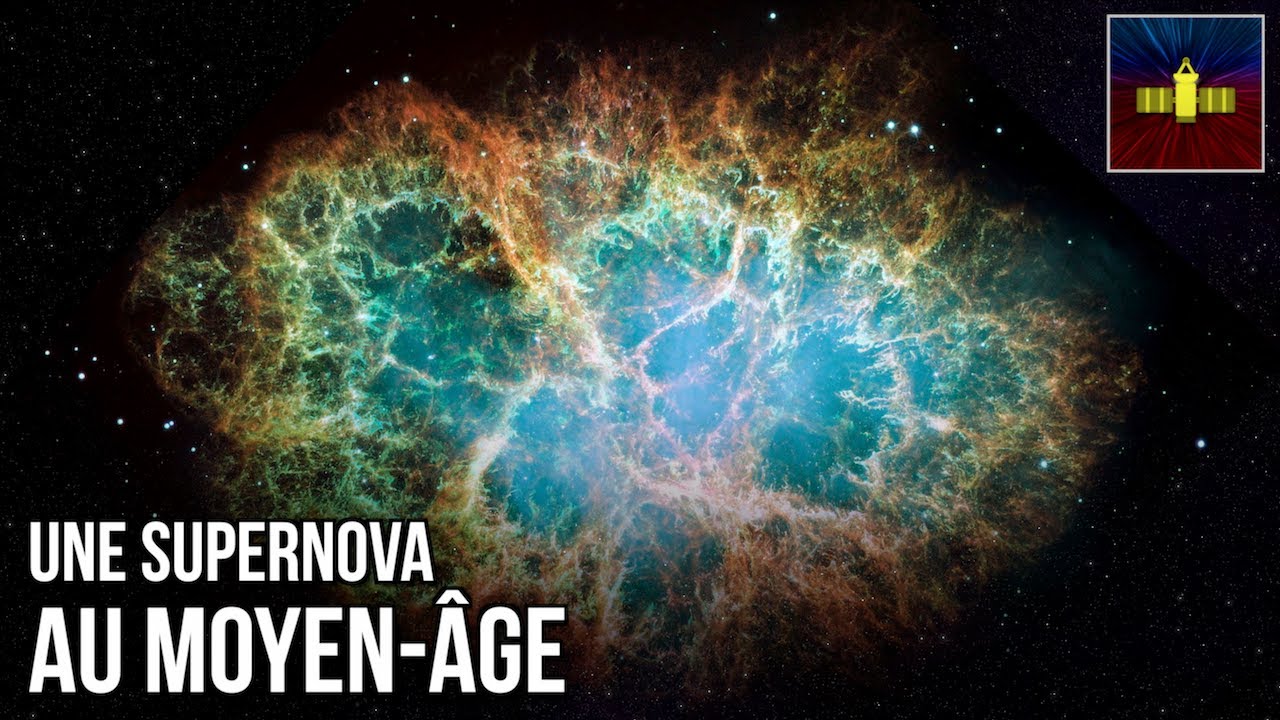
🛰 Une explosion galactique au Moyen-Âge
Keywords
Summary
157 words
Critical Evaluation
Value of the Information & Strength of the Argument
The video provides valuable information by connecting historical observations with modern astrophysics, offering a coherent narrative that enhances understanding of stellar evolution and supernova remnants. The argumentation is solid, as it builds a logical chain from the classification of stars to the specific case of the Crab Nebula, using well-established scientific facts. The presenter effectively uses storytelling to make complex concepts accessible, and the inclusion of specific dates and names adds credibility. The explanation of pulsars and their discovery is accurate and well-integrated into the overall narrative.
Scientific Rigor, Source Quality, Title Accuracy
The scientific rigor is high, with information consistent with established astronomical knowledge. The video cites reliable sources such as Wikipedia articles and NASA, which are appropriate for a popular science context. The title accurately reflects the content, focusing on the historical supernova and its modern significance. The video does not overstate claims and appropriately distinguishes between established facts and hypotheses. The presentation is clear and well-structured, with no major inaccuracies detected.
173 words
Title / Content Match
The title accurately reflects the content, which focuses on a supernova observed in 1054 and its modern astronomical significance.
Quality & Reliability
8/10
The video presents accurate scientific information about stellar evolution, supernovae, and the historical connection between the SN 1054 event, the Crab Nebula, and the discovery of pulsars. The content aligns with established astronomical knowledge and is supported by references to Wikipedia and NASA. Minor simplifications are typical of popular science but do not compromise accuracy.
Key Moments
Markers derived by PSI from the transcript: the creator did not define chapters.
- Introduction to the episode's topic: the death of stars and their traces.
- Explanation of what a star is and the process of nuclear fusion.
- Classification of stars: brown dwarfs, red dwarfs, yellow dwarfs, and giants.
- Description of the death of massive stars and supernova explosions.
- Introduction to the Crab Nebula and its famous Hubble image.
- Historical account of the 1054 supernova observed by Chinese astronomers.
- Charles Messier's discovery of the nebula in 1758 and the creation of his catalog.
- Discovery of the first pulsar by Jocelyn Bell Burnell in 1968.
- Connection between the pulsar in the Crab Nebula and the 1054 supernova.
- Conclusion and teaser for the next video.
Cited Sources
- Charles Messier — Background on the astronomer who cataloged M1.
- Nébuleuse du Crabe — Details about the Crab Nebula.
- PSR B0531+21 — Information on the pulsar in the Crab Nebula.
- Pulsar — General information on pulsars.
- SN 1054 — Historical supernova event.
- Supernova — General information on supernovae.
- Étoile — Types of stars.
- Messier 1: The Crab Nebula — NASA page on the Crab Nebula.
- Video: Pulsar discovery — Related video on pulsars.
Concurring Sources
- SN 1054 — Confirms the historical supernova event.
- Crab Pulsar — Confirms the pulsar in the Crab Nebula.
Contribution & Novelties
The video’s original contribution lies in its narrative approach, weaving together historical records, astronomical cataloging, and modern astrophysics to tell the story of a single supernova. It effectively demonstrates how different observations across centuries converge to provide a comprehensive understanding of cosmic phenomena. The video also highlights the importance of amateur and historical observations in advancing science.
Pour aller plus loin :
- Supernova — General overview of supernovae and their types.
- Crab Nebula — Detailed information about the nebula and its pulsar.
- Pulsar — Explanation of pulsars and their discovery.
- Jocelyn Bell Burnell — Biography of the discoverer of the first pulsar.
- Messier object — Information on the Messier catalog.
110 words
Radar Profile
The radar profile shows high scores in information quantity, quality, and reliability, with a slightly lower technical level, indicating a well-balanced popular science video that is both informative and accessible.
💬 Très positif. Sur les 30 commentaires analysés, les spectateurs expriment un fort enthousiasme pour la clarté des explications, la qualité de la narration et l'originalité du format, avec quelques remarques constructives sur des simplifications.