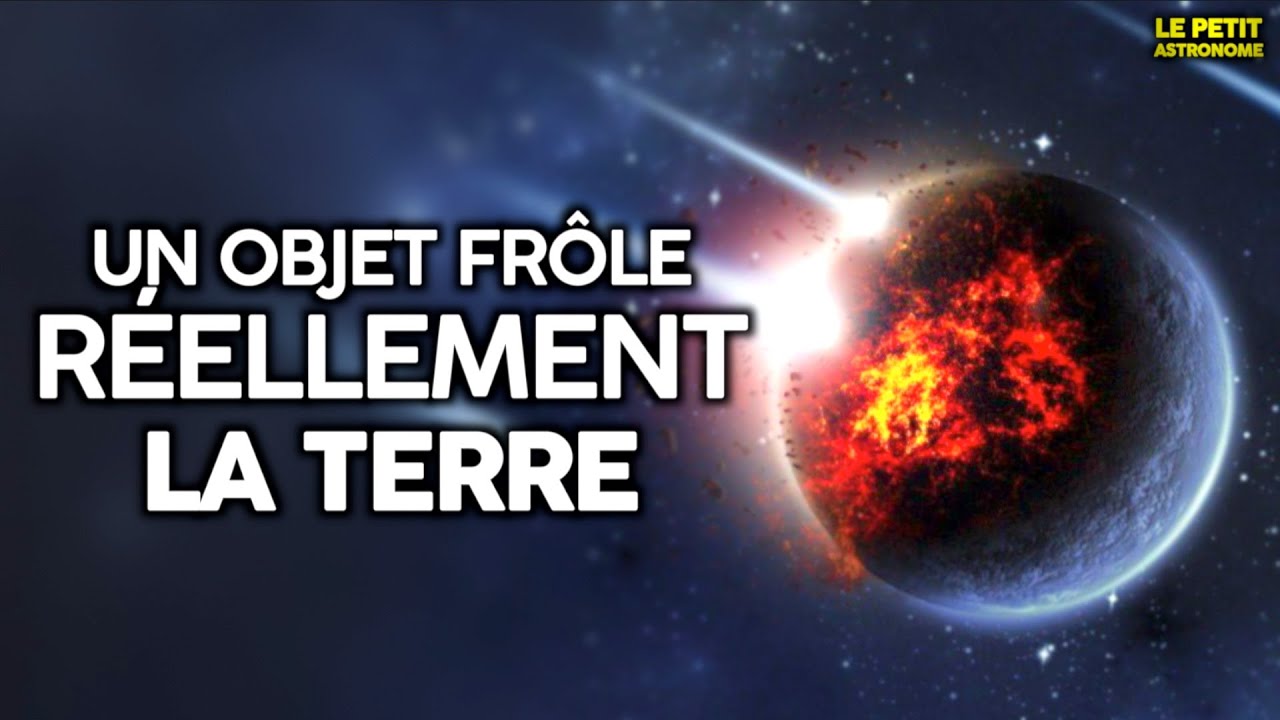
Un géocroiseur frôle la Terre (pour de vrai)
Keywords
Summary
163 words
Critical Evaluation
Value of the Information & Strength of the Argument
The video provides valuable information by debunking sensationalist media narratives and presenting a well-documented case of a real close approach. The argumentation is solid: the presenter builds a logical case from the initial detection to the final identification as a rocket booster, using credible sources and clear reasoning. He effectively explains the technical aspects of orbital mechanics and the Lucy mission, making complex concepts accessible. The discussion of space debris is well-contextualized with historical examples, strengthening the overall argument.
Scientific Rigor, Source Quality, Title Accuracy
The video demonstrates high scientific rigor by citing authoritative sources such as NASA, the Minor Planet Center, and Wikipedia articles. The presenter clearly distinguishes between verified facts and hypotheses, and he corrects common misconceptions. The title accurately reflects the content, focusing on a real close approach rather than a sensationalized one. The video’s structure, with chapters, aids comprehension. The sources are relevant and support the claims made, though some are secondary (e.g., news articles). Overall, the title and content are well-aligned.
175 words
Title / Content Match
The title accurately reflects the content: it highlights a real close approach of an object, later identified as a rocket booster, and the video delivers on this promise with detailed explanation.
Quality & Reliability
8/10
The video is well-researched, citing multiple credible sources (NASA, Minor Planet Center, Wikipedia) and clearly distinguishing between verified facts and hypotheses. The presenter demonstrates scientific rigor by correcting media exaggerations and providing accurate orbital data.
Chapters
Cited Sources
- 2022 UQ1 - Wikipedia — Provides details on the object's discovery and orbital characteristics.
- Lucy (spacecraft) - Wikipedia — Background on the Lucy mission and its objectives.
- Discovery Program - Wikipedia — Overview of NASA's Discovery program, which includes Lucy.
- MPEC 2022-U58 : 2022 UQ1 — Official Minor Planet Center electronic circular confirming the object's designation.
- Asteroid 2022 UQ1 flew past Earth at 0.02 LD — News article reporting the close approach and initial classification.
- L'astéroïde qui a frôlé la Terre était en fait un bout de fusée — MSN article confirming the object was a rocket booster.
- Lucy Mission In-Depth - NASA — NASA's official page on the Lucy mission.
- Centaur rocket booster from the 1960s is still in orbit — Article about a Centaur booster from the 1960s, relevant to space debris discussion.
- 2020 SO - Wikipedia — Example of a misidentified object that turned out to be a rocket booster.
- J002E3 - Wikipedia (French) — Another example of a misidentified rocket stage.
- C'est confirmé : 2020 SO n'est pas une mini-lune mais bien un bout de fusée — French article confirming the nature of 2020 SO.
- Archive of a tweet by Tony Dunn — Archived tweet possibly showing orbital simulation of 2022 UQ1.
Concurring Sources
- 2022 UQ1 - Wikipedia — Confirms the object's identification as a rocket booster and its close approach.
- MPEC 2022-U58 — Official confirmation of the object's designation and orbital data.
- Asteroid 2022 UQ1 flew past Earth at 0.02 LD — Reports the close approach and initial classification as an asteroid.
Dissenting Sources
- Media reports exaggerating asteroid threats — The video criticizes media outlets for sensationalizing asteroid approaches, such as 2018 VP1, which was not a real threat.
Contribution & Novelties
The video provides a fresh perspective on a recent astronomical event by revealing that a ’near-Earth asteroid’ was actually a rocket booster, highlighting the growing issue of space debris. It also educates viewers on the Lucy mission and the challenges of space exploration.
Pour aller plus loin :
- Near-Earth object — Background on NEOs and their detection.
- Space debris — Overview of the space debris problem.
- Gravity assist — Explanation of the technique used by Lucy.
- ATLAS (telescope system) — Information on the survey that detected 2022 UQ1.
88 words
Radar Profile
The radar profile shows high scores in information quantity, quality, and reliability, with a slightly lower technical level, indicating a well-balanced and accessible science communication video.
💬 Très positif. Sur les 30 commentaires analysés, les spectateurs expriment une forte appréciation pour la qualité des explications et la rigueur scientifique, avec des remarques humoristiques et des demandes de sujets similaires.