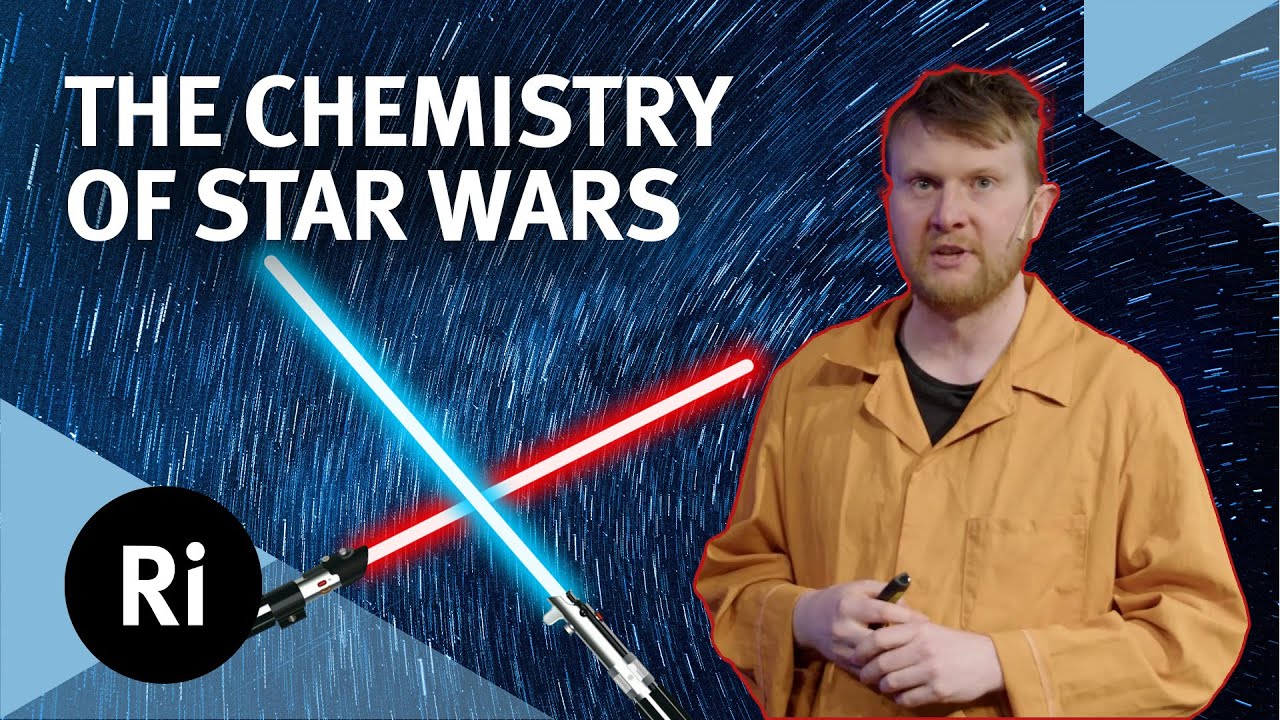
The chemistry of Star Wars - with Alex Baker
Keywords
Summary
170 words
Critical Evaluation
The lecture is a prime example of effective science communication, blending entertainment with accurate scientific content. Dr. Baker’s expertise is evident in his confident handling of topics such as plasma physics, spectroscopy, and polymer chemistry. The demonstrations are well-executed and visually compelling, reinforcing the theoretical explanations. The argumentation is logically structured, moving from weaponry to armor to other aspects of the Star Wars universe, each segment building on the previous one. The scientific accuracy is high, with no major errors detected; the explanations align with established scientific knowledge. The sources are not explicitly cited within the talk, but the presenter’s credentials and the institutional backing of the Royal Institution lend credibility. The title accurately reflects the content, and the lecture delivers on its promise. The only minor criticism is that some topics, such as the freezing in carbonite, are treated briefly and could have been explored in more depth. Overall, this is a high-quality educational presentation that successfully engages its audience.
161 words
Title / Content Match
The title accurately reflects the content, which explores various chemical concepts through the lens of Star Wars.
Quality & Reliability
8/10
The lecture is presented by an award-winning research chemist from the University of Warwick, with clear expertise in chemistry. The content is scientifically accurate, with demonstrations and explanations grounded in established principles (plasma physics, spectroscopy, polymer chemistry). The presentation is engaging and accessible, but as a public lecture, it simplifies complex topics and does not provide deep technical detail or citations to primary literature.
Key Moments
Markers derived by PSI from the transcript: the creator did not define chapters.
- Introduction: Alex Baker sets up the premise of becoming a bounty hunter.
- Discussion on blasters: explains they are not lasers but plasma weapons.
- Demonstration of plasma pipe, showing a 'blaster' effect.
- Lightsabers: explanation of plasma blade and magnetic field containment.
- Tesla coil demonstration of uncontrolled plasma, resembling force lightning.
- Controlled plasma in a magnetic field, demonstrating lightsaber blade concept.
- Flame tests: identifying elements by color, linking to lightsaber colors.
- Discussion on armor: polymers like ABS and polyethylene for protection.
- Further exploration of Star Wars chemistry, including carbonite freezing.
- Conclusion and final thoughts on bounty hunting and chemistry.
Cited Sources
- Ri Science Podcast — Mentioned as a resource for further science content from the Royal Institution.
- Royal Institution Editorial Policy — Referenced in the description for editorial guidelines.
- Donate to the Royal Institution — Mentioned as a way to support the institution's lectures.
Concurring Sources
- Royal Institution — The host institution, known for public science lectures and demonstrations.
Contribution & Novelties
The lecture provides a fresh and engaging perspective on chemistry by using the Star Wars universe as a thematic framework. It effectively demonstrates that concepts like plasma, spectroscopy, and polymers are not just abstract but have tangible applications and connections to popular culture. The live demonstrations make the science tangible and memorable.
Pour aller plus loin :
- Plasma (physics) — Overview of the fourth state of matter, relevant to blasters and lightsabers.
- Atomic emission spectroscopy — Explains how elements emit characteristic colors, as shown in flame tests.
- Polyethylene — Details on the polymer used for armor, including high-density variants for protection.
101 words
Radar Profile
The radar profile shows high scores in information quantity, quality, and reliability, with a moderate technical level. This indicates a well-rounded educational lecture that is both informative and accessible, though not highly technical.
💬 Sur les 0 commentaires analysés, aucune tendance n'est disponible.