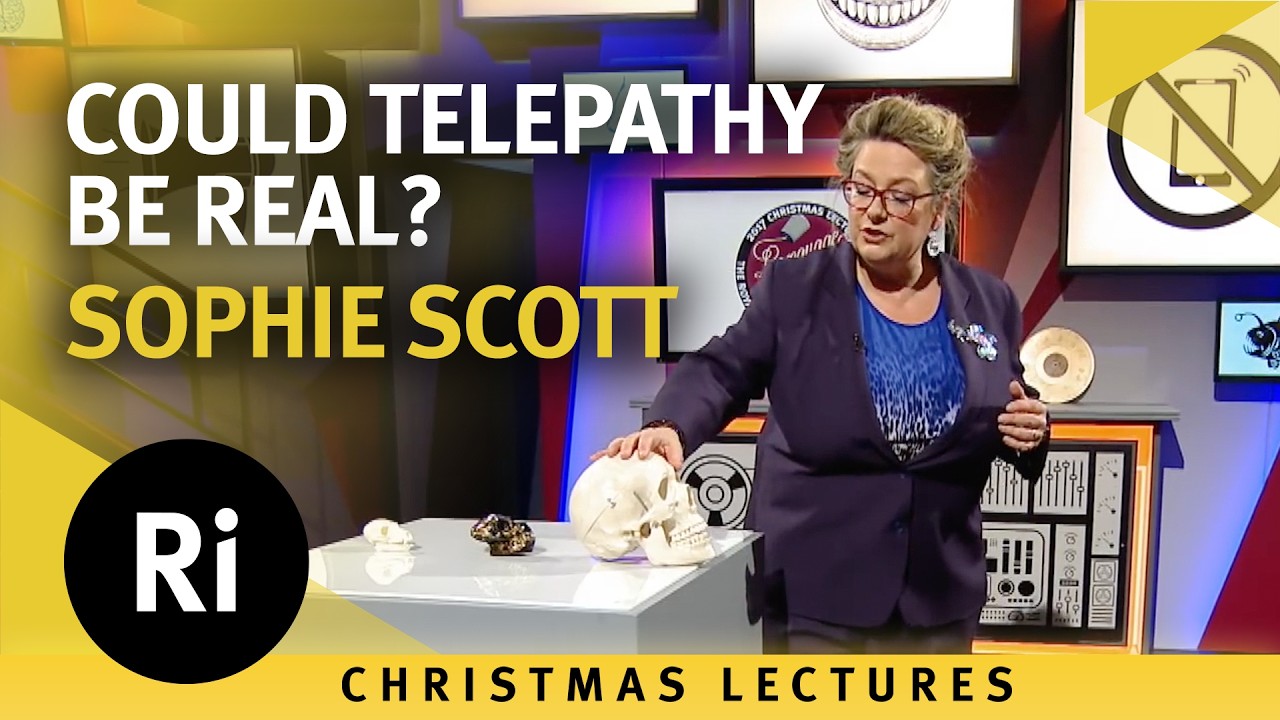
Could telepathy become reality? 2017 CHRISTMAS LECTURES with Sophie Scott 2/3
Keywords
Summary
133 words
Critical Evaluation
The lecture is an engaging and informative overview of non-verbal communication, presented by an expert in the field. Sophie Scott’s delivery is clear and accessible, making complex topics understandable for a general audience. The demonstrations with live animals and audience participation effectively illustrate key points. The scientific content is accurate and up-to-date, drawing on established research in ethology and neuroscience. However, the lecture lacks depth in some areas, particularly in the discussion of telepathy, which is only briefly mentioned. The sources cited are not explicitly referenced during the lecture, and the description provides only general links to the Royal Institution’s channels. The title may overemphasize telepathy, which is a minor part of the content. Overall, the lecture is a valuable educational resource that successfully conveys the importance of silent communication in both animals and humans.
135 words
Title / Content Match
The title is somewhat misleading as the lecture focuses primarily on non-verbal communication and only briefly touches on telepathy at the end, but it does address the question of brain-to-brain communication.
Quality & Reliability
8/10
The lecture is presented by Professor Sophie Scott, a renowned cognitive neuroscientist, and features live demonstrations and expert guests. The content is well-structured and based on established scientific knowledge, though it is aimed at a general audience and lacks detailed citations.
Key Moments
Markers derived by PSI from the transcript: the creator did not define chapters.
- Introduction to silent communication and the lecture's scope.
- Demonstration of smell perception with smoke rings.
- Explanation of pheromones and their role in insect communication.
- Live demonstration with aphids and their alarm pheromone.
- Discussion of how parasitic wasps eavesdrop on aphid pheromones.
- Explanation of the vomeronasal organ in snakes and other mammals.
- Comparison of primate skulls and the reduction of smell in humans.
- Introduction to visual communication, including bioluminescence.
- Demonstration of body language and facial expressions.
- Discussion of contagious yawning and smiling.
- Exploration of brain-to-brain communication and telepathy.
Cited Sources
- Royal Institution Tumblr — Additional content and behind-the-scenes from the Royal Institution.
- Royal Institution Editorial Policy — Policy on editorial standards for Royal Institution content.
- Christmas Lectures Playlist — Playlist of the 2017 Christmas Lectures.
Concurring Sources
- Pheromones and Animal Behavior — Supports the role of pheromones in insect communication.
- Vomeronasal Organ — Confirms the presence and function of this organ in snakes and other mammals.
Dissenting Sources
- Human Pheromone Receptors — Some research suggests humans may have functional pheromone receptors, contrary to the lecture's claim that we lack them.
Contribution & Novelties
The lecture provides an engaging overview of non-verbal communication, integrating multiple sensory modalities and evolutionary perspectives. It offers a unique blend of live demonstrations and expert insights, making complex scientific concepts accessible to a broad audience.
Pour aller plus loin :
- Pheromone — Overview of pheromones and their role in animal communication.
- Vomeronasal organ — Detailed explanation of this sensory organ and its function.
- Mirror neurons — Neural basis for understanding others’ actions and emotions, relevant to contagious behaviors.
- Brain-to-brain communication — Overview of experimental approaches to direct neural communication.
90 words
Radar Profile
The radar profile shows high scores in quantity and quality of information, with a moderate technical level. The lecture is scientifically reliable but accessible, making it suitable for a general audience interested in neuroscience and animal behavior.
💬 No comments were provided for analysis.