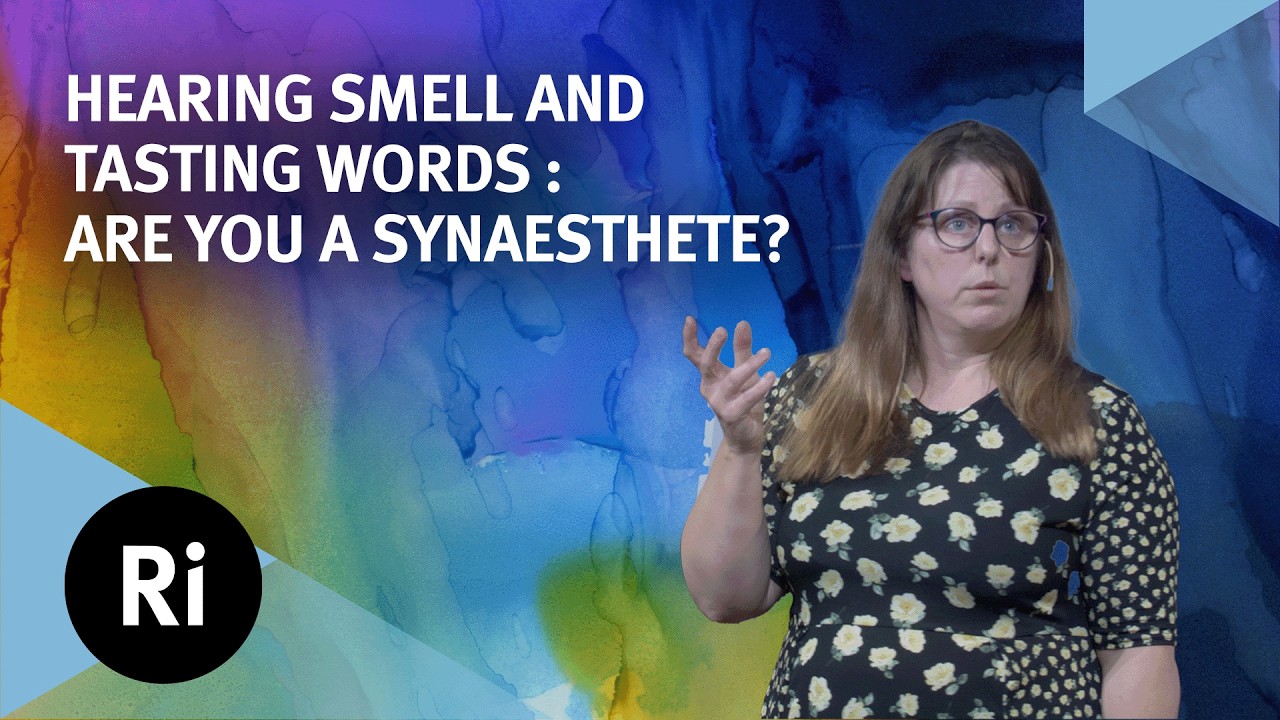
Hearing smell and tasting words: The science of synaesthesia - with Mary Jane Spiller
Keywords
Summary
148 words
Critical Evaluation
The lecture provides a comprehensive and engaging introduction to synaesthesia, grounded in the speaker’s expertise as a cognitive psychologist and researcher. Spiller effectively uses audience participation to illustrate the phenomenon, making the content accessible while maintaining scientific rigor. She clearly distinguishes between subjective experiences and measurable phenomena, emphasizing the importance of objective tests like the Stroop task to validate synaesthetic experiences. The talk covers a range of synaesthesia types, from grapheme-color to spatial and time-space, and discusses individual differences, such as projector vs. associator synesthetes. The historical context is briefly mentioned, and the speaker touches on potential neural mechanisms, including hyperconnectivity and genetic factors. However, the lecture lacks specific citations to studies, which would strengthen the scientific credibility. The speaker’s personal experience with synaesthesia adds authenticity but also introduces a potential bias, though she maintains a balanced perspective. The discussion of the impact of synaesthesia on cognition is somewhat speculative, but she appropriately frames it as correlational. Overall, the talk is informative and well-structured, suitable for a general audience interested in neuroscience and perception. The interactive elements and visual examples enhance understanding, though the lack of detailed references is a minor weakness. The title accurately reflects the content, and the talk successfully conveys the complexity and fascination of synaesthesia.
209 words
Title / Content Match
The title accurately reflects the content, which explores synaesthesia through sensory examples and scientific explanations.
Quality & Reliability
8/10
Talk by a cognitive psychologist with PhD on synaesthesia, published in the Oxford Handbook of Synesthesia. Content is well-structured, based on established research, and includes interactive demonstrations. No citations to specific studies are given, but the speaker's expertise and the institutional setting (Royal Institution) support reliability.
Chapters
- What Color Is Monday?
- What Does the Name “Derek” Taste Like?
- Introducing Synesthesia
- Grapheme–Color Synesthesia
- Projector vs Associator Synesthetes
- Spatial Synesthesia: Seeing Numbers in Space
- Time–Space Synesthesia
- Tasting Words and Shapes in Food
- When Synesthetic Associations Feel “Wrong”
- The History of Synesthesia Research
- Testing Whether Synesthesia Is Real
- The Stroop Test and Automatic Perception
- Imagining Letters and Seeing Colours
- Does Attention Affect Synesthetic Experience
Cited Sources
- RI Science Podcast — Mentioned as a resource for further exploration of science topics.
- Editing RI Talks and Moderating Comments — Linked in the description, likely for information on how talks are edited and comments moderated.
- Donate to the Royal Institution — Support page for the Royal Institution, mentioned in the description.
- Q&A Session for this talk — Exclusive Q&A for Science Supporter members, mentioned in the description.
Concurring Sources
- Synesthesia - Wikipedia — General information on synaesthesia, consistent with the talk's content.
- Oxford Handbook of Synesthesia — The speaker contributed a chapter; authoritative reference on the topic.
Contribution & Novelties
The lecture provides an accessible overview of synaesthesia, highlighting its diversity and the scientific methods used to study it. It emphasizes that synaesthesia is a real perceptual phenomenon, not just metaphorical, and discusses its potential neural basis. The speaker’s personal experience adds a unique perspective.
Pour aller plus loin :
- Synesthesia - Wikipedia — Comprehensive overview of synaesthesia, its types, and research.
- Oxford Handbook of Synesthesia — The speaker contributed a chapter; authoritative reference.
- Grapheme-color synesthesia - Wikipedia — Detailed information on the most studied form.
- Stroop effect - Wikipedia — The test used to demonstrate automaticity in synaesthesia.
99 words
Radar Profile
The radar profile shows high scores across all dimensions, indicating a well-rounded and reliable presentation. The lecture excels in providing substantial information and maintaining scientific rigor, with a strong technical level suitable for an interested audience.